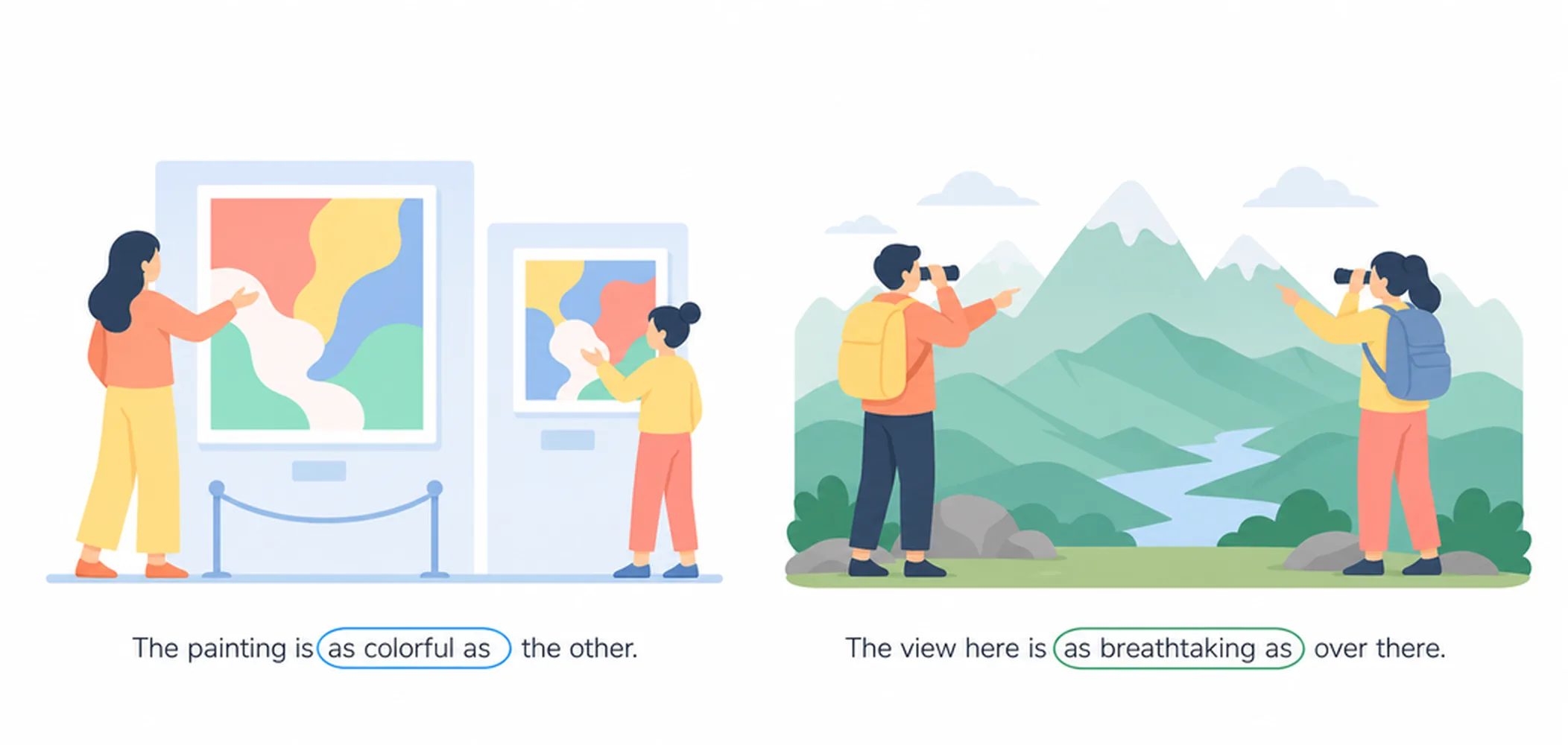
What is 'as...as' for comparatives?
The structure 'as...as' is used to compare two people, things, or actions when they are equal or similar. Unlike comparative adjectives (bigger, faster), which show difference, 'as...as' shows that both sides of the comparison have the same quality or degree. This is a very common way to express equality in English.
How to form 'as...as' sentences
The pattern is: as + adjective/adverb + as. Place the first 'as' before the adjective or adverb, and the second 'as' after it. You can use this with any adjective (tall, intelligent, interesting) or adverb (quickly, carefully, loudly). The verb comes before the first 'as' in most sentences. Remember: both 'as' words are essential for the meaning to be clear.
Negative forms and variations
To express that two things are NOT equal, use 'not as...as' or 'not so...as'. Both forms mean the same thing. For example: 'This book is not as interesting as that one' or 'This book is not so interesting as that one.' In negative sentences, 'not so...as' is more common in British English, while 'not as...as' is used in both British and American English.
as...as vs Comparative Adjectives: What's the Difference?
| as…as (Equality Comparative) | -er / more… than (Standard Comparative) | |
|---|---|---|
| Form | as + adjective/adverb + as e.g., as tall as, as quickly as |
adjective + -er + than or more + adjective + than e.g., taller than, more beautiful than |
| When to use | Use when two things are equal in some quality or degree. In the negative form, it shows one is less than the other. | Use when one thing has more of a quality than another — i.e., there is a clear difference or inequality between the two. |
| Positive example | Maria is as tall as her brother. (They are the same height.) |
Maria is taller than her brother. (Maria has more height than her brother.) |
| Negative example | This film is not as exciting as the first one. (The first film is more exciting.) |
This film is less exciting than the first one. (Directly states the first is more exciting.) |
| Question example | Is the new office as big as the old one? (Asking if they are equal in size.) |
Is the new office bigger than the old one? (Asking if one exceeds the other in size.) |
| Key signal words | as…as, not as…as, just as…as, almost as…as, twice as…as, half as…as | than, much -er than, far more…than, a lot more…than, slightly more…than, even -er than |
| Meaning conveyed | Equality (positive) or inferiority (negative). The structure itself does not imply one is better or worse — only that the degree is the same or not the same. | Superiority — one person, thing, or action clearly has a higher degree of the quality than the other. |
| Adjective length rule | No change to the adjective — the same base form is always used regardless of syllable count. as happy as / as comfortable as |
Short adjectives (1–2 syllables): add -er. Long adjectives (3+ syllables): use more. happier than / more comfortable than |
| 🔑 Key Difference: Use as…as to say two things are equal in a quality ("She is as smart as her sister" = same level of intelligence). Use -er/more…than to say one thing surpasses the other ("She is smarter than her sister" = she has more intelligence). In the negative, not as…as and less…than can often be used interchangeably to express inferiority, but not as…as is generally considered more natural and polite in everyday English. | ||
Examples





What to Remember
- Use 'as...as' to show two things are equal or have the same quality, not to show difference.
- The pattern is always: as + adjective/adverb + as, with the first 'as' before and second 'as' after.
- You can use 'as...as' with any adjective or adverb to compare people, things, or actions equally.
- Don't confuse 'as...as' with comparative forms like 'bigger' or 'faster', which show one thing is more than another.
- In negative sentences, you can use 'not as...as' to show two things are unequal or different.