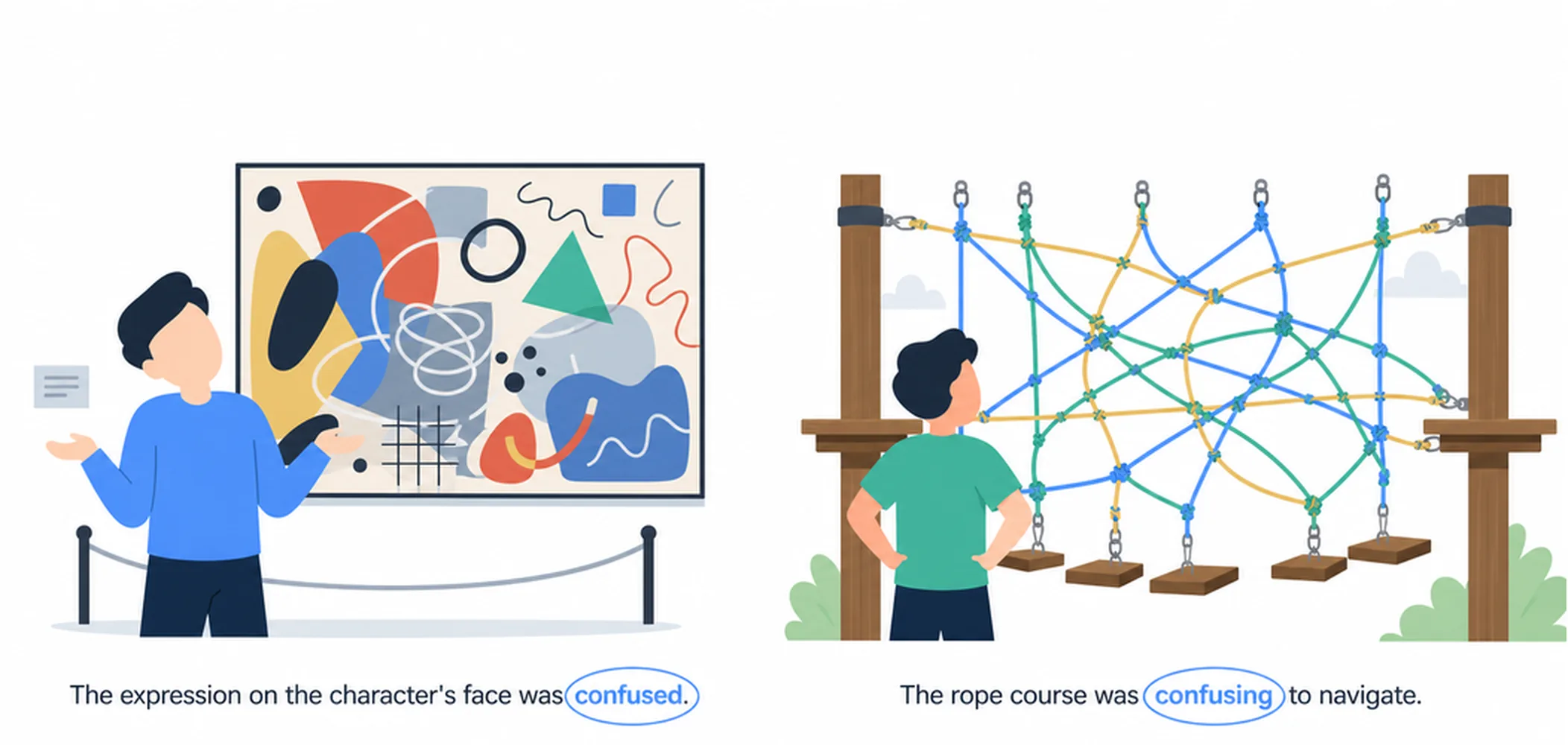
The Key Difference
Both 'confused' and 'confusing' are participle adjectives derived from the verb 'confuse,' but they describe different perspectives. Use 'confused' (past participle) to describe someone's emotional state or condition—how a person feels. Use 'confusing' (present participle) to describe something that causes confusion—the quality of a thing or situation. This distinction applies to many emotion-related adjectives like 'tired/tiring,' 'interested/interesting,' and 'bored/boring.'
Examples with 'Confused' (-ed)
The -ed form describes the emotional state of a person or sometimes an animal.
Examples with 'Confusing' (-ing)
The -ing form describes the quality or characteristic of something that produces confusion.
Quick Memory Tip
Ask yourself: Is it about a PERSON'S FEELING (confused) or about the THING that CAUSES the feeling (confusing)? Person = -ed. Thing = -ing. For example: 'I am confused' (my feeling) vs. 'The instructions are confusing' (the thing causing the feeling).
Confused vs Confusing — Side-by-Side Comparison
| Dimension | Confused | Confusing |
|---|---|---|
| Form | Past participle used as an adjective (participial adjective) | Present participle used as an adjective (participial adjective) |
| When to use | Use when describing a person (or living being) who experiences the feeling of confusion — the subject is affected by something | Use when describing a thing, situation, or person that causes or produces confusion in others — the subject creates the feeling |
| What it describes | The emotional or mental state of the person feeling confusion | The quality of something that makes it hard to understand or follow |
| Who / what it refers to | Typically refers to a person, animal, or sentient being — the one who is confused | Typically refers to instructions, explanations, maps, situations, behaviour, or anything that causes confusion |
| Positive example | She was confused by the teacher's explanation. | The teacher's explanation was confusing. |
| Negative example | The students were not confused after reading the summary. | The summary was not confusing at all. |
| Question example | Are you confused about the assignment? | Is the assignment confusing to you? |
| Key signal words | I feel…, He/She is…, They were…, I am…, We got… — focus on the person's reaction or state | It is…, The instructions are…, This map is…, The rules seem… — focus on the source or cause |
| 🔑 Key Difference: Confused describes how a person feels — they are the receiver of the confusion. Confusing describes what a thing or situation does — it is the cause of the confusion. A simple test: if you can ask "How do you feel?" and the answer applies, use confused; if you can ask "What is it like?" about an object or situation, use confusing. | ||
Examples






What to Remember
- Use 'confused' to describe a person's feeling or emotional state, not a thing.
- Use 'confusing' to describe something that causes confusion, not how a person feels.
- Past participle adjectives (-ed) focus on the person experiencing the emotion or condition.
- Present participle adjectives (-ing) focus on the thing or situation that causes the emotion.
- This -ed/-ing distinction applies to many emotion words: tired/tiring, interested/interesting, bored/boring, excited/exciting.