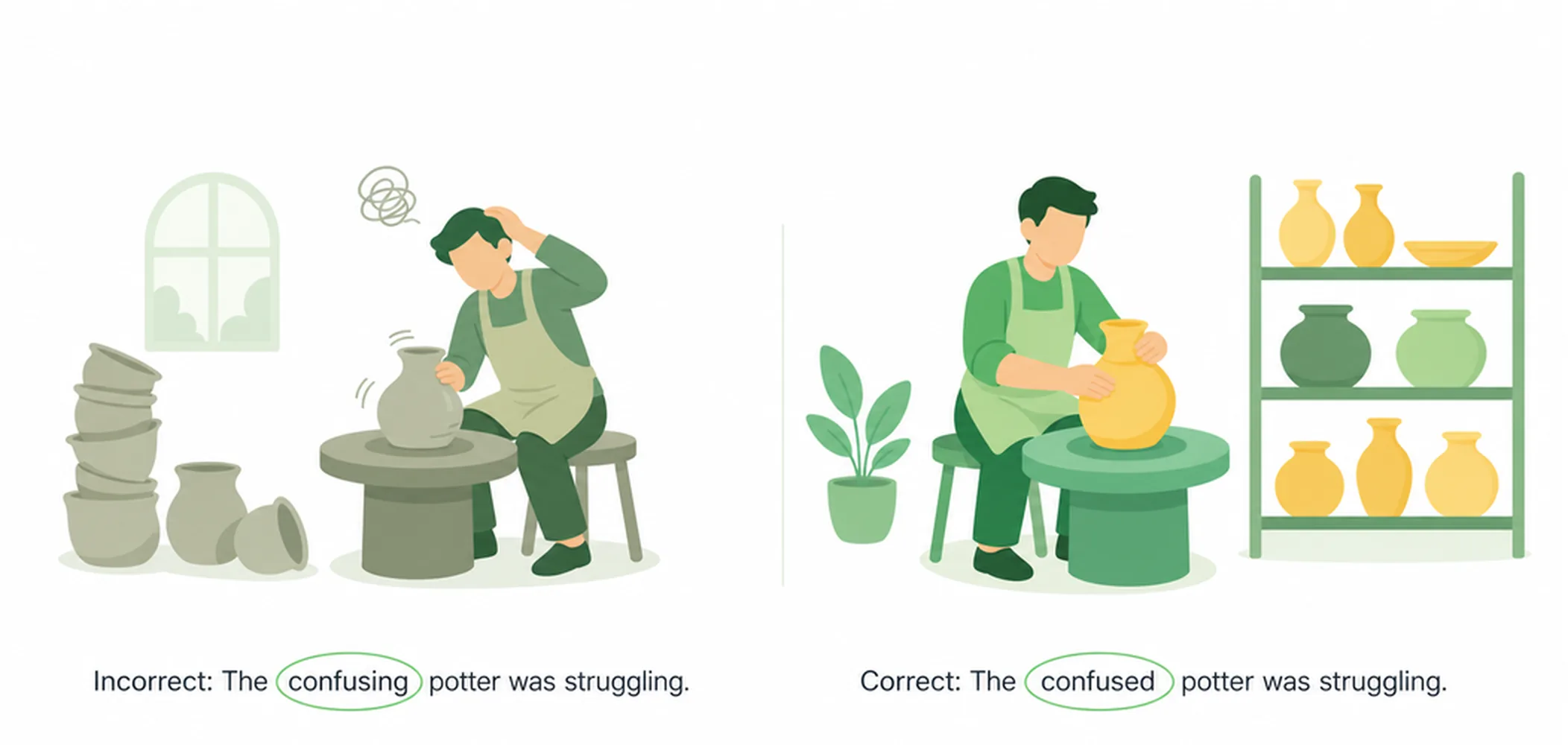
Why Learners Confuse Participle Adjectives
Participle adjectives (-ed and -ing forms) are tricky because they look like verbs but function as adjectives. The key confusion happens because learners often choose the wrong form without thinking about meaning: -ed describes how someone feels or is affected, while -ing describes the quality of something that causes that feeling. This article highlights the most common mistakes B2 learners make with these forms.
-ed vs -ing Participle Adjectives: Side-by-Side Comparison
| Dimension | -ED Participle Adjectives | -ING Participle Adjectives |
|---|---|---|
| Form | Past participle form of the verb bore → bored, excite → excited, confuse → confused |
Present participle form of the verb bore → boring, excite → exciting, confuse → confusing |
| Meaning | Describes a feeling or emotional state experienced by a person or living being — how someone feels | Describes a quality or characteristic of a person, thing, or situation — what something or someone is like or causes |
| What / Who It Describes | Typically describes people (or animals) who are experiencing an emotion or reaction The student is bored. She felt tired. |
Typically describes things, situations, events, or people that produce a certain effect or have a particular quality The lesson is boring. It was an exciting match. |
| Paired Word Examples |
• bored — I am bored. • excited — She is excited. • confused — He looked confused. • interested — They were interested. • tired — We felt tired. • frightened — The child was frightened. • amazed — I was amazed. • disappointed — He seemed disappointed. |
• boring — The film is boring. • exciting — It was an exciting game. • confusing — The instructions are confusing. • interesting — That is an interesting idea. • tiring — It was a tiring journey. • frightening — The storm was frightening. • amazing — She gave an amazing speech. • disappointing — The result was disappointing. |
| Positive Example | The children were excited about the trip. (The children felt excitement.) |
The trip was exciting for the children. (The trip produced excitement.) |
| Negative Example (Common Mistake) | ❌ The lesson was bored. ✅ The student was bored. (A lesson cannot feel boredom.) |
❌ I am very interesting in art. ✅ I am very interested in art. (You feel interest; you are not what causes interest.) |
| Question Example | Are you interested in learning more? Were you surprised by the news? |
Was the lecture interesting today? Was the news surprising to you? |
| Key Signal Words / Test | Ask: "How does the person feel?" Subject is usually a person or animal. Often follows verbs: feel, seem, look, be, become |
Ask: "What is the thing/situation like?" Subject is usually a thing, event, or situation. Often modifies nouns: an exciting story, a boring meeting |
| Grammar Position | Used predicatively after linking verbs or attributively before nouns: a bored audience / the audience was bored |
Used predicatively after linking verbs or attributively before nouns: a boring lecture / the lecture was boring |
| 🔑 Key Difference: Use -ED adjectives to describe how a person feels (they receive the emotion), and use -ING adjectives to describe what a thing, situation, or person is like (they cause or produce the emotion). A simple test: if you can ask "How do you feel?" → use -ed; if you can ask "What is it like?" → use -ing. For example: "I am bored" (you feel it) vs. "This film is boring" (the film causes it). | ||
Examples

The meeting was postponed, which was disappointing news for everyone.
Adjective describing a noun · -ing form causes an emotion

My colleague seemed worried about the delayed project.
Adjectives describing people and nouns · -ed forms show state/affection

That confusing explanation left the students confused.
Comparison · -ing describes the thing causing confusion; -ed describes the people affected

The exhausting work was exhausting, leaving everyone exhausted by Friday.
Same root, different forms · -ing describes the work's quality; -ed describes the people's state
When to use it
Describing Emotions
Use -ed participles to describe how people feel or are affected by something. These work with feeling verbs.
"I was bored by the lecture, but my friend was fascinated."
Describing Things & Events
Use -ing participles to describe qualities of things, people, or situations that cause emotions or reactions.
"The shocking news left her stunned. His annoying habit drives me crazy."
Passive Voice Context
-ed forms often relate to passive constructions (something is done TO you), while -ing forms relate to active qualities.
"He was relieved by the reassuring letter from his bank."
Signal words
feel
seem
appear
be
look
get
become
make
find
Common Mistakes
✕
Wrong
I'm very interesting in learning new languages.
✓
Correct
I'm very interested in learning new languages.
-ed describes how YOU feel. The thing that causes interest is 'interesting'; you become 'interested.'
✕
Wrong
The conference was very bored because the speaker talked too slowly.
✓
Correct
The conference was very boring because the speaker talked too slowly.
Use -ing to describe the quality of something. The conference itself was boring (it caused boredom). Avoid confusing the audience with 'bored.'
✕
Wrong
She felt exciting when she heard the news about her promotion.
✓
Correct
She felt excited when she heard the news about her promotion.
-ed describes an emotional state YOU experience. Use 'excited' for how she felt, not 'exciting' (which means it causes excitement).
✕
Wrong
The exciting student completed the bored assignment.
✓
Correct
The excited student completed the boring assignment.
Use -ed participles for how people feel (excited student) and -ing participles for what causes the feeling (boring assignment).
✕
Wrong
We were disappointed by the disappointed results of the exam.
✓
Correct
We were disappointed by the disappointing results of the exam.
YOU are disappointed (-ed). The RESULTS are disappointing (-ing) because they cause disappointment.
✕
Wrong
The confusing students asked confusing questions about the topic.
✓
Correct
The confused students asked confusing questions about the topic.
The STUDENTS are confused (-ed) by something. Their QUESTIONS are confusing (-ing) to others. Don't mix them up.
✕
Wrong
I watched a terrified film that made me feel terrified.
✓
Correct
I watched a terrifying film that made me feel terrified.
The FILM is terrifying (-ing). YOU feel terrified (-ed) afterward. Only emotions and states use -ed with people.
KEY TAKEAWAYS
What to Remember
- Use -ed participles to describe how a person feels or their emotional state.
- Use -ing participles to describe the quality or characteristic that causes the feeling.
- Remember: a boring lesson makes students bored, not the other way around.
- Check if you're describing a person's feeling (-ed) or a thing's quality (-ing).
- Common mistake: confusing "interested in" (the person) with "interesting" (the thing).