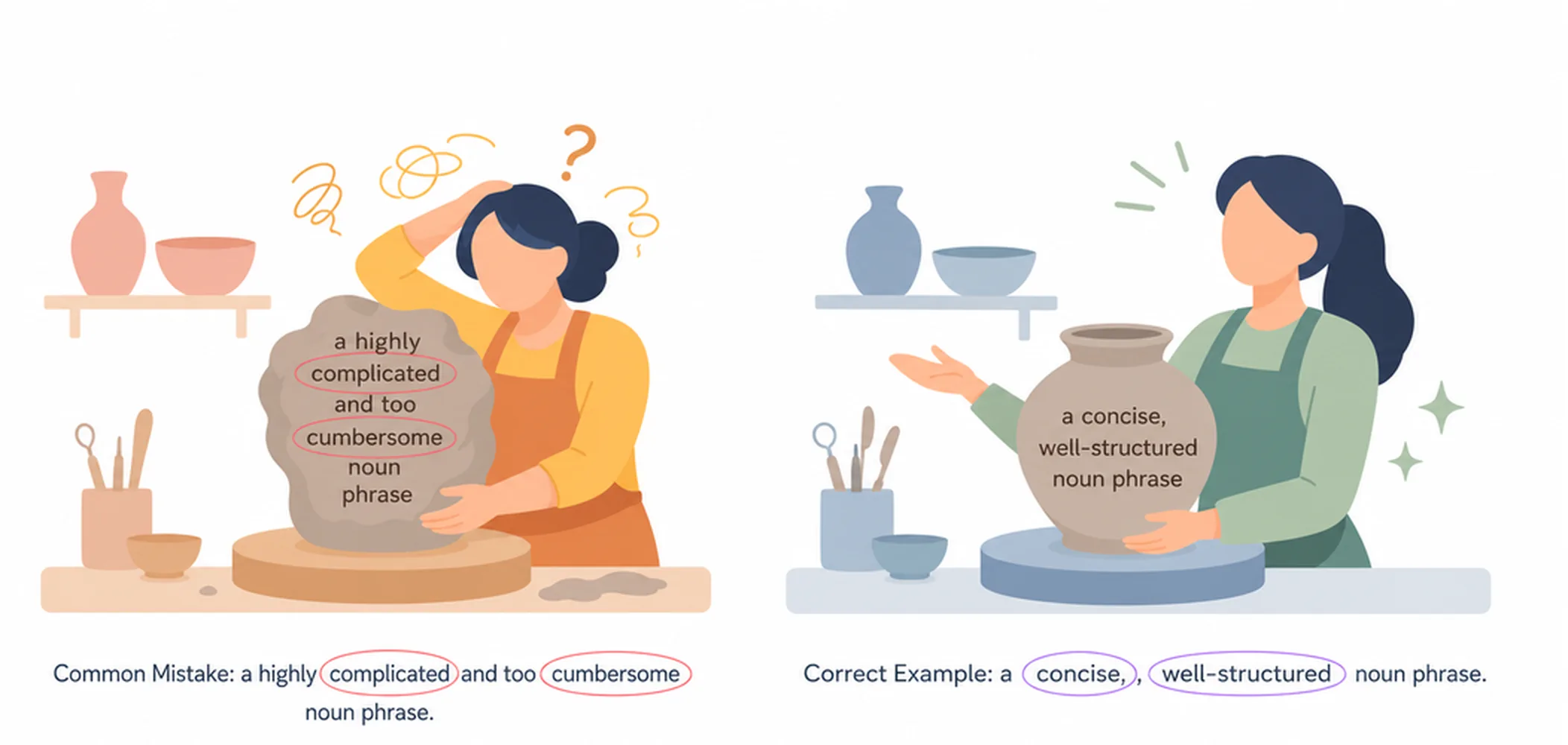
Why Complex Noun Phrases Are Tricky
Complex noun phrases combine nouns with modifiers, prepositional phrases, or relative clauses. At B1 level, learners often mix up word order, use wrong prepositions, or forget to include necessary words. These mistakes happen because English noun phrases follow strict rules about where adjectives, nouns, and phrases can go. Understanding these patterns will help you write clearer, more natural English.
Complex Noun Phrase Formulas
Formula 1: Full Complex Noun Phrase Structure
A complete noun phrase follows a strict order of adjectives and modifiers. All components combine to describe the noun head.
Pattern
Article
+
Opinion Adj.
+
Size Adj.
+
Age Adj.
+
Colour Adj.
+
Origin Adj.
+
Material Adj.
+
Noun (Head)
+
Prep. Phrase
+
Relative Clause
Correct Example
The
beautiful
large
old
red
Italian
wooden
chair
in the corner
that I bought yesterday
is antique.
Formula 2: Common Mistake — Wrong Adjective Order
Adjectives must follow a specific order. Placing them in the wrong sequence creates an awkward or ungrammatical phrase.
| Incorrect Order | Correct Order |
|---|---|
|
Article
+
Material Adj.
+
Colour Adj.
+
Opinion Adj.
+
Noun
|
Article
+
Opinion Adj.
+
Colour Adj.
+
Material Adj.
+
Noun
|
Incorrect Example
A
wooden
red
beautiful
table
is in the living room.
Correct Example
A
beautiful
red
<span style="display:inline-block;border-radius:3px;padding:2px 8px;font-weight
Examples

The large wooden desk in the corner of the office belongs to the manager.
Adjectives before noun · Prepositional phrases after noun

My friend's expensive new laptop, which she bought last month, is very fast.
Possessive + adjectives + relative clause

The students from the advanced English class who passed the exam received certificates.
Noun + prepositional phrase + relative clause

A small red car parked outside the shop caught everyone's attention.
Opinion and colour adjectives before noun
When to use it
Professional Writing
Use complex noun phrases in emails, reports, and formal documents to give detailed information about people, objects, or ideas without using extra sentences.
"The detailed financial report prepared by the accounting team that was submitted yesterday shows promising results."
Academic English
Complex noun phrases help you describe research findings, reference sources, and ideas in essays and presentations.
"The groundbreaking study conducted at Harvard University that was published in 2023 found new evidence."
Everyday Conversation
Use shorter complex phrases in speaking to add specific details about people and objects naturally.
"My cousin's old wooden house near the beach needs repair."
Signal words
which
that
who
whose
in
on
with
of
from
and
Common Mistakes
✕
Wrong
I bought a book red interesting about history.
✓
Correct
I bought an interesting red history book.
Adjectives must go before the noun in the correct order: opinion, then colour, then noun type.
✕
Wrong
The company of my friend's office is very successful.
✓
Correct
My friend's company office is very successful.
Avoid stacking too many prepositions. Use possessives and noun compounds instead of chains of 'of' phrases.
✕
Wrong
A letter which arrived yesterday from my boss was urgent.
✓
Correct
A letter from my boss that arrived yesterday was urgent.
Place the relative clause near the noun it modifies. Prepositional phrases usually come before relative clauses.
✕
Wrong
The students tired of the lessons wanted to leave.
✓
Correct
The tired students wanted to leave. / The students who were tired of the lessons wanted to leave.
Avoid dangling modifiers. Make sure adjective phrases clearly relate to the noun they describe, or use a full relative clause.
✕
Wrong
I need a pen writing in blue.
✓
Correct
I need a pen that writes in blue. / I need a blue pen.
Don't use simple verb forms in noun phrases. Use relative clauses (that writes) or adjectives (blue) instead.
✕
Wrong
The building tall with windows modern is impressive.
✓
Correct
The tall building with modern windows is impressive.
Adjectives come before the noun, not after. Prepositional phrases come after the noun.
KEY TAKEAWAYS
What to Remember
- Adjectives come before the noun, but adjectives after the noun require a preposition or relative clause.
- Prepositional phrases go after the noun they modify, never between the adjective and noun.
- Use correct prepositions in noun phrases; common mistakes include "interested about" instead of "interested in."
- Include the article (a, an, the) at the beginning of complex noun phrases, even with multiple modifiers.
- Relative clauses (who, which, that) come at the end and must agree with the noun they describe.