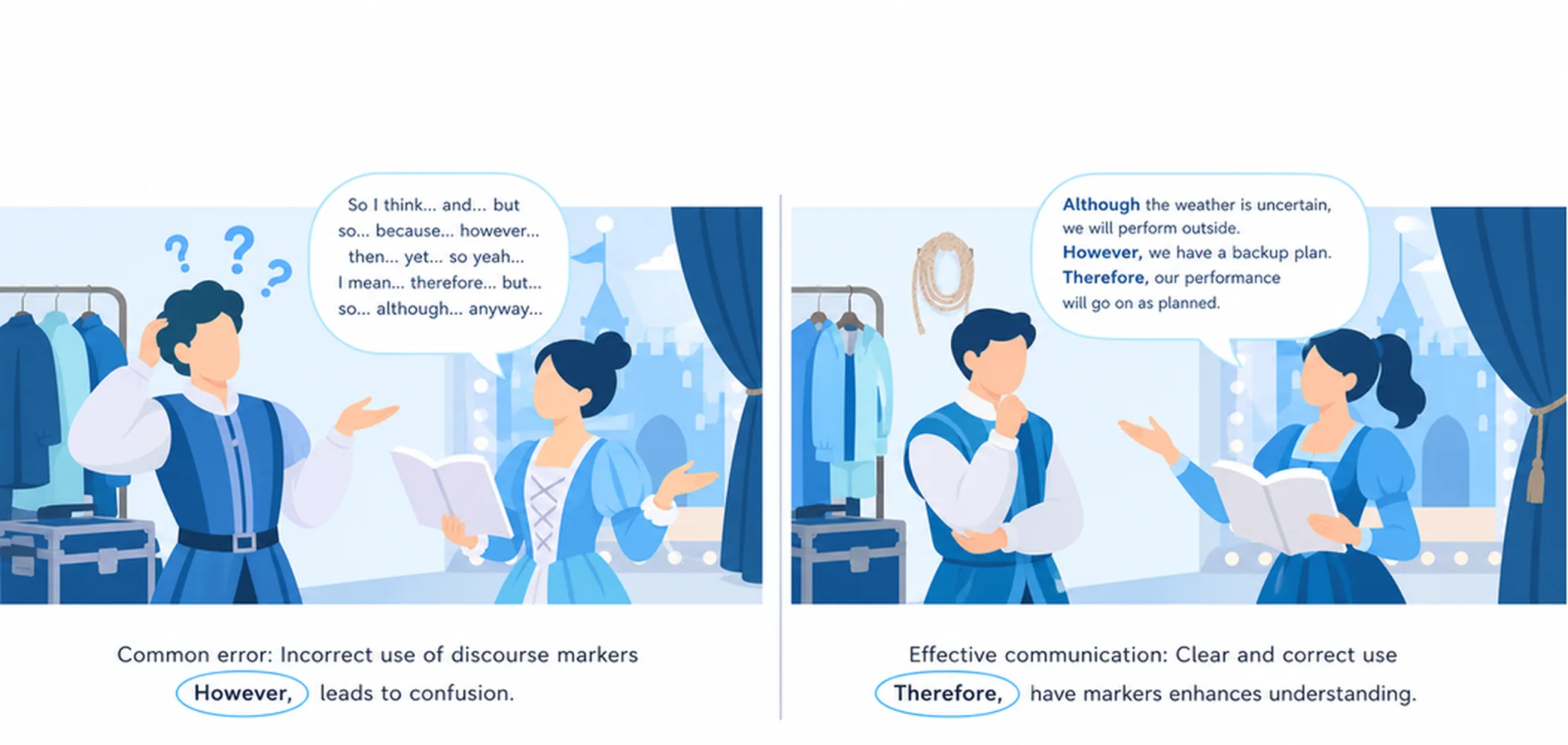
Why Discourse Markers Cause Confusion
Discourse markers are words and phrases that connect ideas, show relationships between sentences, and guide readers through your argument. They're essential for C1–C2 writing, but learners often misuse them by placing them incorrectly, confusing similar markers, or overusing them. These mistakes weaken your writing's clarity and flow. Understanding the correct placement, register, and function of each marker will help you write more naturally and persuasively.
Easily Confused Discourse Markers Compared
| Criterion | However | Nevertheless | Furthermore | Moreover | Therefore | Thus |
|---|---|---|---|---|---|---|
| Function | Introduces a contrasting idea; signals that the following point limits or contradicts the previous one. | Signals that despite an acknowledged difficulty or obstacle, the following point still holds true. | Adds an additional point that builds on and extends the previous one, often introducing new information. | Adds a stronger or more important point on top of what has already been said, intensifying the argument. | Signals a logical conclusion or result that follows directly from the preceding information. | Signals a logical consequence or manner; can also mean "in this way." More formal and concise than therefore. |
| Register | Neutral to formal; widely used in both academic and professional writing as well as careful speech. | Formal; primarily used in academic essays, legal texts, and formal arguments. Rarely in casual speech. | Formal; common in academic and professional writing. Occasionally used in formal speeches. | Formal to very formal; frequent in academic writing, reports, and editorials. Rare in conversation. | Neutral to formal; widely used across academic writing, journalism, and careful spoken English. | Formal to very formal; common in academic, legal, and scientific writing. Sounds stilted in casual conversation. |
| Typical Position in Sentence | Usually at the start of a new sentence or clause, followed by a comma. Can appear mid-sentence between commas. | Typically at the start of a new sentence, followed by a comma. Occasionally mid-sentence. | Typically at the start of a sentence or clause, followed by a comma. Rarely mid-sentence. | Almost always at the start of a sentence, followed by a comma. Very rarely appears mid-sentence. | Start of a sentence (followed by a comma) or mid-sentence between commas. Common in concluding clauses. | Start of a sentence, mid-sentence, or at the end. When meaning "in this way," it often appears mid-sentence. |
| Correct Usage Example | "The study showed positive results. However, the sample size was too small to draw firm conclusions." | "The budget cuts were severe. Nevertheless, the team delivered the project on time." | "The policy reduces emissions. Furthermore, it creates thousands of green jobs." | "The drug is highly effective. Moreover, it has fewer side effects than existing treatments." | "Traffic was unusually heavy. Therefore, we arrived late to the conference." | "The variables were carefully controlled; thus, the results can be considered reliable." |
| Common Mistake Example | "She studied hard. However, she passed the exam." — No contrast exists; use therefore or consequently instead. | "It was raining. Nevertheless, we went outside because we had umbrellas." — The obstacle is too weak; however fits better here. | "I like coffee. Furthermore, I also like tea." — Too informal a context; both points are trivial additions, not a structured argument. | "He arrived late. Moreover, he apologised." — The second point is not stronger or more significant; furthermore or also would be more appropriate. | "She is tired. Therefore, she enjoys reading." — There is no logical causal link between the two clauses. | "I was hungry, thus I ordered a pizza." — Grammatically acceptable but registers a mismatch; thus sounds overly formal here; use so instead. |
| Key Signal Words / Synonyms | Yet, nonetheless, on the other hand, that said, even so, in contrast | Nonetheless, even so, despite this, all the same, yet, in spite of that | In addition, additionally, also, besides, what is more, on top of that | What is more, in addition, beyond that, on top of this, above all | As a result, consequently, hence, thus, for this reason, so | Therefore, hence, consequently, as a result, in this way, accordingly |
| Punctuation Notes | Always followed by a comma at sentence start. Mid-sentence: set off with commas on both sides. Never used with a coordinating conjunction (but however is wrong). | Always followed by a comma at sentence start. Can follow a semicolon: …; nevertheless, Avoid pairing with but. | Followed by a comma at sentence start. Can follow a semicolon. Do not confuse with farther/further (comparative adjective). | Followed by a comma at sentence start. Can follow a semicolon. Do not use moreover immediately after and. | Followed by a comma at sentence start. Mid-sentence requires commas. Do not use therefore after so — that creates redundancy. | When meaning "as a result," followed by a comma or preceded by a semicolon. When meaning "in this way," no comma is always required. |
Key Differences at a Glance:
- However vs. Nevertheless: Both signal contrast, but nevertheless specifically concedes an obstacle or difficulty before asserting that the outcome holds true anyway. However simply introduces any contrasting point without requiring an acknowledged obstacle.
- Furthermore vs. Moreover: Both add information, but moreover implies the added point is stronger, more surprising, or more significant than what came before, reinforcing or escalating the argument. Furthermore merely extends it with additional, often parallel, information.
- Therefore vs. Thus: Both express logical consequence, but thus is more formal and concise, often preferred in scientific and legal writing. Thus can also mean "in this way" (manner), whereas therefore cannot. In general academic writing, they are often interchangeable, but register awareness is essential.
- Contrast vs. Addition vs. Result: The most critical distinction is functional — however and nevertheless signal contrast; furthermore and moreover signal addition; therefore and thus signal result/consequence. Mixing these categories is the most common and serious error learners make.
Examples

The economy showed signs of recovery. However, inflation remained a serious concern.
Formal writing · Contrasting ideas

We implemented new software. Furthermore, we trained all staff members to use it effectively.
Academic writing · Adding information

The first draft was incomplete. In conclusion, we need to revise and resubmit it.
Formal essay · Summarizing

Sales declined by 15%. Nonetheless, the company maintained profitability.
Business writing · Showing contrast despite negative news
When to use it
Academic Essays
Use discourse markers like 'In addition,' 'Therefore,' and 'To summarize' to structure arguments and connect paragraphs smoothly.
"The data supports this conclusion. Furthermore, recent studies confirm these findings."
Business Reports
Employ markers such as 'Consequently,' 'Nevertheless,' and 'In contrast' to show cause–effect relationships and acknowledge counterarguments.
"Revenue increased significantly. However, operational costs also rose."
Formal Presentations
Use 'First,' 'Next,' and 'Finally' to guide listeners through your points; use 'In other words' to clarify complex ideas.
"First, we'll review objectives. Next, we'll analyze results. Finally, we'll recommend action."
Signal words
However
Therefore
Moreover
Nevertheless
Furthermore
In addition
On the other hand
In contrast
Consequently
As a result
In conclusion
To summarize
In other words
Likewise
Similarly
Common Mistakes
✕
Wrong
We need to improve sales. However we must cut costs first.
✓
Correct
We need to improve sales. However, we must cut costs first.
Discourse markers like 'however' must be followed by a comma when they begin a sentence or clause.
✕
Wrong
The project was delayed. Moreover that, the budget increased.
✓
Correct
The project was delayed. Moreover, the budget increased.
Moreover stands alone and should not be followed by 'that'. Use 'Moreover,' or 'In addition,' without 'that'.
✕
Wrong
She studied hard. Therefore she passed the exam.
✓
Correct
She studied hard. Therefore, she passed the exam.
Therefore requires a comma after it when it appears at the start of a sentence.
✕
Wrong
The cost is high. On the other hand, the quality is poor.
✓
Correct
The cost is high. On the other hand, the quality is excellent.
On the other hand introduces a contrasting viewpoint. Here, both ideas are negative, so the contrast is unclear. Use it when one side has merit.
✕
Wrong
First, we'll discuss budget. Secondly, we'll review timelines. Thirdly, we'll decide.
✓
Correct
First, we'll discuss budget. Second, we'll review timelines. Finally, we'll decide.
Use 'Second' and 'Finally' in formal writing rather than 'Secondly' and 'Thirdly'. 'Finally' is preferred for the last point.
✕
Wrong
The data shows growth. Likewise, revenue also increased.
✓
Correct
The data shows growth. Likewise, revenue increased.
Likewise means 'in the same way'. Don't repeat the idea with 'also' since likewise already indicates similarity.
✕
Wrong
She was promoted, nevertheless she felt unhappy.
✓
Correct
She was promoted; nevertheless, she felt unhappy.
Nevertheless is a conjunctive adverb requiring a semicolon before it or a full stop. A comma alone creates a comma splice.
KEY TAKEAWAYS
What to Remember
- Place discourse markers at the start of sentences or clauses, not randomly in the middle of your thought.
- Use commas to separate discourse markers from the main clause they introduce.
- Choose formal markers like "furthermore" for academic writing and casual ones like "anyway" for informal contexts.
- Avoid overusing discourse markers; use them strategically to connect key ideas, not between every sentence.
- Don't confuse similar markers like "however" and "nevertheless"—both show contrast but have slightly different emphasis and formality.