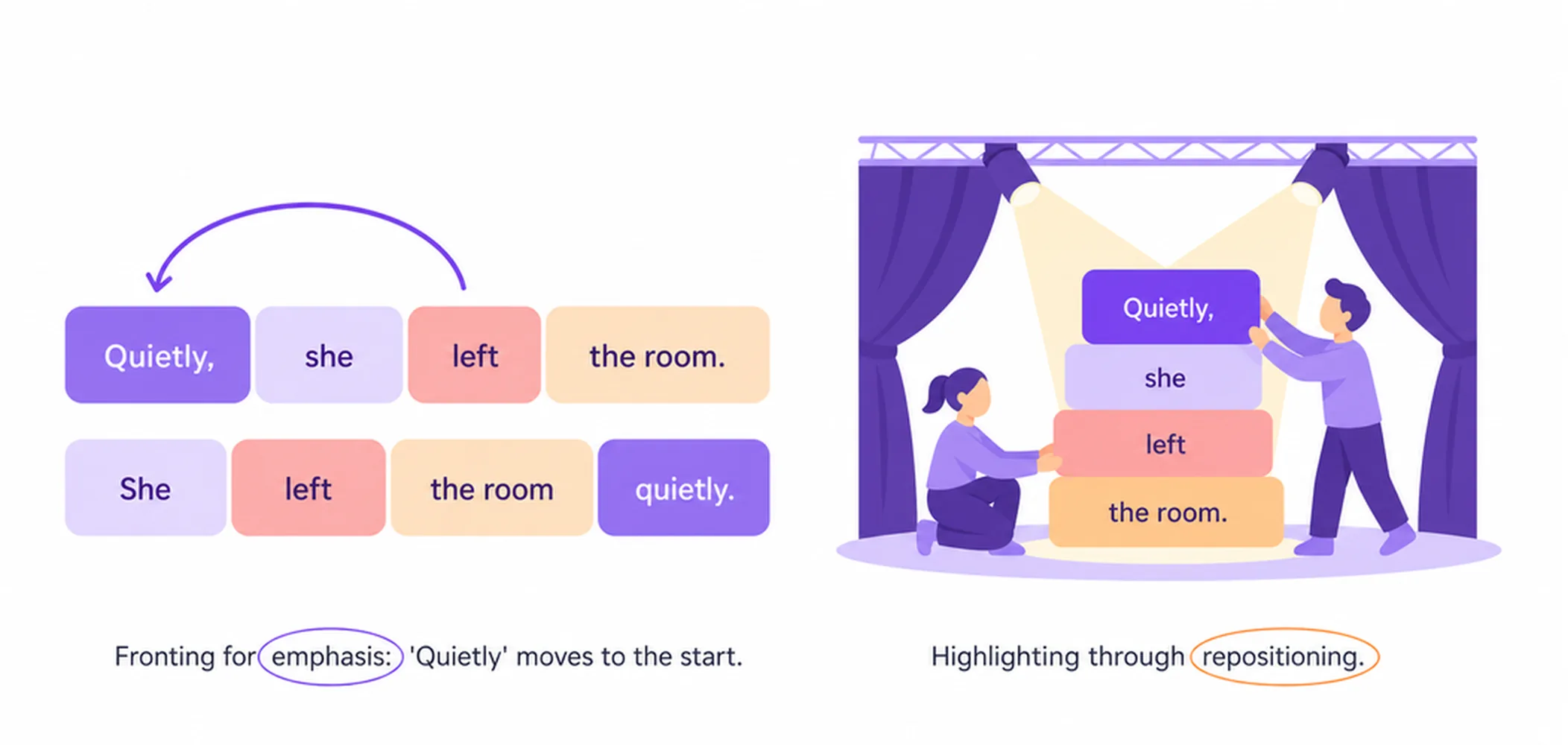
What is Fronting?
Fronting is an advanced grammatical technique in which a constituent—a word, phrase, or clause—is moved to the beginning of a sentence for emphasis, contrast, or stylistic effect. Instead of following the standard subject-verb-object word order, speakers and writers relocate elements that would typically appear later in the clause to the front. This deviation from neutral word order immediately draws attention to the fronted element and can fundamentally shift the tone, urgency, or focus of an utterance. Fronting is particularly common in literary, journalistic, and formal discourse, where writers deliberately manipulate syntax to create rhetorical impact.
Key Characteristics of Fronting
Fronting serves multiple communicative purposes: it creates emphasis on the relocated element, establishes discourse cohesion by linking to previously mentioned information, expresses emotional intensity or urgency, and provides stylistic sophistication. When an element is fronted, the remaining clause typically undergoes inversion or restructuring, particularly when the fronted element is not the subject. For instance, fronting an object, predicate adjective, or adverbial to sentence-initial position often requires subject-verb inversion or a marked shift in word order. The technique is not random; it follows specific grammatical patterns and is constrained by what can be fronted—objects, predicates, adverbials, and certain dependent clauses can all move to the front, but the movement must maintain grammatical acceptability and convey clear communicative intent.
Fronting vs. Standard Word Order
| Aspect | Standard Order (Subject–Verb–Object) | Fronted Version (Fronting Applied) |
|---|---|---|
| What Moves | Nothing is moved. The subject comes first, followed by the verb, then the object or complement. Example: She ate the cake. |
The object, adverbial, or complement is moved to the front of the sentence before the subject. Example: The cake, she ate. |
| What Changes | Word order follows the default SVO pattern. No special stress or contrast is implied by position alone. Example: He finished the report yesterday. |
The fronted element gains prominence. The original position is left empty or a pronoun may replace it. Example: Yesterday, he finished the report. |
| Emphasis or Effect | Neutral tone. All elements carry equal weight. No single part is highlighted above the others. Example: They never found the missing key. |
Strong emphasis falls on the fronted element. Creates drama, contrast, or focuses the reader's attention. Example: The missing key, they never found. |
| Object Fronting | The object sits after the verb in its natural position with no special focus on it. Example: I love that old song. |
The object is placed at the start of the sentence, often to contrast it with something else mentioned earlier. Example: That old song, I love. |
| Adverbial Fronting | The adverbial phrase appears at the end or mid-sentence, describing when, where, or how the action took place. Example: The children ran into the garden happily. |
The adverbial is fronted to set the scene or create a vivid, literary effect. Common in narrative writing. Example: Happily into the garden, the children ran. |
| Complement Fronting | The complement follows the linking verb in the standard position with no special emphasis on the quality described. Example: His dedication to the project was remarkable. |
The complement is fronted for strong rhetorical impact, often used in formal speeches or persuasive writing. Example: Remarkable was his dedication to the project. |
| Negative Fronting (Inversion) | The negative adverbial sits in its natural mid or end position. Word order of subject and auxiliary remains normal. Example: I have never seen such a mess. |
The negative adverbial is fronted and triggers subject–auxiliary inversion. Highly formal and emphatic in tone. Example: Never have I seen such a mess. |
| Register and Style | Suits all registers — informal conversation, casual writing, and formal texts alike. Unmarked and universally neutral. Example: The results were shocking to everyone. |
More common in formal, literary, or persuasive contexts. In informal speech it can sound dramatic or emphatic. Example: Shocking to everyone were the results. |
| Linking to Previous Information | The topic is introduced naturally in sentence-initial subject position. No explicit link back to what was just said. Example: We discussed the budget at the meeting. |
Fronting can place already-known (given) information first, linking back to the previous sentence for cohesion. Example: The budget, we discussed at the meeting. |
Examples






What to Remember
- Fronting moves a constituent (word, phrase, or clause) to sentence-beginning for emphasis or contrast.
- The fronted element typically appears before the subject and verb in standard word order.
- Fronting creates stylistic or rhetorical effect by deviating from neutral subject-verb-object sentence structure.
- Not all constituents can be fronted equally; some fronting requires inverting subject and auxiliary verb.
- Fronting is an advanced technique best used intentionally for specific communicative purposes, not casually.