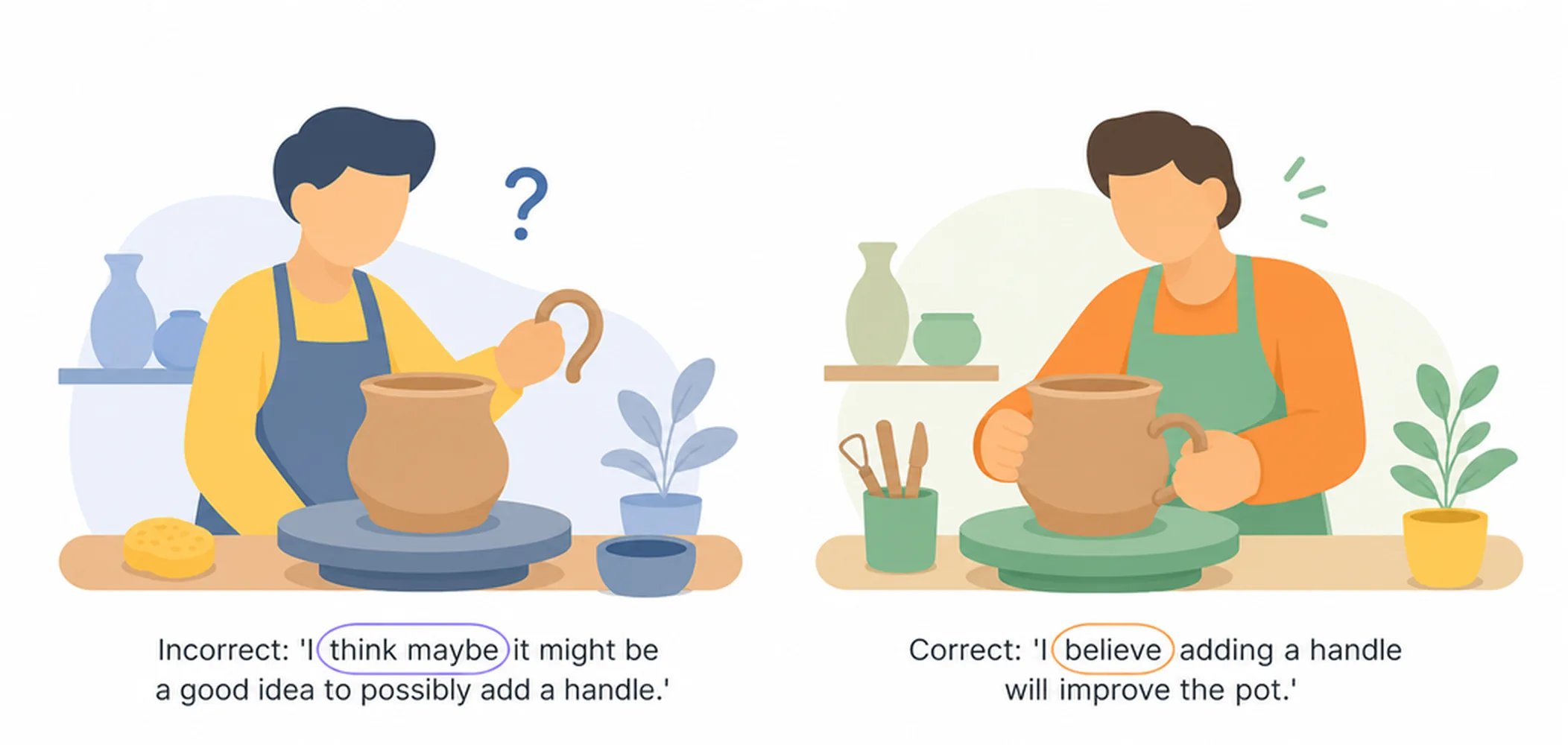
Why Hedging Mistakes Matter at C1
Hedging—softening claims through modals, adverbs, and cautious phrases—is essential for academic and professional writing at advanced levels. C1 learners often overhear hedging in native speech but misapply it, mixing registers, choosing weak expressions instead of precise ones, or omitting hedging where nuance is required. These mistakes undermine credibility and clarity, making your argument appear uncertain rather than appropriately measured.
Common Hedging Errors
Below are frequent mistakes C1 learners make when using hedging language. Each shows how subtle errors in modal choice, adverb placement, or phrase selection can weaken your writing.
Incorrect vs Correct Hedging: Side-by-Side
| Aspect | Common Mistake (Incorrect Hedging) | Correct Alternative (C1 Level) |
|---|---|---|
| Form |
Using absolute statements disguised with vague language: "It is maybe true that…" "It is a little bit possible that…" |
Using modal verbs, reporting verbs, or epistemic adverbs with precise register: "It could be argued that…" "There is some evidence to suggest that…" |
| When to Use |
Learners often hedge when they are certain, adding unnecessary doubt, or fail to hedge when expressing unverified claims: "Everyone knows that climate change is a little bit real." |
Hedge only when the claim is uncertain, approximate, or based on limited evidence. Use hedging to show academic caution, not vagueness: "Research tends to indicate that climate change is accelerating." |
| Positive Example |
Incorrect: "This study maybe shows that exercise is good for mental health." Informal adverb "maybe" is inappropriate in academic writing. |
Correct: "This study appears to suggest that regular exercise may benefit mental health." Layered, appropriate hedging with modal + reporting verb. |
| Negative Example |
Incorrect: "The results are not very definite and don't really show much." Over-hedging undermines the value of the research entirely. |
Correct: "The results do not conclusively demonstrate a causal relationship, though a correlation cannot be ruled out." Precise negation with academic tone preserved. |
| Question / Indirect Claim Example |
Incorrect: "Could it be that perhaps this is possibly a factor?" Stacking multiple hedges creates confusion and sounds evasive. |
Correct: "One might question whether this variable constitutes a contributing factor." Single, well-placed hedge maintains scholarly precision. |
| Key Signal Words / Phrases |
Overused or register-inappropriate hedges: maybe, perhaps, a little bit, kind of, sort of, I think (in formal essays), very possibly, not really sure if |
Academically appropriate hedging expressions: may, might, could, would, appears to, seems to, tends to, it is possible that, there is reason to believe, evidence suggests, it could be argued, is likely to, arguably, broadly speaking, in most cases, to some extent |
Key Difference: The most common mistake C1 learners make with hedging is confusing informality with caution. Words like maybe or kind of feel like hedges but are register-inappropriate in academic or professional writing. Equally damaging is over-hedging — stacking multiple uncertain expressions in one sentence — which destroys credibility. Correct hedging at C1 level means choosing a single, precise mechanism (modal verb, reporting verb, or epistemic adverb) that accurately reflects the degree of certainty, and deploying it in a register that matches the context. The goal is not to avoid commitment, but to signal informed academic caution.
Examples

The data might suggest a correlation, though further research is needed.
Academic writing · Appropriate single hedge with modal

One could argue that this interpretation is overly simplistic.
Formal discourse · Distancing from assertion while remaining clear

It appears that early-stage investors are increasingly cautious.
Reporting observation · Measured claim without over-hedging

The findings arguably undermine the original hypothesis.
Academic analysis · Single adverbial hedge, correctly placed
When to use it
Academic Writing
Use single, precise hedges (may, might, could, appears, suggests) to present findings cautiously without appearing evasive.
The analysis may indicate a shift in consumer behaviour.
Professional Reports
Hedge recommendations and projections with modal verbs or conditional phrases to acknowledge uncertainty responsibly.
We could consider expanding into this market, provided demand increases.
Spoken Argument
Use hedging phrases naturally in debate or discussion to show openness to alternative views while maintaining your position.
It's arguably the case that both approaches have merit.
Signal words
might
may
could
appears
seems
suggests
arguably
in some respects
to some extent
one could argue
it might be said
would appear to
Common Mistakes
✕
Wrong
The data might possibly suggest that climate change is affecting crop yields.
✓
Correct
The data might suggest that climate change is affecting crop yields.
Double hedging (might + possibly) is redundant and weakens the claim unnecessarily. Use one hedging device per statement.
✕
Wrong
It seems to me that the study appears to indicate a correlation.
✓
Correct
The study appears to indicate a correlation.
Stacking 'seems' with 'appears' plus 'to me' is excessive. Remove personal attribution and redundant hedging in formal contexts.
✕
Wrong
The results could be arguably interpreted as contradictory.
✓
Correct
The results could arguably be interpreted as contradictory.
Adverb placement matters. 'Arguably' modifies the verb 'interpreted,' so it must come immediately before it, not after 'be.'
✕
Wrong
This finding somewhat tends to challenge the conventional wisdom.
✓
Correct
This finding tends to challenge the conventional wisdom.
'Tends to' already hedges the claim. Adding 'somewhat' is redundant in academic writing; choose one softening device.
✕
Wrong
One could argue that the hypothesis might well be possibly correct.
✓
Correct
One could argue that the hypothesis might well be correct.
'Might' and 'possibly' express the same epistemic uncertainty. Use only 'might' or only 'possibly,' not both.
✕
Wrong
It could be said that this method is perhaps somewhat questionable.
✓
Correct
This method may be questionable, or: One could question this method's validity.
Excessive hedging ('could be said,' 'perhaps,' 'somewhat') obscures your actual position. Use one hedging marker and a direct verb.
✕
Wrong
The evidence would seem to imply that regulations might possibly improve outcomes.
✓
Correct
The evidence suggests that regulations may improve outcomes.
Use precise single modals ('may,' 'might') and clear verbs ('suggests') instead of stacked hedging phrases ('would seem to imply' + 'possibly').
KEY TAKEAWAYS
What to Remember
- Use hedging to express appropriate uncertainty, not to avoid commitment or sound tentative throughout entire arguments.
- Choose precise hedging devices (may, tend to, arguably) over vague weakeners (kind of, sort of, pretty much).
- Match hedging strength to context: stronger claims need more hedging; overly hedged claims lose persuasive force.
- Avoid mixing casual and formal hedging in the same text; maintain consistent register appropriate to your audience.
- Place hedging strategically before claims needing nuance, not randomly, to preserve clarity and academic credibility.