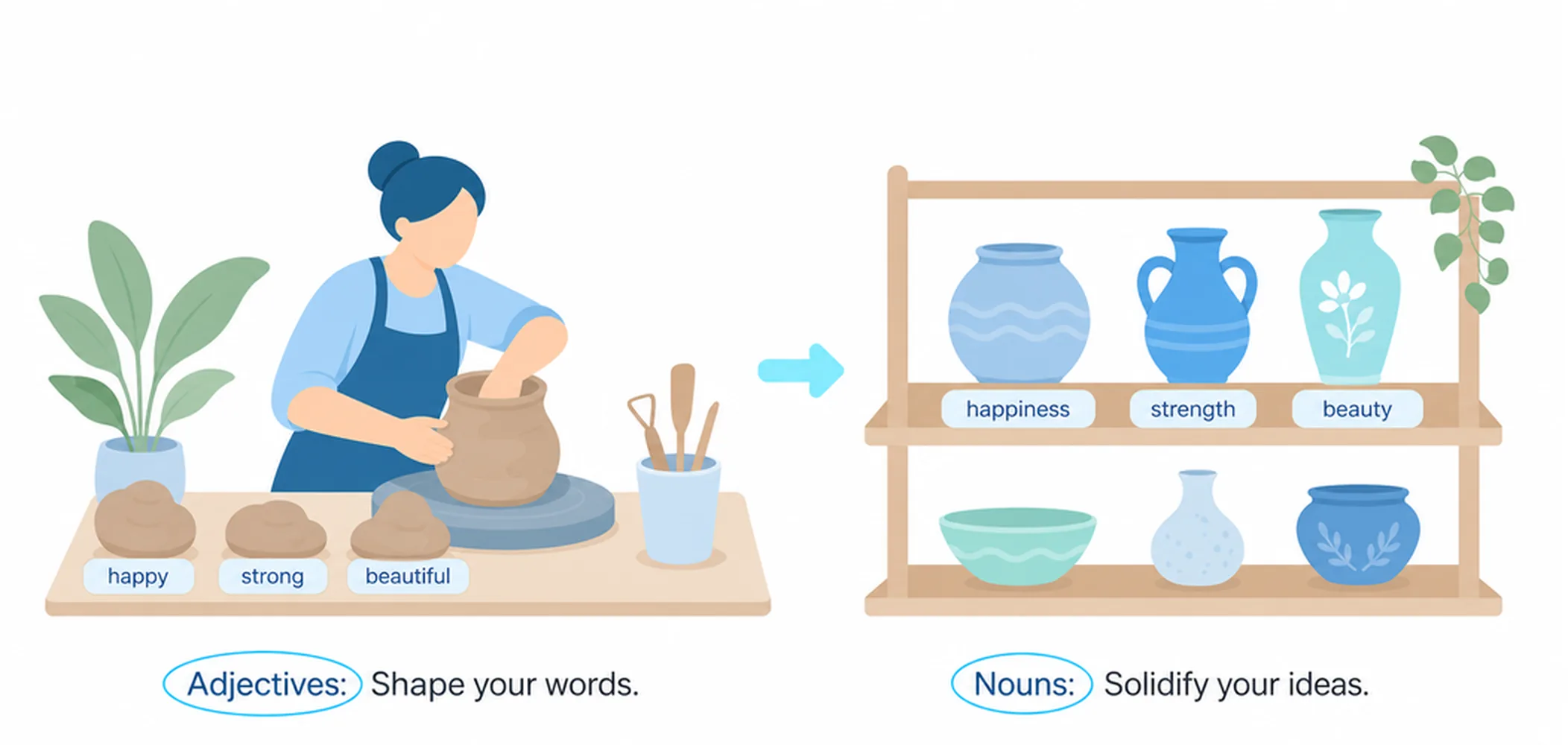
What is Nominalization?
Nominalization is the grammatical process of converting words from other parts of speech—particularly adjectives—into nouns. This transformation allows writers to express abstract qualities, states, or concepts as distinct entities. When you nominalize an adjective, you create a noun that typically refers to the state or quality itself rather than describing an object. For example, 'happy' becomes 'happiness,' and 'rapid' becomes 'rapidity.' Nominalization is essential for academic and formal writing, where abstract nouns help convey complex ideas with precision and sophistication.
Common Nominalization Suffixes
English employs several productive suffixes to nominalize adjectives. The suffix '-ity' converts many Latin-origin adjectives: popular → popularity, complex → complexity, stupid → stupidity. The suffix '-ness' works with Germanic-origin adjectives: happy → happiness, dark → darkness, kind → kindness. The suffix '-ance' or '-ence' appears in formal contexts: tolerant → tolerance, patient → patience, different → difference. The suffix '-ism' creates nouns denoting ideologies or systems: liberal → liberalism, social → socialism. Less common but equally valid patterns include '-th' (warm → warmth, deep → depth) and '-ure' (obscure → obscurity). Mastering these patterns allows you to construct appropriate nominalized forms for academic and professional discourse.
Strategic Use in Advanced Writing
Nominalization transforms sentences by shifting focus from actions and descriptions to abstract concepts. Instead of writing 'The project was expensive and complicated,' a nominalized version might read: 'The expense and complexity of the project created obstacles.' This shift allows you to create more concise, formal prose typical of academic writing. However, excessive nominalization can obscure meaning and create dense, impenetrable text. The key at C1 level is deploying nominalization strategically to emphasize concepts, create cohesion through repetition of related nouns, or elevate register when appropriate. In analytical essays, nominalization helps you discuss abstract qualities with the grammatical weight they deserve.
Adjective-to-Noun Nominalization Patterns
| Suffix | Origin | Adjective Pattern | Examples (Adj → Noun) | Note |
|---|---|---|---|---|
| -ness | Old English | Most adjectives; very productive | dark → darkness happy → happiness sad → sadness kind → kindness aware → awareness |
Most versatile suffix; works with native and borrowed adjectives; y → i before suffix |
| -ity / -ty | Latin / French | Latinate adjectives (often ending in -al, -ous, -ble, -id) | equal → equality curious → curiosity able → ability humid → humidity real → reality |
Often triggers spelling changes (e.g., drop silent e, ous → drop ous) |
| -ce / -cy | Latin / French | Adjectives ending in -ent or -ant | patient → patience fluent → fluency important → importance efficient → efficiency relevant → relevance |
-ence/-ance = state; -ency/-ancy = quality or role; both forms sometimes exist |
| -th | Old English | Short, native Germanic adjectives | warm → warmth wide → width strong → strength long → length true → truth |
Closed, unproductive set; often involves vowel change (e.g., strong → strength) |
| -ism | Greek / Latin | Adjectives denoting ideology, style, or condition | real → realism ideal → idealism national → nationalism heroic → heroism cynical → cynicism |
Refers to a doctrine, movement, or characteristic behavior; pairs with -ist (person) |
| -ry / -ery | Old French / Latin | Adjectives describing a quality, state, or collective | brave → bravery slave → slavery jealous → jealousy modest → modesty honest → honesty |
Less consistent; some forms use -y alone (jealous → jealousy); often unpredictable |
| -ude | Latin | Latinate adjectives (often ending in -tude base) | apt → aptitude exact → exactitude solitary → solitude grateful → gratitude certain → certitude |
Formal/literary register; small closed set; not productive in modern English |
| Zero derivation (conversion) | English | Common adjectives used directly as nouns (no suffix added) | the good (goodness) the beautiful the poor (poor people) the unknown the obvious |
Used with definite article the; often refers to a group or abstract concept; no spelling change |
Examples






What to Remember
- Nominalization converts adjectives into nouns to express abstract qualities as distinct entities rather than descriptions.
- Common patterns include adding suffixes like -ness, -ity, -ation, and -ance to transform adjectives into nouns.
- The resulting nominalized noun typically refers to a state or quality itself, not the object being described.
- Nominalization is particularly valuable in academic and formal writing for creating more sophisticated, abstract expressions.
- Be aware that nominalized forms may change the adjective's meaning or require different sentence structures when used.