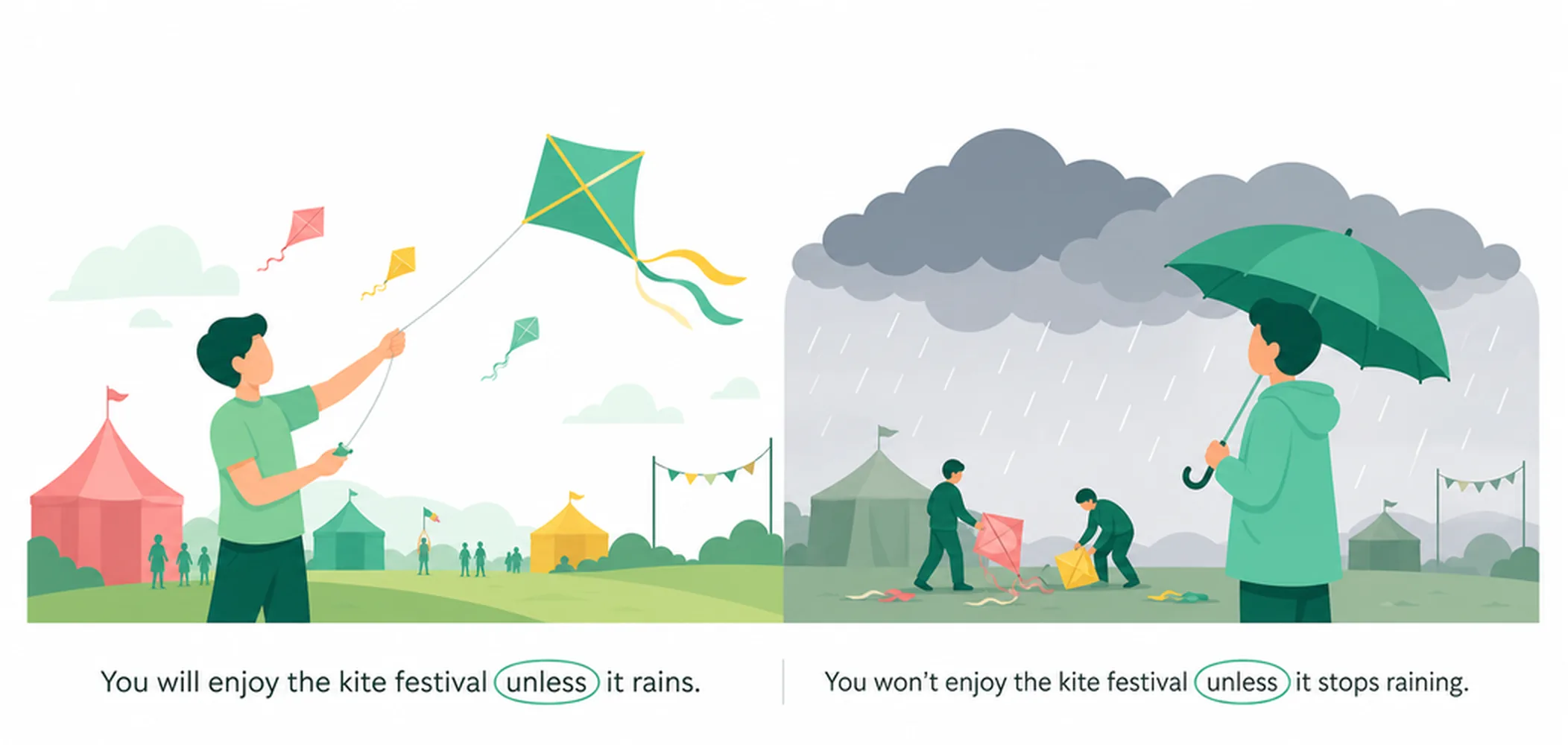
What is 'Unless' in First Conditional?
'Unless' means 'if not'. In first conditional sentences, we use 'unless' to talk about a negative condition that must be avoided for something to happen. Instead of saying 'if something does not happen', we can use 'unless something happens'. Both structures have the same meaning, but 'unless' is more direct and commonly used in everyday English.
How to Form Sentences with 'Unless'
The basic structure is: Unless + present simple, will + infinitive. The 'unless' clause contains the condition we want to avoid (present simple tense), and the main clause tells us the result (will + infinitive). You can put the 'unless' clause at the beginning or end of the sentence. Both orders are correct: 'Unless you study, you will fail the exam' or 'You will fail the exam unless you study'.
'Unless' vs 'If Not'
'Unless' and 'if not' mean the same thing, but 'unless' is simpler and more natural. Compare: 'Unless you call me, I will leave without you' (= 'If you do not call me, I will leave without you'). Both sentences are correct, but the first one using 'unless' sounds more fluent. Use 'unless' in speaking and informal writing, and both forms are acceptable in formal writing.
'Unless' vs 'If Not': Side-by-Side Comparison
| Category | First Conditional with UNLESS | First Conditional with IF NOT |
|---|---|---|
| Form | Unless + present simple, will + base verb Unless [condition], [result] |
If + present simple negative, will + base verb If [negative condition], [result] |
| When to use | Use unless to mean "except if" or "if not." It introduces the one condition that would prevent the result from happening. Common in warnings and conditions. | Use if not to state a negative condition directly. It is slightly more explicit and is easier to follow when the sentence is complex or when a negative idea needs emphasis. |
| Positive example | Unless you study, you will fail the exam. (Studying is the only thing that will prevent failure.) |
If you don't study, you will fail the exam. (Same meaning expressed with a direct negative condition.) |
| Negative example | Unless it rains, we will have the picnic outside. (Rain is the only thing that would stop the picnic.) |
If it doesn't rain, we will have the picnic outside. (Directly states that the absence of rain leads to the picnic.) |
| Question example | Will you come to the party unless you are busy? (Asking whether being busy is the only obstacle.) |
Will you come to the party if you aren't busy? (Directly asking about the negative condition of not being busy.) |
| Key signal words | unless, except if, only if not Often paired with warnings: otherwise, or else |
if not, if never, if no Often paired with: then, in that case, as a result |
Examples





What to Remember
- Unless means 'if not' and introduces a negative condition that must be avoided for something to happen.
- Use present simple tense in the unless clause to describe the condition you want to prevent.
- Use will + infinitive in the main clause to describe what happens if the condition is avoided.
- Unless clauses can appear at the beginning or end of the sentence with no difference in meaning.
- Never use 'will' in the unless clause; only use present simple tense there.