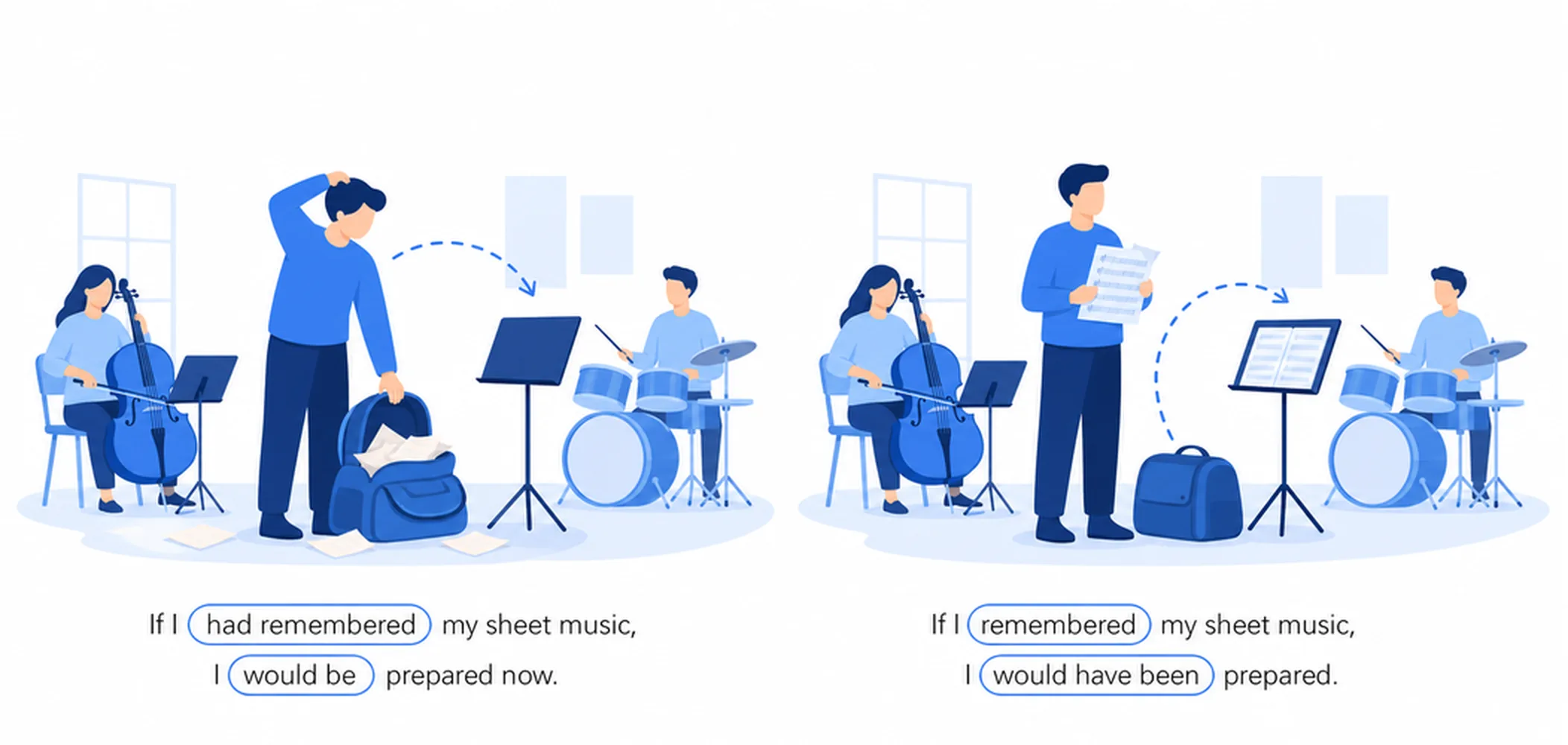
Why Mixed Conditionals Confuse Advanced Learners
Mixed conditionals blend two time frames—typically a past condition with a present consequence, or vice versa. Advanced learners often revert to standard conditional patterns (second or third) because they're familiar, or they miscombine verb tenses without considering the semantic relationship between the condition and result. The key challenge is recognizing which tense structure matches each temporal relationship, and resisting the impulse to 'balance' both clauses symmetrically.
Common Mistakes
Below are the errors C1 learners make most frequently with mixed conditionals, along with explanations of why they occur.
Common Mistakes vs. Correct Mixed Conditionals
| Category | Incorrect (Common Mistake) | Correct Version | Explanation of Error |
|---|---|---|---|
| Past → Present Unreal past cause, present result |
If I studied harder at university, I would have a better job now. | If I had studied harder at university, I would have a better job now. | The "if" clause refers to a past event that didn't happen, so it requires the past perfect ("had studied"), not the simple past. Using simple past implies an open/real condition. |
| Past → Present Result clause modal |
If she had taken that job, she would have been rich now. | If she had taken that job, she would be rich now. | The result clause describes a present consequence ("now"), so it needs "would + base verb," not "would have + past participle." Using "would have been" incorrectly shifts the result back to the past. |
| Present → Past Unreal present cause, past result |
If I wasn't so shy, I would apply for the role last year. | If I weren't so shy, I would have applied for the role last year. | Two errors here: (1) "wasn't" should be "weren't" (subjunctive mood preferred in formal English); (2) the result refers to a specific past moment ("last year"), so "would have applied" (perfect infinitive) is required instead of "would apply." |
| Present → Past If-clause verb form |
If he would be more patient, he would have finished the project on time. | If he were more patient, he would have finished the project on time. | "Would" must never appear in the "if" clause of a standard conditional (a very common mistake). The if-clause uses past subjunctive "were" to express an unreal present state. |
| Confusing 2nd & 3rd Conditional Wrong conditional type |
If I had more confidence, I would have got the promotion back then. | If I had had more confidence at the time, I would have got the promotion back then. | When both the condition and result refer to the past, this is a pure 3rd conditional requiring past perfect in the if-clause ("had had"). Using simple "had" suggests a present lack of confidence causing a past result — a mixed conditional that changes the meaning. |
| Modal Verb in Result Clause Wrong modal choice |
If they had invested wisely, they will be millionaires today. | If they had invested wisely, they would be millionaires today. | Using "will" in the result clause turns the sentence into a real/first conditional, which contradicts the unreal past condition established by "had invested." Hypothetical results always require a past modal ("would/could/might"), never "will." |
| Double Past Perfect Error Over-applying the pattern |
If I had been born in France, I would have spoken French fluently now. | If I had been born in France, I would speak French fluently now. | Learners over-apply the 3rd conditional pattern to the result clause. Because the result ("speaking French") is a present ongoing ability, the result clause must use "would + base verb," not "would have + past participle." |
| Inverted / Formal Mixed Conditional Inversion error |
Had he not been so reckless, he would be still alive today. | Had he not been so reckless, he would still be alive today. | The inverted if-clause form is correct here, but adverbs like "still" must be placed between the modal and the main verb ("would still be"), not after the main verb. Misplacing adverbs is a frequent stylistic error in formal mixed conditionals. |
| Using "Unless" Incorrectly Negative connector |
Unless she had practised more, she would be a professional pianist now. | If she had practised more, she would be a professional pianist now. | "Unless" means "if not," so this sentence reads: "If she had NOT practised more, she would be a pianist" — the opposite of the intended meaning. Mixed conditionals expressing a positive unreal condition should use "if," not "unless." |
| Time Marker Mismatch Signal word confusion |
If I had taken better care of my health, I would be feeling great yesterday. | If I had taken better care of my health, I would have felt great yesterday. OR …I would be feeling great now / today. | The time adverb "yesterday" signals a past result, which requires "would have + past participle." "Would be feeling" (present continuous) only works with present-time markers like "now" or "today." Always match the result clause structure to the time adverb used. |
Key Difference — Quick Reference: A mixed conditional combines clauses from different conditional types to show that a condition and its result exist in different time frames. The most common type uses a past perfect if-clause (unreal past cause) + "would + base verb" result clause (present consequence). The reverse — past subjunctive if-clause (unreal present state) + "would have + past participle" result clause (past consequence) — is equally valid but less frequent. The most widespread advanced-learner errors are: (1) using simple past instead of past perfect in the if-clause; (2) using "would have + past participle" when the result is present; (3) placing "would" inside the if-clause; and (4) mismatching time adverbs with the wrong result-clause structure.
Formula
Formula
If
+
subject
+
had + past participle
+
(past condition),
+
subject
+
would + infinitive
+
(present consequence)
If you had studied medicine, you would be a doctor now.
Examples

If she hadn't taken that degree abroad, she wouldn't be fluent in Mandarin today.
Mixed conditional · Past condition, present consequence

If he were confident in his abilities now, he would have applied for the promotion last year.
Mixed conditional · Present condition, past consequence
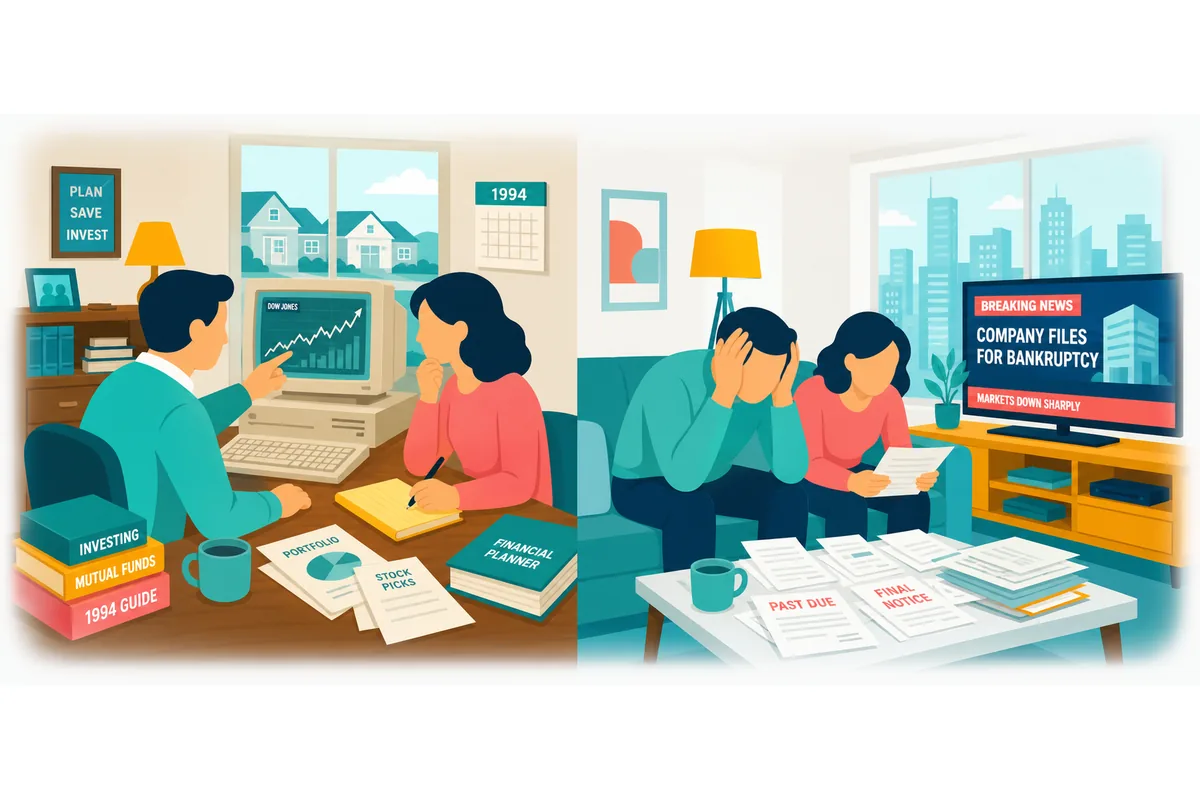
If they had invested wisely in the 1990s, they wouldn't be facing bankruptcy today.
Mixed conditional · Past condition, present consequence

If you spoke Portuguese fluently, you could have negotiated that deal in São Paulo last month.
Mixed conditional · Present condition, past consequence
When to use it
Counterfactual life scenarios
Use mixed conditionals when imagining how past decisions affect your present situation, or how present traits would have changed past outcomes.
If I hadn't moved countries at 21, I wouldn't speak three languages today.
Professional hypotheticals
In business or academic contexts, mix time frames to explore cause-and-effect chains across decades or project phases.
If the company had adopted remote work in 2015, it would be more competitive now.
Regret or reflection
Mixed conditionals express how a single past choice ripples into present consequences, or how current characteristics would have altered history.
If she were more risk-averse, she wouldn't have started that business ten years ago.
Signal words
if
unless
provided that
as long as
in case
had + past participle
would have
would + infinitive
Common Mistakes
✕
Wrong
If he studied harder at university, he would have gotten a better job now.
✓
Correct
If he had studied harder at university, he would have a better job now.
Condition is past (had studied), so use past perfect. Present consequence uses would + infinitive. Don't use would + perfect in the condition.
✕
Wrong
If she didn't move to Berlin last year, she wouldn't be happy today.
✓
Correct
If she hadn't moved to Berlin last year, she wouldn't be happy today.
Past condition requires past perfect (hadn't moved), not simple past. Simple past can confuse the time relationship and create ambiguity.
✕
Wrong
If you would have known about the deadline, you could handle the project better.
✓
Correct
If you had known about the deadline, you could handle the project better.
Never use would have in the if-clause of any conditional. Use had + past participle for past mixed conditions. Would appears only in the result clause.
✕
Wrong
If they had invested in technology five years ago, they would be struggling financially now.
✓
Correct
If they hadn't invested in technology five years ago, they would be struggling financially now.
Logic error: past investment (they did invest) wouldn't cause present struggle. Use negative past perfect to reverse the meaning.
✕
Wrong
If she would speak French fluently, she could have gotten that job last month.
✓
Correct
If she spoke French fluently, she could have gotten that job last month.
Present condition (speaks) with past consequence requires simple present in if-clause, not would + infinitive. Would never follows if in a condition.
✕
Wrong
Unless he hadn't made that mistake years ago, he wouldn't feel regretful now.
✓
Correct
Unless he had made that mistake years ago, he wouldn't feel regretful now.
Double negative (hadn't + would not) creates confusion. Use unless + past perfect, but avoid negating both clauses simultaneously.
✕
Wrong
If you were working there in 2015, you would experience the recession directly.
✓
Correct
If you had been working there in 2015, you would have experienced the recession directly.
Past condition requires past perfect (had been working) with past consequence (would have experienced), not simple past + present.
KEY TAKEAWAYS
What to Remember
- Mixed conditionals connect different time frames: past condition + present result, or present condition + past result.
- Use past perfect in the condition clause when referring to a completed action in the past.
- Use a present or future modal in the result clause to show current or ongoing consequences.
- Avoid using matching tenses across both clauses; asymmetrical structures are grammatically correct and semantically necessary.
- Don't default to standard second or third conditional patterns when the time frames require a mixed structure.