What is a Concrete Noun?
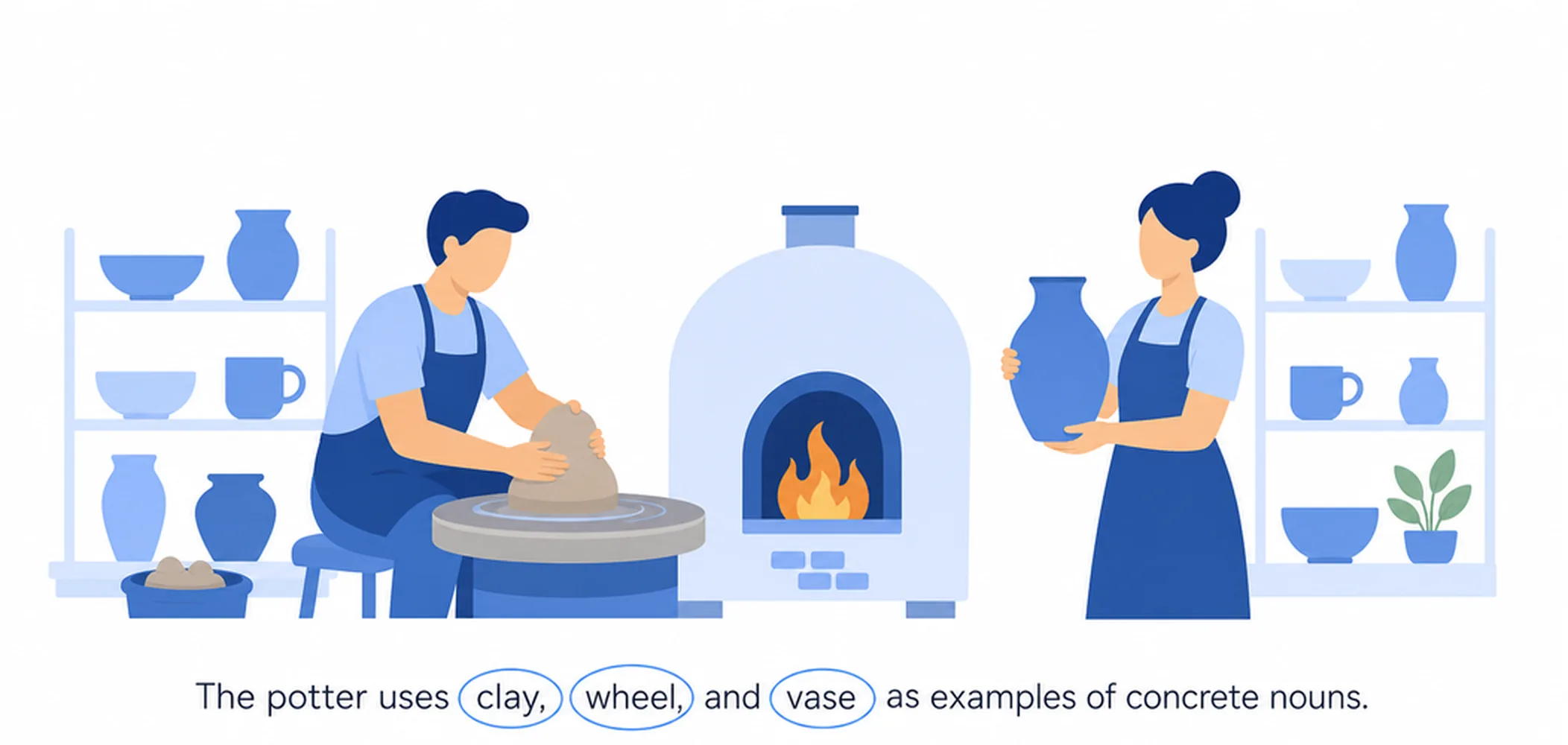
A concrete noun is a word for something you can perceive with your five senses. You can see it, touch it, hear it, smell it, or taste it. Concrete nouns name real, physical things that exist in the world around us. Most nouns in English are concrete nouns because they refer to things you can experience directly.
How to Recognize Concrete Nouns
To identify a concrete noun, ask yourself: 'Can I touch this thing? Can I see it? Can I experience it with my senses?' If the answer is yes, it is probably a concrete noun. For example, you can touch a table, see a tree, hear music, smell coffee, and taste an apple. All of these are concrete nouns. Concrete nouns can be countable (a book, three books) or uncountable (water, sand, air).
Concrete Nouns vs Abstract Nouns
Not all nouns are concrete. Some nouns name ideas, feelings, or concepts that you cannot see or touch. These are called abstract nouns. For example, love, happiness, and freedom are abstract nouns because you cannot touch them. Concrete nouns are different because they always represent physical things. Learning to tell the difference between concrete and abstract nouns will help you understand English grammar better.
Concrete Nouns vs Abstract Nouns: Side-by-Side Comparison
| Comparison Aspect | Concrete Nouns | Abstract Nouns |
|---|---|---|
| Definition | A noun that refers to a physical person, place, animal, or thing that exists in the material world and can be directly perceived. | A noun that refers to an idea, concept, feeling, quality, or state that has no physical form and cannot be directly perceived by the senses. |
| Sensory Experience | Can be experienced through one or more of the five senses: sight, hearing, touch, taste, or smell. | Cannot be directly experienced through the five senses; it exists only in the mind as a concept or emotion. |
| Physical Existence | Has a tangible, physical presence in the real world. You can point to it, hold it, or observe it. | Has no tangible, physical presence. It cannot be pointed to, held, or directly observed in the real world. |
| Examples — People & Living Things | doctor, child, eagle, dolphin, teacher | courage, wisdom, innocence, personality, ambition |
| Examples — Places & Objects | mountain, library, telephone, river, bridge | democracy, justice, belief, culture, freedom |
| Examples — Feelings & Ideas | tear (a physical drop), scar, heartbeat, sweat, shiver | love, fear, happiness, grief, nostalgia |
| Positive Example Sentence | "She placed the book on the wooden table." | "She felt an overwhelming sense of pride after the performance." |
| Negative Example Sentence | "There was no water left in the bottle." | "There was no justice in the final decision." |
| Can Be Measured or Counted | Often yes — concrete nouns can frequently be counted or measured physically (e.g., three apples, two metres of rope). | Rarely in a direct, physical sense — abstract nouns are typically uncountable and measured only metaphorically (e.g., a great deal of patience). |
| Key Signal Words / Formation | Often identified by asking: "Can I see, hear, touch, taste, or smell it?" A "yes" answer usually points to a concrete noun. | Often formed with suffixes such as -tion, -ness, -ity, -ment, -ship, -dom, -ance, and -ism. |
| Role in Writing | Grounds writing in vivid, sensory detail; makes descriptions feel real, immediate, and relatable to the reader. | Elevates writing to explore deeper themes, emotions, and ideas; essential for philosophical, analytical, or emotional expression. |
Examples






What to Remember
- Concrete nouns name things you can perceive with your five senses: see, touch, hear, smell, or taste.
- Real, physical objects that exist in the world are concrete nouns you can experience directly.
- To identify a concrete nouns, ask yourself if you can touch it or sense it.
- Most nouns in English are concrete nouns because they refer to physical things around us.
- Abstract nouns name ideas or feelings you cannot perceive with your senses, unlike concrete nouns.