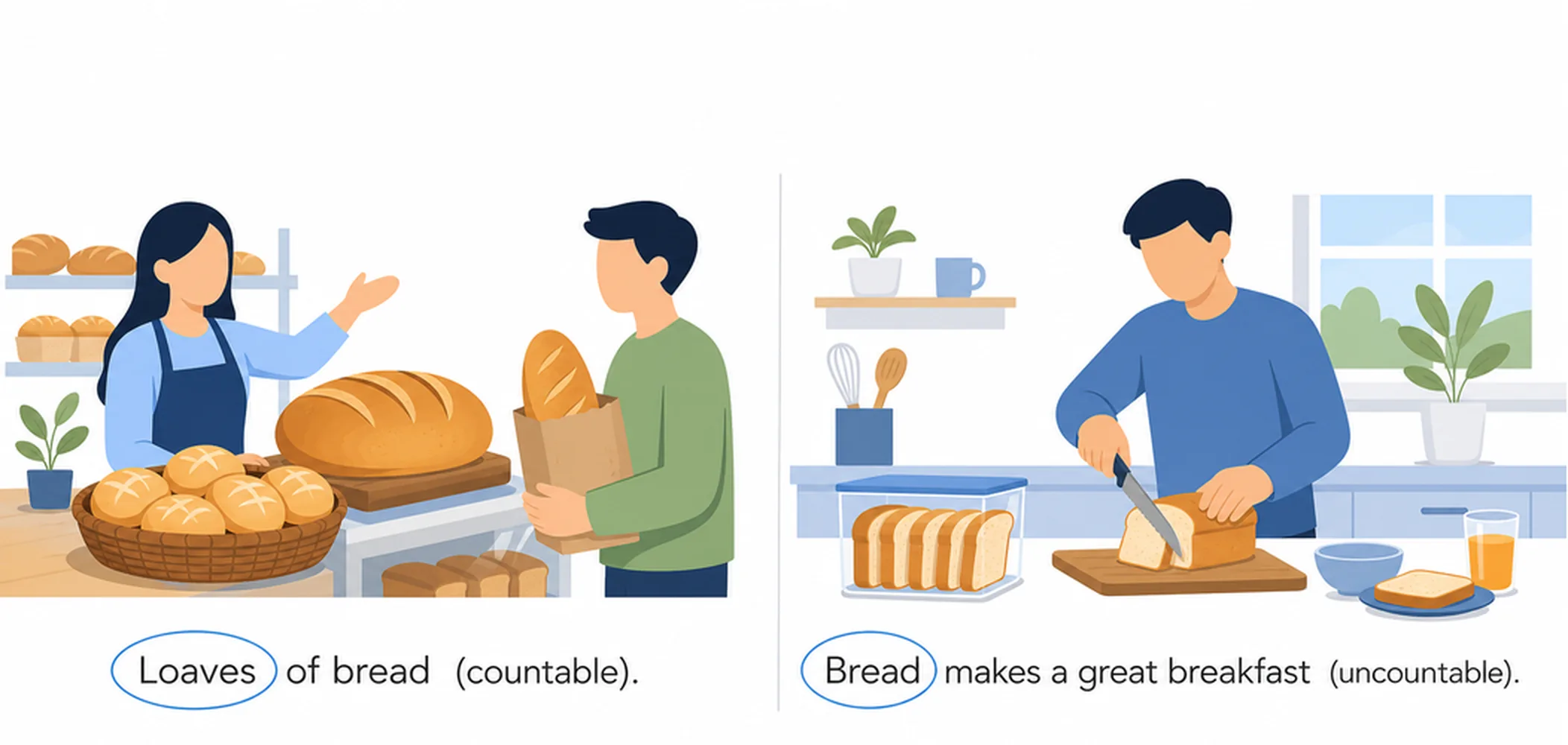
What are countable and uncountable nouns?
Countable nouns are things you can count: one apple, two apples, three apples. Uncountable nouns are things you cannot count: water, rice, information. Most nouns are always countable or always uncountable. However, some nouns can be both! These nouns are countable in one meaning and uncountable in another meaning.
How to use these nouns correctly
The key is to understand the meaning. If you are talking about the general substance or concept, use it as uncountable. If you are talking about different types, amounts, or specific examples, use it as countable. For example: 'I drink coffee every morning' (uncountable—the substance) versus 'The café has three coffees from Brazil' (countable—three different types). When you learn new nouns, check if they can be both countable and uncountable!
Common Nouns That Are Both Countable and Uncountable
| Noun | Uncountable Meaning | Uncountable Example | Countable Meaning | Countable Example | Note |
|---|---|---|---|---|---|
| coffee | The substance / drink in general | I love coffee in the morning. | A cup or serving of coffee | Can I get two coffees, please? | Countable form common when ordering in a café |
| hair | Hair as a mass on the head | She has beautiful hair. | An individual strand of hair | There's a hair in my soup. | Use a hair only for a single detached strand |
| light | Illumination in general | The room was full of light. | A lamp or light source | Turn off the lights before you leave. | Also: a light = a flame (e.g., Got a light?) |
| glass | The material glass is made of | The table is made of glass. | A drinking vessel or a window pane | She dropped a glass on the floor. | Plural glasses also means eyeglasses |
| time | Time as an abstract concept | Time flies when you're having fun. | A specific occasion or instance | I've been to Paris three times. | Countable: a time, many times |
| paper | The material used for writing | The book is printed on recycled paper. | A newspaper or an academic essay | He published a paper on climate change. | Also: papers = official documents |
| iron | The metal element / material | The gate is made of iron. | A clothes iron or a golf club | She pressed her shirt with an iron. | Also dietary: foods rich in iron (uncountable) |
| experience | Skills / knowledge gained over time | She has years of teaching experience. | A specific event or encounter | Living abroad was an amazing experience. | Meaning shifts significantly between forms |
| work | Labour / employment in general | She has a lot of work to do. | A creative piece (book, painting, etc.) | This is one of Picasso's finest works. | Do not say a work for employment |
| noise | Sound in general; disturbance | There's too much noise in here. | A particular sound or bang | I heard a strange noise outside. | Similar pattern with sound and smell |
Examples






What to Remember
- Most nouns are always countable or always uncountable, but some can be both.
- These nouns are countable in one meaning and uncountable in another meaning.
- Coffee is uncountable when referring to the substance, but countable when referring to cups.
- When a noun is countable, use a/an, numbers, and plural forms with it.
- When a noun is uncountable, don't use a/an or numbers; use "some" instead.