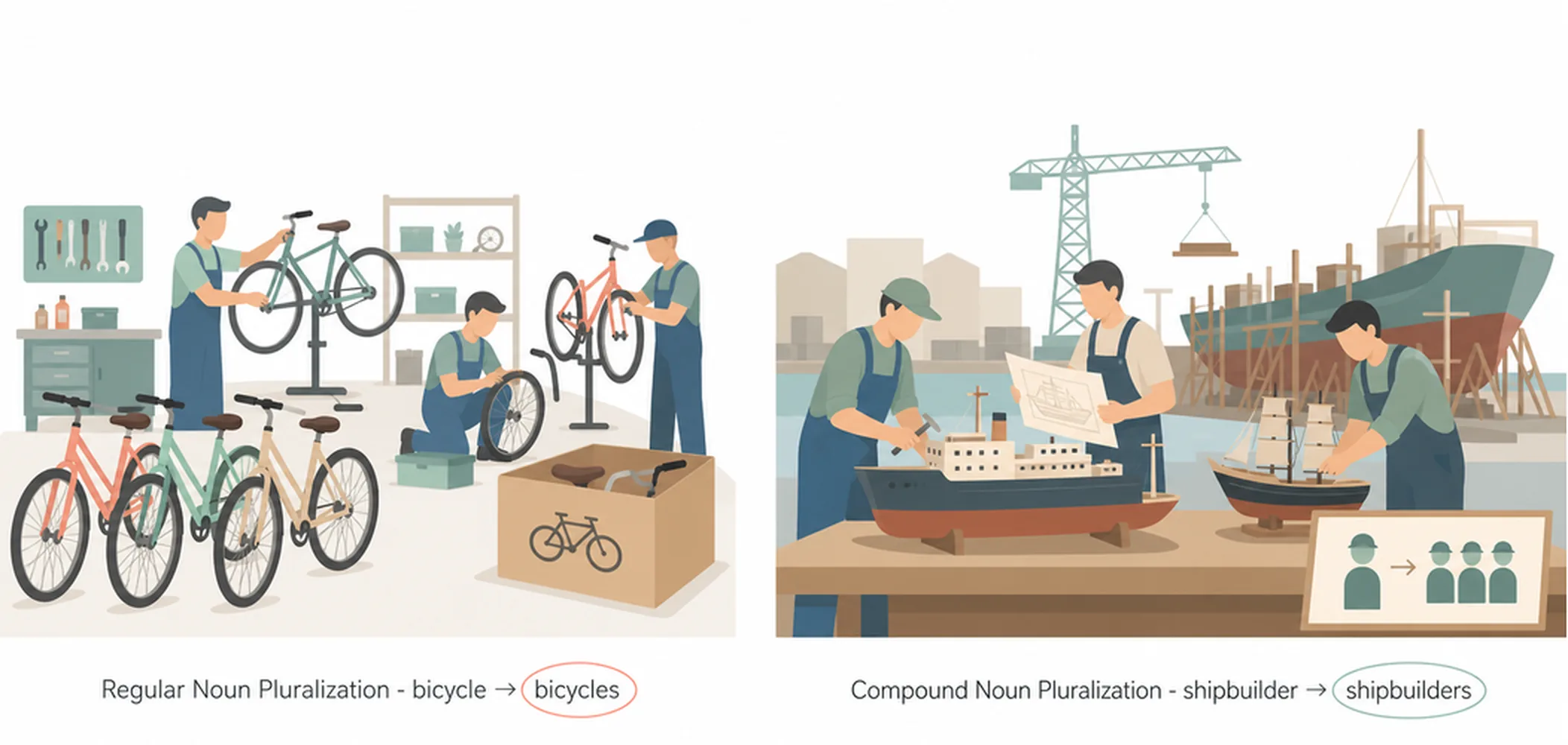
What is a Compound Noun?
A compound noun is two or more words that together make one noun. For example, 'toothbrush' is a compound noun. It is one thing made from two words: 'tooth' + 'brush'. Other examples are 'football', 'classroom', and 'mother-in-law'. When you want to talk about more than one, you need to make it plural.
How to Make Compound Nouns Plural
Most compound nouns are made plural like normal nouns. You usually add -s or -es to the end: 'toothbrush' becomes 'toothbrushes'. However, when a compound noun has two words joined with a hyphen (like 'mother-in-law'), you make the most important word plural: 'mothers-in-law'. The important word is usually at the beginning.
Special Cases
Some compound nouns are irregular and do not follow the normal rules. For example, 'man' + 'woman' in compounds: 'policeman' becomes 'policemen', not 'policemans'. The word 'man' or 'woman' inside changes to 'men' or 'women'. This is important to remember for words like 'fireman', 'businessman', and 'saleswoman'.
Compound Noun Plurals at a Glance
| Type | Plural Rule | Singular → Plural | Note |
|---|---|---|---|
| One word | Add -s or -es to the end of the whole word | toothbrush → toothbrushes | Treat it like any regular noun; the last letter determines -s vs. -es |
| Hyphenated | Pluralise the most important (head) noun, usually the first one | mother-in-law → mothers-in-law | The head noun carries the meaning; words like in and of are never pluralised |
| Two separate words | Pluralise the head (main) noun, which is usually the first word | post office → post offices | The second word acts as a modifier; only the noun being counted changes |
Examples






What to Remember
- A compound noun is two or more words that together make one noun.
- Most compound nouns add -s or -es to the end to become plural.
- For hyphenated compound nouns, add -s or -es to the most important word.
- 'Toothbrush' becomes 'toothbrushes' and 'mother-in-law' becomes 'mothers-in-law' following these plural rules.
- Always check if the compound noun is written as one word or hyphenated.