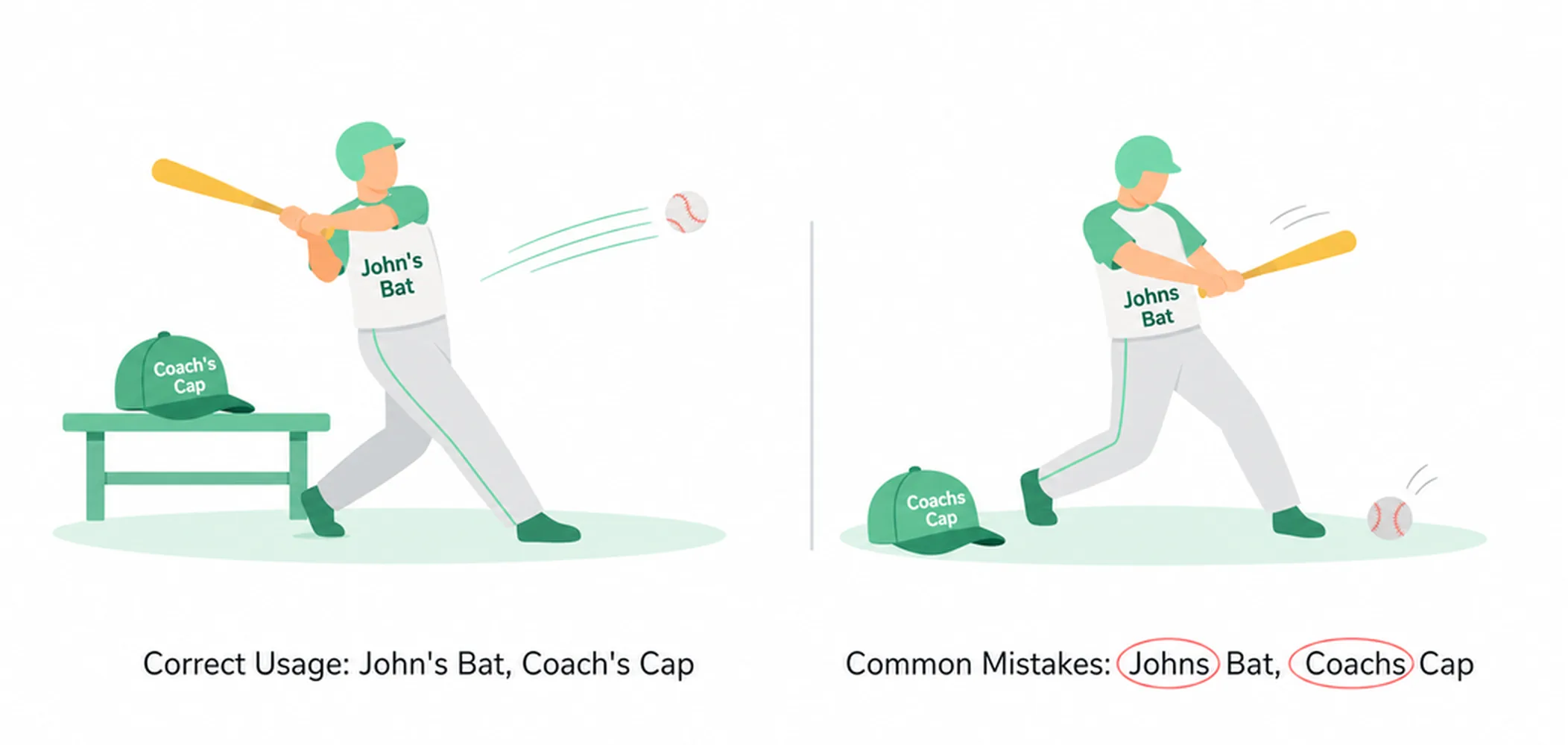
Why Do Learners Make Possessive Mistakes?
Possessives are tricky because English uses different forms depending on the situation. Some learners confuse 's with s', forget apostrophes entirely, or mix up possessive pronouns like 'his' and 'her'. These mistakes happen because possessive rules are different in many other languages. Understanding the correct patterns will help you write and speak more accurately.
Correct vs Incorrect Possessive Forms
| Category | Incorrect Form | Correct Form | Rule |
|---|---|---|---|
| Singular Nouns | |||
| Basic form | the dog bowl | the dog's bowl | Add 's to a singular noun to show possession. |
| When to use | Omitting the apostrophe entirely | When one person or thing owns something | Always required for singular nouns regardless of what letter the noun ends with. |
| Positive example | "This is Sarahs book." | "This is Sarah's book." | Sarah is singular; add 's directly after the name. |
| Negative example | "It is not the cats toy." | "It is not the cat's toy." | Negation does not remove the need for the possessive apostrophe. |
| Question example | "Is this the teachers desk?" | "Is this the teacher's desk?" | Question structure does not change possessive rules. |
| Key signal words | — | belongs to, owned by, of the | If you can rephrase with "belonging to," use 's. |
| Singular Nouns Ending in –S | |||
| Basic form | James' car (sometimes acceptable but often inconsistent) | James's car | Most modern style guides recommend adding 's even after a name ending in s. |
| When to use | Dropping the extra s inconsistently | A singular noun or name ending in the letter s | Choose one style (with or without extra s) and apply it consistently throughout a document. |
| Positive example | "I read Dickens' novels." | "I read Dickens's novels." | Adding 's reflects the extra syllable often pronounced in speech. |
| Negative example | "This is not Chris' fault." | "This is not Chris's fault." | Treat names ending in s like any other singular noun. |
| Question example | "Is that Alexis' jacket?" | "Is that Alexis's jacket?" | Consistent application across sentence types is key. |
| Key signal words | — | Any proper noun or common noun ending in –s, –x, or –z | Tip: say it aloud — if you pronounce an extra syllable, write 's. |
| Regular Plural Nouns (ending in –S) | |||
| Basic form | the student's projects (when referring to multiple students) | the students' projects | For plurals already ending in –s, add only an apostrophe after the final s. |
| When to use | Adding 's after a plural noun already ending in s | When more than one person or thing (using a regular plural) owns something | Avoid double-s constructions like students's — they are always wrong. |
| Positive example | "The girls's lockers are painted blue." | "The girls' lockers are painted blue." | girls is already plural; apostrophe goes after the existing s. |
| Negative example | "These are not the players's uniforms." | "These are not the players' uniforms." | Never add an extra s after the apostrophe on a regular plural noun. |
| Question example | "Have you seen the teacher's lounge?" (meaning all teachers) | "Have you seen the teachers' lounge?" | Context matters: one teacher = teacher's; many teachers = teachers'. |
| Key signal words | — | all, many, several, the (plural noun), both | If the noun is plural before adding possession, put the apostrophe after the s. |
| Irregular Plural Nouns (not ending in –S) | |||
| Basic form | the children' toys | the children's toys | Irregular plurals that do not end in –s take 's, just like singular nouns. |
| When to use | Treating them like regular plurals and placing only ' after a word that does not already end in s | With words like men, women, children, geese, mice, teeth, feet, people | Because these plurals don't end in s, the rule reverts to adding 's. |
| Positive example | "The women' conference starts today." | "The women's conference starts today." | women is already plural but doesn't end in s, so add 's. |
| Negative example | "These are not the mices' droppings." | "These are not the mice's droppings." | mices' is doubly wrong: the plural of mouse is mice, and it takes 's. |
| Question example | "Where is the mens' restroom?" | "Where is the men's restroom?" | mens' is incorrect; the plural men takes 's, not ' alone. |
| Key signal words | — | men, women, children, people, geese, teeth, feet, oxen, mice, lice | Memorise the common irregular plurals and always give them 's. |
| Possessive Pronouns | |||
| Basic form | it's, their's, your's, who's (used as possessives) | its, theirs, yours, whose | Possessive pronouns never use an apostrophe. Apostrophes with pronouns indicate contractions, not possession. |
| When to use | Confusing contractions (it's = it is) with possessives (its) | When showing ownership through a pronoun (my, your, his, her, its, our, their, whose) | Test: replace the word with it is. If it makes sense, use it's; if not, use its. |
| Positive example | "The dog wagged it's tail." | "The dog wagged its tail." | it's = it is; its = belonging to it. Only the latter fits here. |
| Negative example | "The house is not their's to sell." | "The house is not theirs to sell." | their's does not exist; theirs is already possessive without an apostrophe. |
| Question example | "Who's book is on the table?" | "Whose book is on the table?" | who's = who is; whose = belonging to whom. Test: "Who is book?" — nonsensical, so use whose. |
| Key signal words | it's, your's, their's, who's, our's, her's, his' | its, yours, theirs, whose, ours, hers, his, mine | None of these possessive pronouns ever take an apostrophe. Ever. |
| Joint vs. Individual Possession | |||
| Basic form | Tom and Jerry's cars (when each owns separate cars) | Tom's and Jerry's cars (individual) / Tom and Jerry's car (joint) | For joint ownership, add 's only to the last noun. For individual ownership, add 's to each noun. |
Examples

Maria's pen is blue.
Singular possessive · Everyday usage

The students' classroom is on the second floor.
Plural possessive · School context
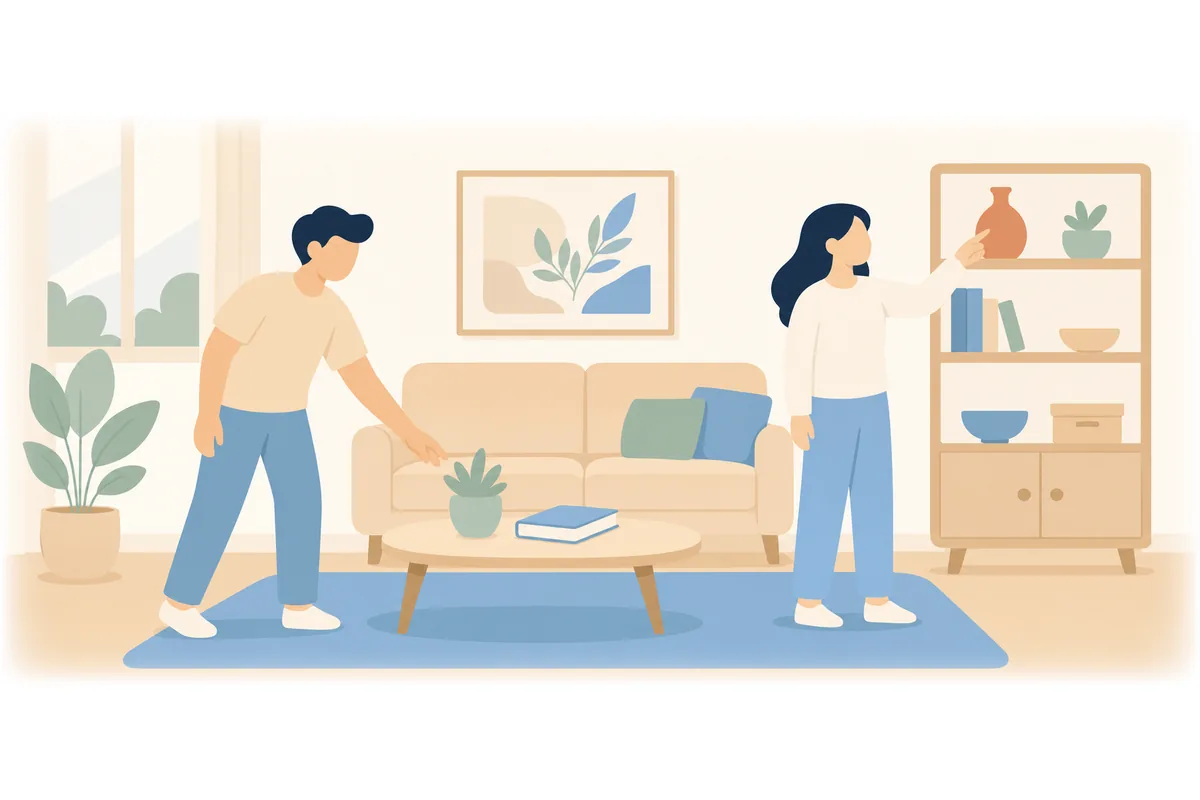
This is mine, and that is yours.
Possessive pronouns · Common expressions
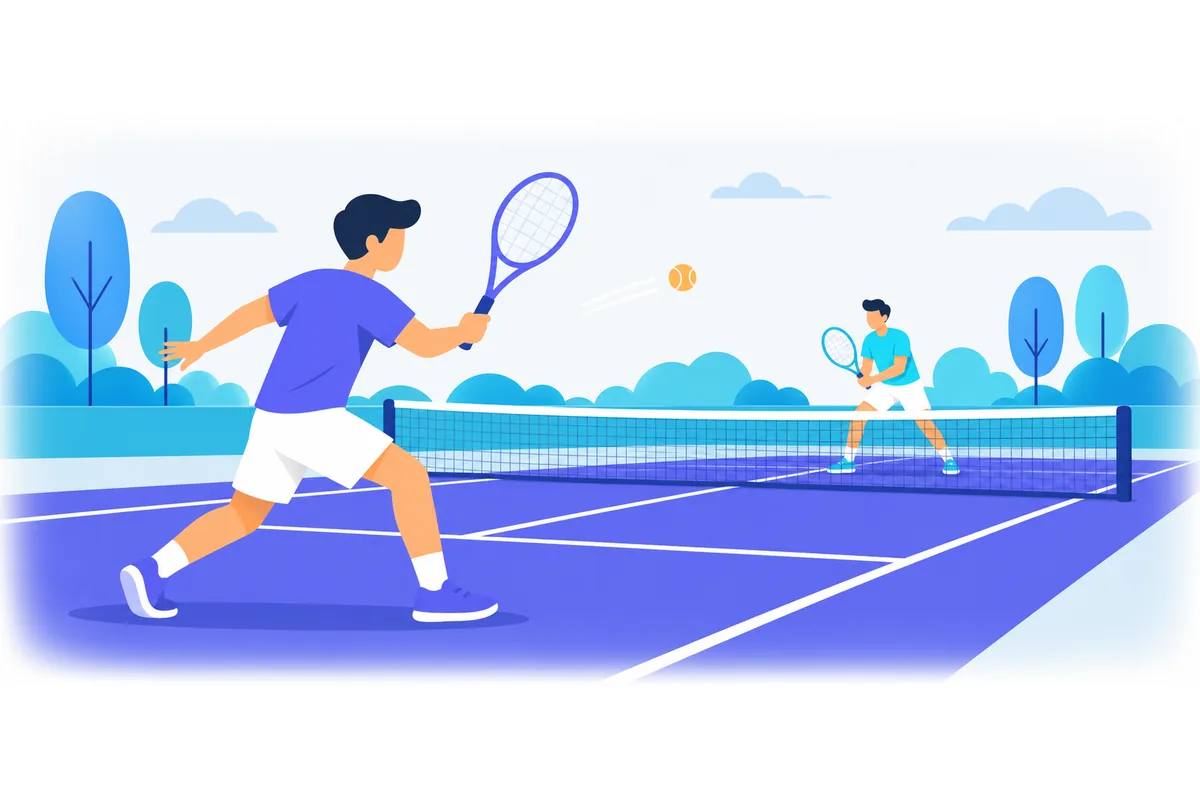
My friend and I love playing tennis together.
Subject pronoun · Everyday usage
When to use it
Family relationships
Use possessives to show who owns something or who is related to someone.
"My mother's house is big. My brother's car is red."
School and work
Possessives are used when talking about people's belongings or responsibilities.
"The teacher's desk is neat. The students' homework is done."
Daily conversations
You use possessives naturally when talking with friends about your things.
"Is this your book? Yes, it's mine. That's his."
Signal words
's
s'
mine
yours
his
hers
ours
theirs
Common Mistakes
✕
Wrong
The book of John is on the table.
✓
Correct
John's book is on the table.
Use 's with names to show possession, not 'of' (in informal contexts).
✕
Wrong
Its a beautiful day today.
✓
Correct
It's a beautiful day today.
It's = it is. 'Its' (no apostrophe) is the possessive form, not a contraction.
✕
Wrong
The books of the students are new.
✓
Correct
The students' books are new.
For plural nouns ending in s, add only an apostrophe after the s.
✕
Wrong
Her and him went to the cinema.
✓
Correct
She and he went to the cinema.
Use subject pronouns (she, he), not possessive pronouns (her, him), when the pronoun is the subject.
✕
Wrong
This pen is mines.
✓
Correct
This pen is mine.
Possessive pronouns (mine, yours, his, hers) never have an apostrophe or s.
✕
Wrong
My sister and me went shopping.
✓
Correct
My sister and I went shopping.
Use 'I' (subject pronoun), not 'me' (object pronoun), when you are the subject of a verb.
✕
Wrong
The childrens toys are expensive.
✓
Correct
The children's toys are expensive.
For irregular plural nouns (children, men, women), add 's like you would for singular nouns.
KEY TAKEAWAYS
What to Remember
- Use 's for singular nouns and 's for plural nouns ending in s.
- Possessive pronouns (his, her, its, their) never use apostrophes.
- Don't confuse it's (it is) with its (possessive form).
- Use 's with irregular plural nouns like children's and people's.
- Remember that 's shows something belongs to one person or thing.