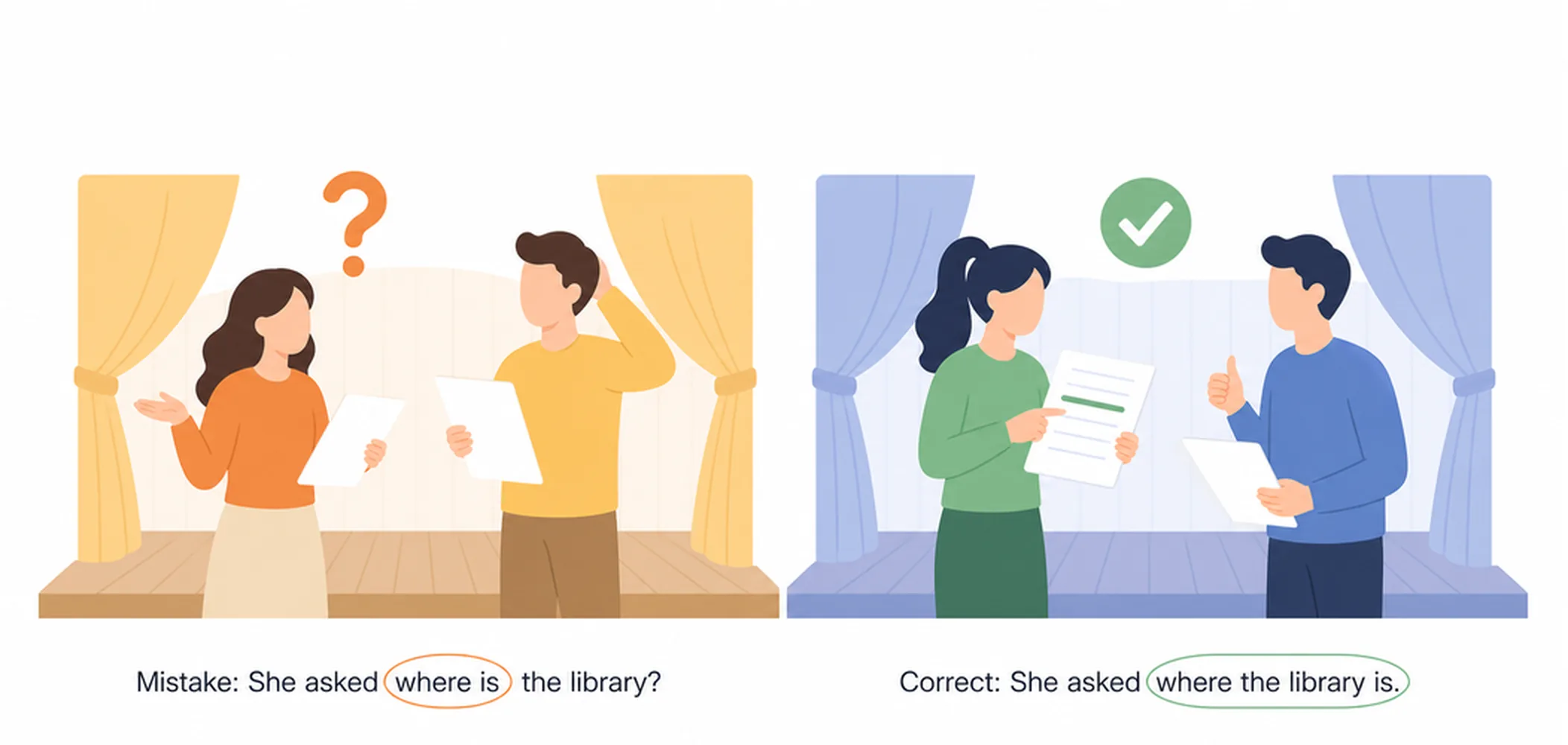
Why Do Learners Make These Mistakes?
Indirect questions are tricky because they look similar to direct questions, but they follow different word order rules. Many learners forget to change the word order or accidentally use the wrong helping verb. Understanding these common mistakes will help you speak and write more naturally in English.
Direct Questions vs. Indirect Questions: Side-by-Side Comparison
| ❌ Incorrect — Direct Question Word Order | ✅ Correct — Indirect Question Word Order |
|---|---|
| Can you tell me where is the station? | Can you tell me where the station is? |
| Do you know what time does the film start? | Do you know what time the film starts? |
| I'd like to know why did she leave? | I'd like to know why she left. |
| Could you explain how does this work? | Could you explain how this works? |
| I wonder where has he gone? | I wonder where he has gone. |
| Do you know is she coming? | Do you know if / whether she is coming? |
| Can you tell me did he finish the report? | Can you tell me if / whether he finished the report? |
| I'm not sure what does she want? | I'm not sure what she wants. |
| Please tell me who is in charge? | Please tell me who is in charge. (subject question — no change needed) |
| She asked me where do I live? | She asked me where I lived. (backshift in reported speech) |
| 🔑 Key Difference: In direct questions, the auxiliary verb comes before the subject (inverted word order), and the sentence ends with a question mark. In indirect questions, the word order reverts to normal subject + verb order (no inversion), the auxiliary do/does/did is dropped, the verb is conjugated correctly, and the sentence typically ends with a full stop. When there is no question word (who, what, where, etc.), if or whether must be added to introduce the indirect yes/no question. | |
Examples

Can you tell me where the station is?
Correct indirect question · Statement word order

I don't know what time the bus arrives.
Correct indirect question · No helping verb in question clause

Do you know if she is coming to the party?
Correct indirect question · Using 'if' instead of direct question mark

Could you tell me how much this jacket costs?
Polite indirect question · Natural conversation
When to use it
Asking Politely
Use indirect questions to ask for information in a polite, friendly way. This is very common in real conversations.
Could you tell me how I can get to the train station?
Reporting Questions
When you tell someone what another person asked, use an indirect question with statement word order.
He asked me what my favorite food was.
Wondering or Uncertain
Use indirect questions when you're not sure about something or thinking aloud.
I wonder if she knows the answer to this question.
Signal words
Can you tell me
Do you know
Could you tell me
I wonder
I don't know
Could you explain
Would you mind telling me
I'm not sure
Common Mistakes
✕
Wrong
Do you know where is the bathroom?
✓
Correct
Do you know where the bathroom is?
In indirect questions, use statement word order (subject + verb), not question word order.
✕
Wrong
I don't know what does he want.
✓
Correct
I don't know what he wants.
Don't use the helping verb 'do/does' in indirect questions. Use normal statement word order.
✕
Wrong
Can you tell me where do you live?
✓
Correct
Can you tell me where you live?
Change the word order to statement form in the indirect question clause.
✕
Wrong
I wonder if does she like coffee.
✓
Correct
I wonder if she likes coffee.
Remove 'does' and use the normal verb form. The main clause provides the question context.
✕
Wrong
Do you know what time is it?
✓
Correct
Do you know what time it is?
Use statement word order: 'what time it is' not 'what time is it'.
✕
Wrong
She asked me why did I leave early?
✓
Correct
She asked me why I left early.
Indirect questions don't use question marks and require statement word order.
✕
Wrong
I'm not sure if are you ready or not.
✓
Correct
I'm not sure if you are ready or not.
Use subject before verb in indirect questions: 'if you are ready', not 'if are you ready'.
KEY TAKEAWAYS
What to Remember
- Indirect questions use statement word order, not question word order with inverted subjects and verbs.
- Always use a question word or "if/whether" to introduce an indirect question after a main clause.
- Do not use auxiliaries like "do" or "does" in indirect questions, even when asking about present actions.
- Change the word order from "Where is she?" to "I wonder where she is" with the subject before the verb.
- End indirect questions with a period or question mark depending on whether the main clause is a statement or question.