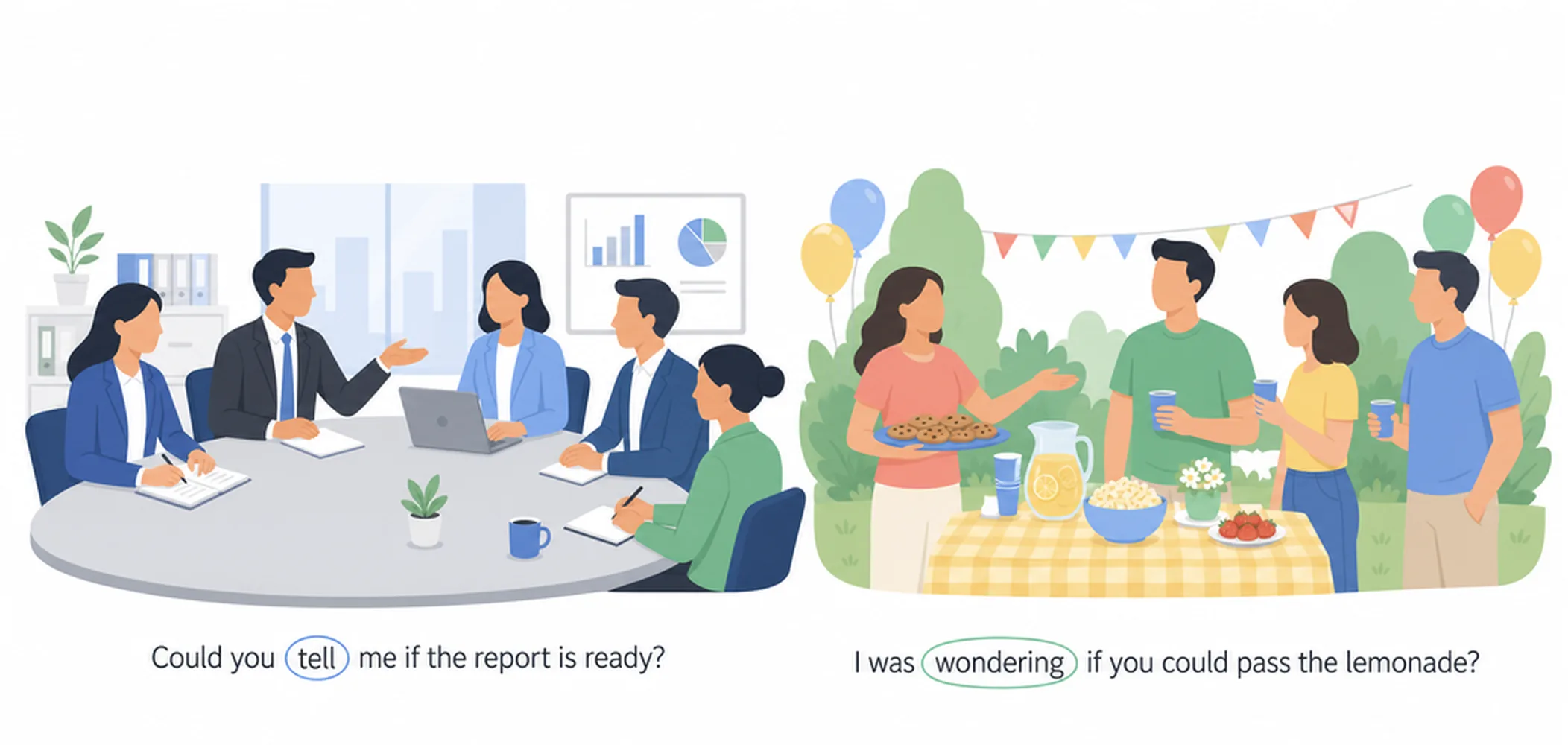
What are indirect questions?
An indirect question is a polite way to ask for information. Instead of asking directly, you add an introductory phrase like 'Could you tell me...?' or 'Do you know...?' This makes your question sound more polite and friendly. Indirect questions are very common in everyday English, especially when speaking to people you don't know well or in formal situations.
How to form indirect questions
To form an indirect question, you start with a polite phrase, then add your question. The word order changes—you use statement word order, not question word order. This means the subject comes before the verb. For example: 'Do you know what time the train leaves?' (not 'what time does the train leave'). The introductory phrase is followed by a question word or 'if/whether', then the statement form.
Why use indirect questions?
Indirect questions are more polite than direct questions. They show respect and consideration for the person you are asking. Direct questions can sometimes sound rude or demanding, especially with strangers. Using indirect questions helps you communicate in a friendly and professional way. In business, customer service, and formal conversations, indirect questions are the best choice.
Direct vs Indirect Questions: Side-by-Side Comparison
| Feature | Direct Question | Indirect Question |
|---|---|---|
| Form | Auxiliary verb + subject + main verb (inverted / question word order) |
Introductory phrase + question word + subject + main verb (statement word order inside the embedded clause) |
| When to use | With friends, family, or in casual, informal contexts where directness is natural and expected. | In formal situations, with strangers, in professional emails, or when you want to sound polite and respectful. |
| Positive example | "Where is the nearest bank?" | "Could you tell me where the nearest bank is?" |
| Negative example | "Why didn't he call?" | "Do you know why he didn't call?" |
| Yes/No question example | "Is the office open on Saturdays?" | "I'd like to know if / whether the office is open on Saturdays." |
| Word order inside clause | Inverted: auxiliary before subject. "What does she want?" |
Normal statement order: subject before verb. "…what she wants." |
| Key signal words / introductory phrases | Question words used directly: What, Where, When, Who, Why, How, Is, Do, Did, Can… | Could you tell me…, Do you know…, I wonder…, I'd like to know…, Would you mind telling me…, Can you explain…, I was wondering… + if / whether (for yes/no questions) |
| Punctuation | Always ends with a question mark (?) | Ends with a question mark (?) if the introductory phrase is a question; ends with a full stop (.) if it is a statement. |
| Tone / register | Neutral to informal; can sound blunt or abrupt in formal contexts. | Polite, formal, and softer; shows respect for the listener and is preferred in professional or unfamiliar settings. |
| 🔑 Key Difference: The most important distinction between direct and indirect questions is word order inside the embedded clause. In a direct question, the auxiliary verb comes before the subject (inverted order). In an indirect question, the embedded clause reverts to normal subject + verb statement order — the question is "hidden" inside a polite introductory phrase. Additionally, yes/no direct questions become indirect by introducing if or whether, while do / does / did are dropped and the verb returns to its base or conjugated form matching the subject. Mastering this shift allows speakers to ask for the same information while adapting their tone to suit formal, professional, or polite social situations. | ||
Examples






What to Remember
- Indirect questions use polite introductory phrases like "Could you tell me...?" or "Do you know...?"
- After the introductory phrase, use statement word order, not question word order.
- Indirect questions sound more polite and friendly than direct questions in formal situations.
- Don't use a question mark after the introductory phrase; use it only at the end.
- Common introductory phrases include "Could you tell me," "Do you know," and "Would you mind telling me."