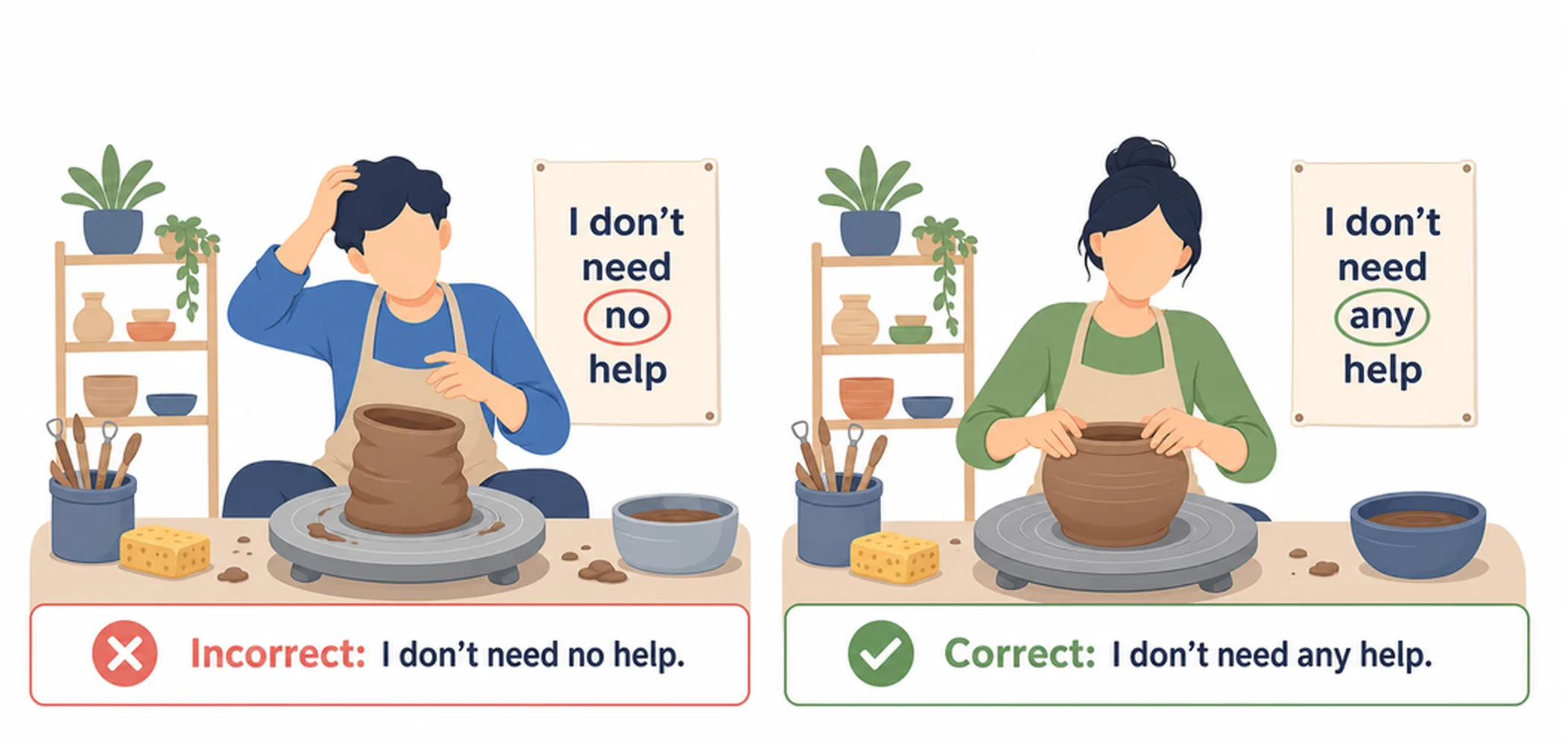
What is a double negative?
A double negative happens when you use two negative words in the same sentence. In English, this is incorrect grammar. When you use two negatives together, they do not make a positive meaning—they just create confusion. For example, 'I don't want nothing' uses two negatives (don't and nothing), but this is wrong English. The correct way to say this is 'I don't want anything.'
Why are double negatives wrong?
Standard English grammar has one clear rule: use only ONE negative word per sentence. The most common negative words are: don't, doesn't, didn't, no, not, nothing, nobody, nowhere, never, and neither. When you use more than one of these words together, it breaks the grammar rule and makes your English sound incorrect. Even if some people use double negatives in spoken English, it is not proper grammar.
How to fix double negatives
To fix a double negative, remove one of the negative words. Keep only one negative word in your sentence. You can also change a negative word to a positive word. For example: instead of 'She didn't say nothing,' say 'She didn't say anything' (remove the negative word nothing and use the positive word anything). Or say 'She said nothing' (remove the negative didn't and keep nothing).
Double Negatives vs. Correct Alternatives
| Category | ❌ Incorrect Double Negative | ✅ Grammatically Correct Single Negative |
|---|---|---|
| Basic Negation | I don't know nothing about it. | I don't know anything about it. — or — I know nothing about it. |
| Nobody / Anyone | She didn't see nobody at the party. | She didn't see anybody at the party. — or — She saw nobody at the party. |
| Never / Ever | He hasn't never been to Paris. | He has never been to Paris. — or — He hasn't ever been to Paris. |
| Nothing / Anything | We didn't do nothing wrong. | We didn't do anything wrong. — or — We did nothing wrong. |
| Nowhere / Anywhere | They couldn't find it nowhere. | They couldn't find it anywhere. — or — They could find it nowhere. |
| Barely / Hardly / Scarcely | I can't barely hear you. | I can barely hear you. — or — I can't hear you. |
| No + Not | There isn't no reason to worry. | There isn't any reason to worry. — or — There is no reason to worry. |
| Neither / Either | I don't want neither of them. | I don't want either of them. — or — I want neither of them. |
| Informal / Dialectal Use (sometimes acceptable in speech) |
"I ain't got no money." (Common in informal dialects, blues lyrics, and spoken vernacular English — widely understood but nonstandard in formal writing.) |
I don't have any money. — or — I have no money. (Preferred in formal, academic, or professional contexts.) |
| Intentional Double Negative (logically positive — can be correct) |
"It's not impossible." (This is a deliberate stylistic choice — the two negatives cancel to imply possibility, often used for understatement or emphasis.) |
It is possible. (More direct, but loses the nuanced, cautious tone the speaker may intend.) |
| 🔑 Key Difference: In standard English grammar, using two negative words in the same clause (e.g., don't + nothing, hasn't + never) is considered incorrect because the negatives logically cancel each other out, technically implying a positive meaning. The rule is: use only one negative element per clause — either a negative verb (don't, can't, haven't) paired with an indefinite word (any, ever, anywhere), or a positive verb paired with a negative pronoun (nothing, never, nowhere). The one exception is the intentional stylistic double negative (e.g., "not uncommon," "not impossible"), where two negatives deliberately combine to create a subtle, understated positive — this is acceptable in formal writing when used consciously and purposefully. | ||
Examples





What to Remember
- A double negative uses two negative words in the same sentence, which is incorrect in standard English.
- Use only ONE negative word per sentence to communicate clearly and correctly.
- Two negatives together create confusion—they do not make a positive meaning in English.
- Replace negative words like 'nothing' and 'nobody' with 'anything' and 'anybody' after 'don't' or 'doesn't'.
- Common negative words include: don't, doesn't, didn't, no, nothing, nobody, never, and nowhere.