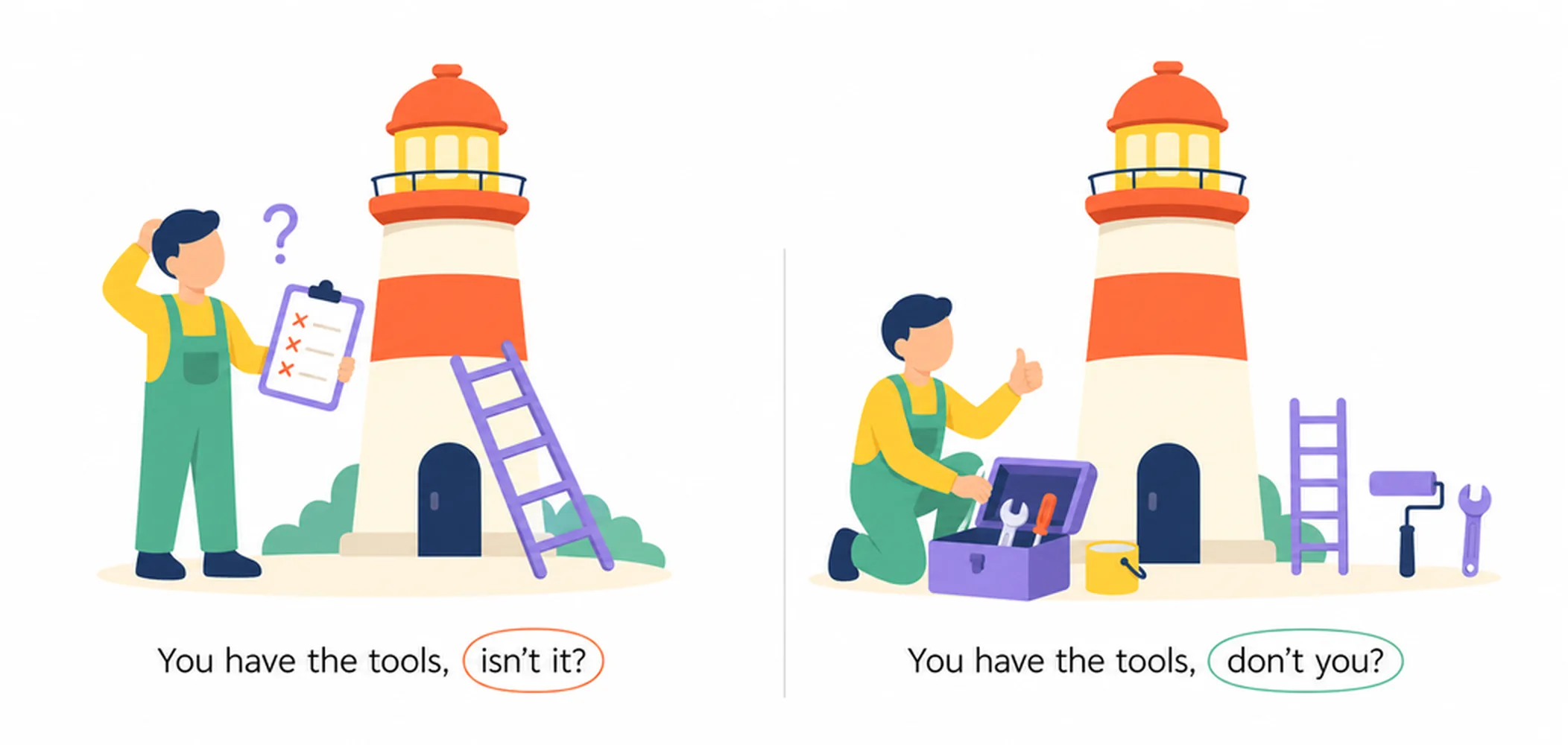
Why Question Tags Are Tricky
Question tags are short questions at the end of a sentence. Many A2 learners make mistakes because the tag grammar depends on the main sentence. The tag must match the verb and be opposite in meaning. This is confusing at first, but with practice it becomes easy. Let's look at the most common mistakes.
Common Mistakes vs. Correct Question Tags
| Category | Incorrect (A2 Learner Error) | Correct Form | Explanation of Error |
|---|---|---|---|
| Wrong auxiliary verb Present Simple (he/she/it) |
She works here, isn't she? | She works here, doesn't she? | Learners incorrectly use be as the auxiliary. Present Simple requires do/does in the question tag, not is/isn't. |
| Wrong auxiliary verb Present Simple (they) |
They play football, aren't they? | They play football, don't they? | A common error: using are/aren't instead of do/don't. The tag must mirror the auxiliary used to form questions in that tense — do for Present Simple. |
| Wrong polarity Positive statement |
You are tired, are you? | You are tired, aren't you? | A positive main clause requires a negative tag. Learners forget to switch polarity and repeat the positive form instead of negating it. |
| Wrong polarity Negative statement |
He doesn't like coffee, doesn't he? | He doesn't like coffee, does he? | A negative main clause requires a positive tag. Learners repeat the negative auxiliary instead of reversing it to the affirmative form. |
| Wrong pronoun Noun to pronoun mismatch |
My sister is a doctor, isn't he? (or using full noun: isn't my sister?) | My sister is a doctor, isn't she? | The tag must use a subject pronoun that matches the noun. Learners sometimes repeat the full noun phrase or choose the wrong gender pronoun. |
| Wrong pronoun "There is/are" constructions |
There is a problem, isn't it? | There is a problem, isn't there? | When the sentence begins with there is/are, the tag must use there, not it. This is a very frequent A2 mistake. |
| Wrong auxiliary verb Past Simple (regular verb) |
You visited Paris, weren't you? | You visited Paris, didn't you? | Past Simple action verbs need did/didn't in the tag. Learners confuse this with was/were, which is only correct when the main verb is be. |
| Wrong auxiliary verb Past Simple (verb "be") |
She was happy, didn't she? | She was happy, wasn't she? | When the main verb is be (was/were), the tag must also use was/were — not did/didn't. Learners over-generalise the did rule. |
| Wrong auxiliary verb Present Continuous |
They are studying, don't they? | They are studying, aren't they? | Present Continuous uses am/is/are as its auxiliary. The tag must echo this auxiliary. Learners incorrectly substitute do/don't from Present Simple habits. |
| Wrong pronoun "Everybody / Everyone" subject |
Everybody knows the answer, doesn't everybody? | Everybody knows the answer, don't they? | Everybody/everyone is singular for the verb (knows) but uses they in the tag — not doesn't it or doesn't he/she. This is an accepted informal rule learners must memorise. |
| Wrong pronoun + polarity Negative subjects: "nobody/nothing" |
Nobody called, didn't they? | Nobody called, did they? | Nobody/nothing/no one act as negative subjects, so the tag must be positive. Learners forget that the negative meaning is already built into the subject word and add another negative in the tag. |
| Wrong auxiliary verb Present Perfect |
You have seen this film, don't you? | You have seen this film, haven't you? | Present Perfect uses have/has as its auxiliary. The tag must repeat this auxiliary. Learners mistakenly use do/don't, confusing it with Present Simple. |
| Irregular tag form "I am" subject |
I am late, amn't I? or isn't I? | I am late, aren't I? | The tag for I am is the irregular form aren't I? — not amn't I (unnatural in most dialects) or isn't I (grammatically wrong). This must be learned as a fixed exception. |
Key Difference — Summary for A2 Learners
- Auxiliary verb rule: The tag must always echo the auxiliary verb of the main clause (e.g., is → isn't, does → doesn't, did → didn't, has → hasn't). Never substitute a different auxiliary.
- Polarity rule: A positive main clause takes a negative tag; a negative main clause takes a positive tag. The only common exception is same-polarity tags used to express surprise or sarcasm (advanced use).
- Pronoun rule: Always replace the subject noun with the correct subject pronoun (he, she, it, they, we, etc.). Special cases: there is → isn't there; everybody → don't they; nobody → did they; I am → aren't I.
Formula
✔ Positive
Subject
+
positive verb
+
...
+
negative auxiliary + subject?
You like coffee, don't you?
✖ Negative
Subject
+
negative verb
+
...
+
positive auxiliary + subject?
She doesn't work here, does she?
Examples

She's coming to the party tonight, isn't she?
Positive sentence + negative tag · Everyday conversation

She doesn't work here, does she?
Negative sentence + positive tag · Seeking confirmation

We can help you, can't we?
Modal verb · Positive sentence + negative tag

They haven't arrived yet, have they?
Present perfect · Negative sentence + positive tag
Signal words
don't
doesn't
didn't
can't
won't
aren't
haven't
hasn't
do
does
did
can
will
are
have
has
Common Mistakes
✕
Wrong
You like coffee, do you?
✓
Correct
You like coffee, don't you?
Use the same auxiliary verb. 'Do' must match 'like' (do you like). Tag is always opposite: positive sentence = negative tag.
✕
Wrong
She doesn't like tea, doesn't she?
✓
Correct
She doesn't like tea, does she?
If the main sentence is negative, the tag must be positive. Both cannot be negative.
✕
Wrong
They are happy, are they?
✓
Correct
They are happy, aren't they?
Positive main sentence = negative tag. Use 'aren't they' not 'are they'.
✕
Wrong
He can swim, can he?
✓
Correct
He can swim, can't he?
Modal verbs like 'can' follow the same rule: positive sentence needs negative tag. Use 'can't he'.
✕
Wrong
I'm late, am I?
✓
Correct
I'm late, aren't I?
For 'I am', use 'aren't I' in the tag, not 'am I'. This is a special exception for first person singular.
✕
Wrong
You walked home, did you walk?
✓
Correct
You walked home, didn't you?
Use the auxiliary verb only (did). Don't repeat the main verb. The tag is always short and simple.
✕
Wrong
They've finished, have they?
✓
Correct
They've finished, haven't they?
Present perfect uses 'have/has'. In a positive sentence, the tag must be negative: 'haven't they'.
KEY TAKEAWAYS
What to Remember
- The question tag must use the same auxiliary verb as the main sentence.
- If the main sentence is positive, the tag must be negative, and vice versa.
- Use the correct pronoun in the tag that matches the subject of the main sentence.
- When there's no auxiliary verb, use "do," "does," or "did" depending on the tense.
- The tag always has a different meaning from the main sentence (opposite polarity).