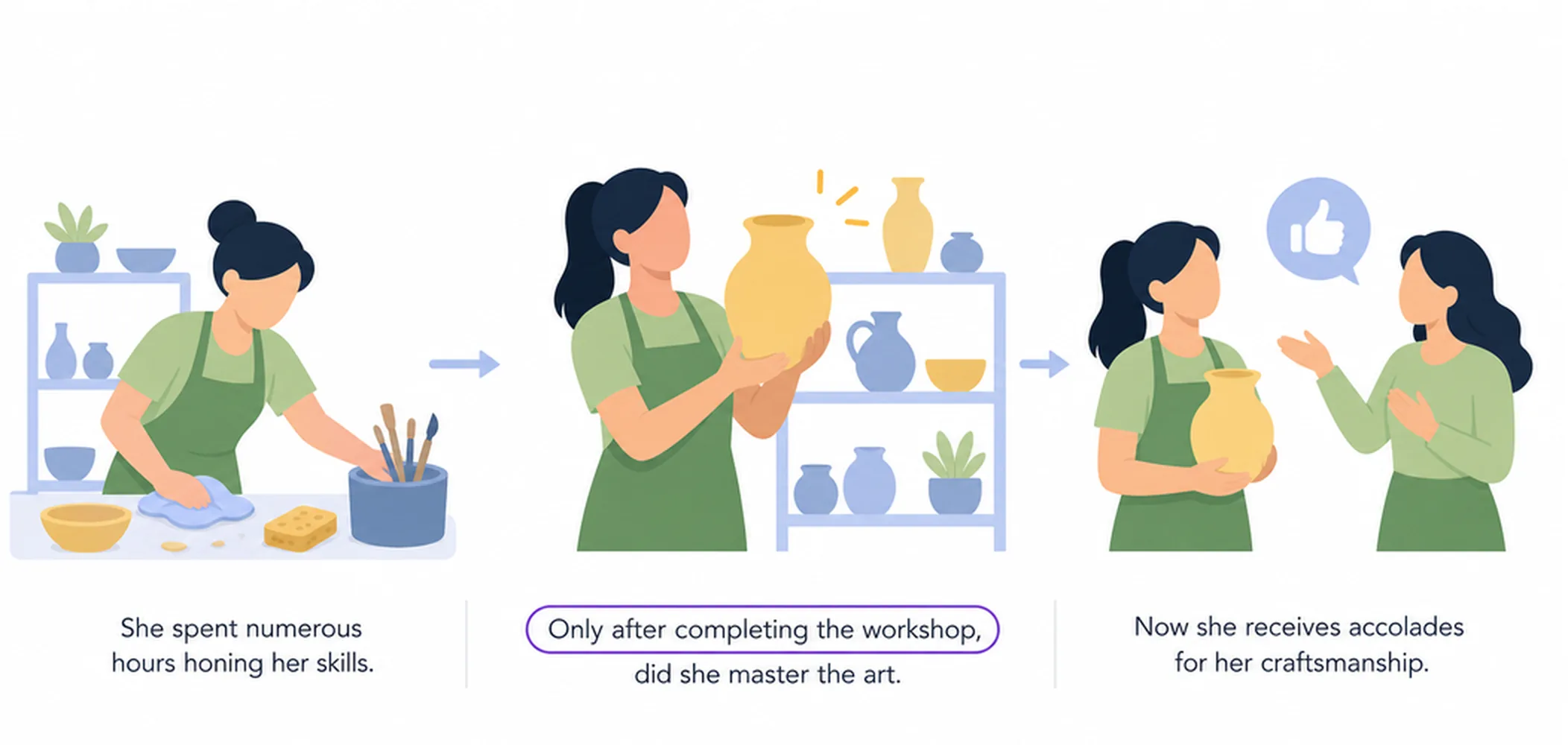
What is Inversion After Only + Time Expression?
Inversion is a word order change used for emphasis. When we put 'only' before a time expression at the start of a sentence, we often flip the position of the subject and auxiliary verb. This creates emphasis and makes the timing sound important or surprising. For example, instead of saying 'I understood the problem only after he explained it,' we can say 'Only after he explained it did I understand the problem.' The inversion makes the time expression stand out.
When and Why to Use This Structure
We use inversion after 'only' + time expression to emphasize how late something happened or how limited the time was. This structure is common in written English and formal speaking. It shows that the timing was unexpected, surprising, or important. Common time expressions that trigger this inversion include: 'only after,' 'only when,' 'only by,' 'only then,' and 'only later.' Without inversion, the meaning stays the same, but the emphasis disappears.
How to Form the Inversion
The pattern is simple: put 'only' + time expression at the start, then move the auxiliary verb (do, did, have, has, can, could, will, would) before the subject. If there is no auxiliary verb in the original sentence, you must add 'do' or 'did.' For example: normal order is 'She finally understood only after the meeting.' Inverted order is 'Only after the meeting did she finally understand.' Notice that the main verb stays in its base form or past participle form.
Only + Time Expressions That Trigger Inversion
| Trigger | Typical Context | Inverted Pattern | Example | Note |
|---|---|---|---|---|
| Only after | Sequence of events; one action follows another | Only after + noun/clause + aux + subject + verb | Only after the meeting did she relax. | Subordinate clause uses normal order; inversion in main clause only |
| Only when | Conditional or temporal condition; restricts circumstances | Only when + clause + aux + subject + verb | Only when the bell rang did the students leave. | Common in formal writing and conditional statements |
| Only then | Refers back to a previously stated moment or condition | Only then + aux + subject + verb | Only then did I understand the truth. | Stands alone at the start; no subordinate clause follows the trigger |
| Only later | Delayed realisation or action; retrospective emphasis | Only later + aux + subject + verb | Only later did we realise the mistake. | Often paired with narrative or reflective past tense |
| Only by | Means or method; the sole way to achieve a result | Only by + gerund/noun phrase + aux + subject + verb | Only by working hard can you succeed. | Gerund (-ing) form is most common after only by |
| Only once | Single occurrence as the necessary condition for a result | Only once + clause + aux + subject + verb | Only once had he visited the city before. | Can introduce a subordinate clause or stand alone as a frequency adverb |
| Only now | Present realisation; something understood or happening at this moment | Only now + aux + subject + verb | Only now do I see how wrong I was. | Typically used with present simple or present perfect |
| Only in + time NP | Specific time period as the sole context for an event | Only in + time phrase + aux + subject + verb | Only in the 20th century did air travel become common. | Common in historical or academic writing |
Examples




What to Remember
- Use inversion after 'only' + time expression at the sentence start for emphasis.
- Flip the subject and auxiliary verb: 'Only after X did/was I...' not 'Only after X I was...'
- The auxiliary verb moves before the subject to create the inverted structure.
- Inversion makes the timing sound important, surprising, or worthy of special attention.
- Without the auxiliary verb, inversion is impossible; you cannot invert with main verbs alone.