Why Do Learners Make Inversion Mistakes?
Inversion—changing the normal word order of a sentence—is tricky because English doesn't always follow Subject-Verb-Object order. Learners often forget to invert when they should, or invert incorrectly because they apply rules from their native language. The most common problems happen with questions, negative adverbs, and emphatic structures. Understanding these patterns will help you sound more natural and grammatically correct.
Correct vs. Incorrect Inversion: Side-by-Side Comparison
| Incorrect Inversion | Corrected Form |
|---|---|
| Mistake Type 1: Questions — Wrong Auxiliary Order | |
| Where he is going? | Where is he going? |
| What she has done? | What has she done? |
| Why you are crying? | Why are you crying? |
| How long they have been waiting? | How long have they been waiting? |
| Mistake Type 2: Negative Adverbs — Missing or Misplaced Auxiliary | |
| Never I have seen such chaos. | Never have I seen such chaos. |
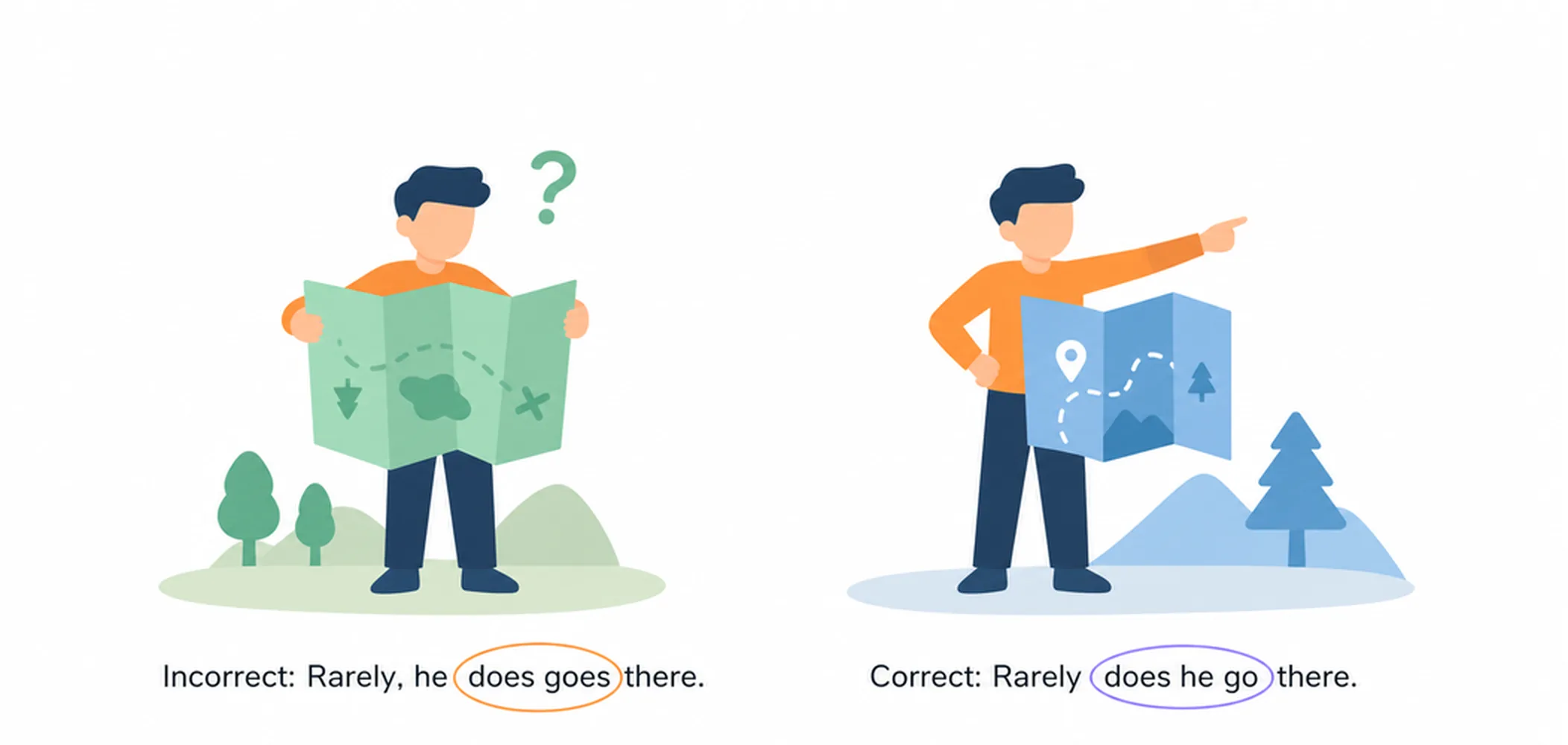
| Rarely she speaks in public. | Rarely does she speak in public. |
| Seldom they visited their relatives. | Seldom did they visit their relatives. |
| Hardly he had sat down when the phone rang. | Hardly had he sat down when the phone rang. |
| No sooner she had arrived than trouble started. | No sooner had she arrived than trouble started. |
| Not only he lied, but he stole too. | Not only did he lie, but he stole too. |
| Little we knew about the danger ahead. | Little did we know about the danger ahead. |
| Mistake Type 3: Emphatic Structures — Only / So / Such | |
| Only then I realised my mistake. | Only then did I realise my mistake. |
| Only by working hard you will succeed. | Only by working hard will you succeed. |
| So tired she was that she fell asleep immediately. | So tired was she that she fell asleep immediately. |
| Such her talent was that everyone applauded. | Such was her talent that everyone applauded. |
| So quickly he ran that no one could catch him. | So quickly did he run that no one could catch him. |
| Mistake Type 4: Conditional Inversion — Omitting or Misusing Auxiliary | |
| Were he would know, he'd tell you. (mixing structures) | Were he to know, he'd tell you. (or: If he knew…) |
| Had I will know earlier, I would have helped. | Had I known earlier, I would have helped. |
| Were she is more careful, she wouldn't make errors. | Were she more careful, she wouldn't make errors. |
| Mistake Type 5: Reported Speech / Narrative Inversion — Applying Inversion Incorrectly | |
| "I'm exhausted," did she say. | "I'm exhausted," she said. (No inversion needed in reporting clauses) |
| He asked where did she live. | He asked where she lived. (Indirect questions use normal word order) |
| She wondered what was he thinking. | She wondered what he was thinking. (No inversion in embedded questions) |
| I don't know why is he upset. | I don't know why he is upset. (Indirect/embedded clause = no inversion) |
| Mistake Type 6: Place / Direction Inversion — Pronoun vs. Noun Subject Confusion | |
| Here comes it. (inverted incorrectly) | Here it comes. (Pronouns do NOT invert with place adverbs) |
| There goes he. (inverted incorrectly) | There he goes. (Pronoun subjects stay before the verb) |
| Down the river flows gracefully. (inversion missed with noun subject) | Down flows the river gracefully. (Noun subjects DO invert with directional adverbs) |
| Out the cat runs to the garden. (inverted form required) | Out ran the cat. (Verb precedes noun subject after directional adverb) |
Inversion (reversing the normal subject–verb order) is required in direct questions but forbidden in indirect/reported questions. With negative and restrictive adverbs (never, rarely, hardly, no sooner, not only, little, only) at the start of a main clause, inversion is obligatory: insert do/does/did for simple tenses, or move the existing auxiliary before the subject. Emphatic fronting with so, such, only, and conditional structures (had, were, should) replacing if also demand inversion. The single most widespread error is failing to insert a dummy auxiliary when the verb has no auxiliary of its own. A second major error is applying inversion inside embedded clauses (reported speech, indirect questions, noun clauses) where normal word order must be restored.
Examples



What to Remember
- Invert the subject and auxiliary verb in questions: "Do you understand?" not "You do understand?"
- Place negative adverbs like never, rarely, and seldom at the sentence start, then invert: "Never have I seen this."
- Don't invert after that-clauses or in reported speech, even with negative adverbs or emphatic structures.
- Use inversion with only, hardly, and scarcely at the start for emphasis: "Only then did I realize."
- Remember inversion applies to the auxiliary verb, not the main verb: "Have you finished?" not "Finished you?"