What is Inversion?
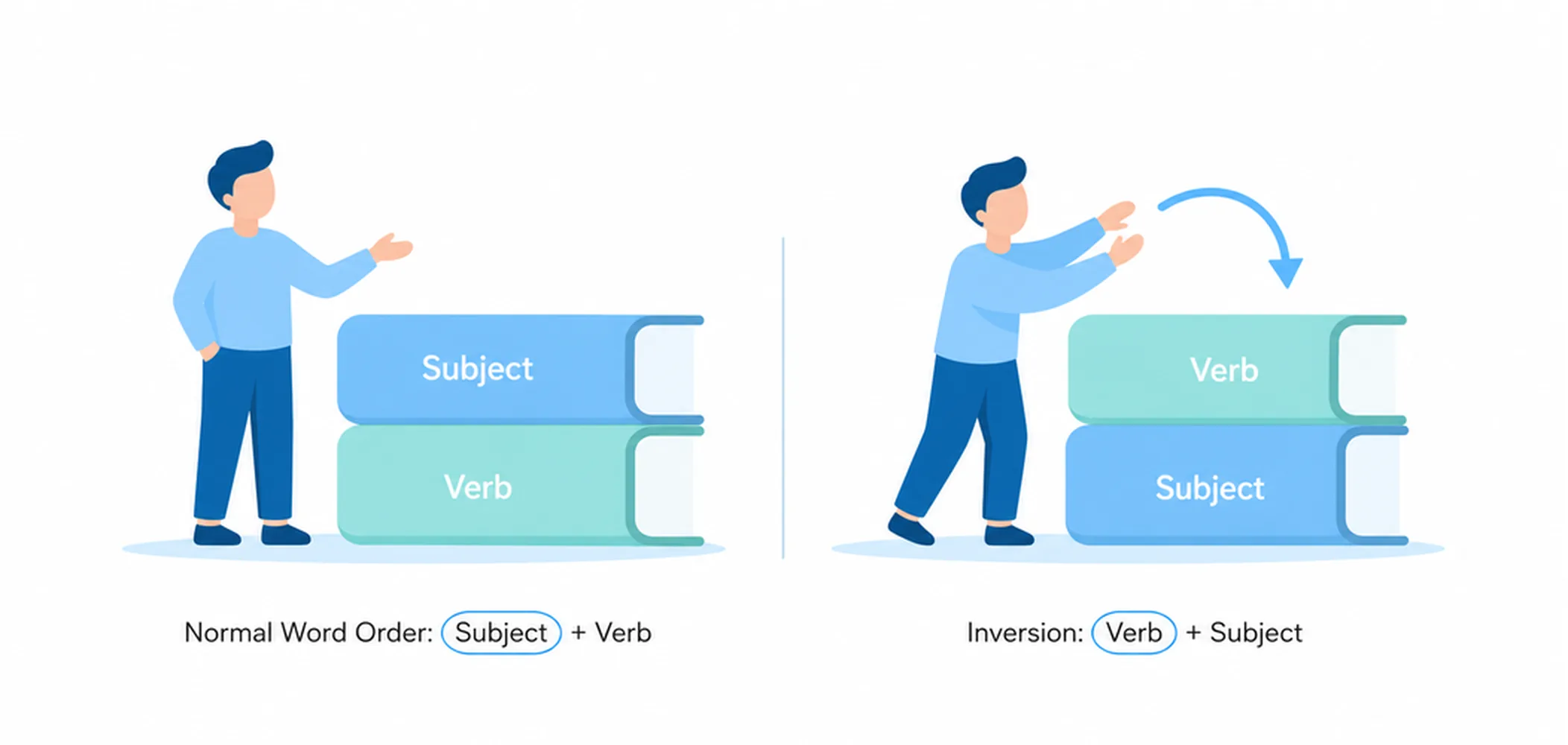
Inversion is a change in the normal word order of a sentence. In English, the typical order is Subject + Verb + Object (SVO). When we invert, we change this pattern by moving the verb or other elements to the beginning of the sentence. This technique is used to create emphasis, add drama, or focus attention on a particular part of the sentence. Inversion is common in both written and spoken English, especially in formal contexts or for stylistic effect.
Key Characteristics
There are several types of inversion in English. The most common is "auxiliary inversion," where we move an auxiliary verb (such as "do," "have," or "be") before the subject. For example: "Never have I seen such a beautiful sunset" instead of "I have never seen such a beautiful sunset." Another type is "full inversion," where the entire verb phrase moves before the subject, often used with adverbs of place or time. For instance: "At the top of the hill stood an old castle" instead of "An old castle stood at the top of the hill." Understanding when and how to use inversion helps you write with more variety and emphasis.
Normal Word Order vs. Inverted Word Order
| Feature | Standard SVO Order | Question Inversion | Negative Adverbial Inversion | Conditional Inversion | Place / Time Adverbial Inversion |
|---|---|---|---|---|---|
| Form | Subject + Verb + Object / Complement (e.g., She has finished the work.) |
Auxiliary / Modal + Subject + Main Verb (e.g., Has she finished the work?) |
Negative Adverbial + Auxiliary + Subject + Main Verb (e.g., Never has she worked so hard.) |
Auxiliary + Subject + Main Verb (replaces "if") (e.g., Had she known, she would have called.) |
Adverbial of Place / Time + Verb + Subject (e.g., On the table sat a cat.) |
| When to Use | Default word order used in statements, most everyday writing and speech. | Forming yes/no and wh- questions in all tenses; introducing indirect speech questions in formal writing. | Emphasising a negative or restrictive adverbial; common in formal, literary, or rhetorical contexts. | Replacing the "if" clause in formal or written conditionals (types 2, 3, and mixed); adds a sophisticated tone. | Giving prominence to a location or time, especially with intransitive verbs; frequent in narrative and descriptive writing. |
| Positive Example | The children are playing in the garden. A bird sat on the fence. |
Are the children playing in the garden? Where did the bird sit? |
Only rarely does she agree with him. Seldom have we seen such talent. |
Should you need help, call me. (= If you should need help…) Were I you, I would apologise. |
On the fence sat a bird. Here comes the bus. |
| Negative Example | She has never lied to me. He did not realise the danger. |
Has she never lied to you? Didn't he realise the danger? |
Never has she lied to me. Not once did he realise the danger. |
Had he not acted quickly, the situation would have worsened. (= If he had not acted…) | Nowhere could she find her keys. Not here does the story end. |
| Question Example | N/A — standard order does not form questions on its own; a rising intonation in speech may imply a question informally. | Can you speak French? Did they arrive on time? What has she decided? |
Not applicable as a direct question form, but the inverted structure itself carries strong emphatic force similar to a rhetorical question: "Little did they know, did they?" |
Not a question form; however, the auxiliary-first structure can resemble a question and is sometimes confused with one: "Were I to resign…" is a conditional, not a question. |
Not used to form direct questions; purely a declarative structure that shifts focus to the adverbial: "There goes my chance!" |
| Key Signal Words | No special signal words — subject simply comes first before the verb in every clause. | Question mark; wh- words (what, where, when, why, how); yes/no question auxiliaries (do, does, did, is, are, was, were, have, has, had, can, could, will, would, shall, should, may, might, must). | Never, rarely, seldom, hardly, barely, scarcely, little, not only…but also, not until, no sooner…than, only after, only when, on no account, under no circumstances, in no way, at no time, not once. | Should, were, had at the start of the clause (without "if"); often followed by a result clause with would, could, or might. | Prepositional phrases of place (on the shelf, in the corner, across the road); directional adverbs (here, there, away, out, up, down, along, off); intransitive or "motion" verbs. |
| Register / Formality | Neutral — suits all registers from casual conversation to academic writing. | Neutral to formal — essential in all spoken and written English to form grammatical questions. | Formal / literary — rarely used in casual conversation; common in speeches, essays, journalism, and fiction for dramatic effect. | Formal / written — typical of academic, legal, and business English; avoids the more colloquial "if" conjunction. | Neutral to literary — "Here comes the bus" is everyday; "Down the hill rolled the boulder" is more narrative and descriptive. |
| Key Difference: In standard SVO order, the subject always precedes the verb and no special emphasis is created. Question inversion is obligatory and grammatical — it is the only way to form a direct question in English. Negative adverbial inversion is optional but powerful: moving a negative or restrictive adverb to the front of the sentence forces subject-auxiliary inversion and intensifies emphasis, making it a stylistic choice. Conditional inversion is also optional, replacing the subordinating conjunction "if" with an inverted auxiliary to create a more formal, concise conditional clause. Place and time adverbial inversion shifts the reader's or listener's attention onto a location or direction, typically with intransitive verbs, and is most common in narrative writing. The unifying principle across all four types is the same: the auxiliary (or main verb "be") moves to a position before the subject, altering the neutral SVO sequence for grammatical necessity, emphasis, formality, or stylistic effect. | |||||
Examples






What to Remember
- Inversion moves the verb or other elements to the beginning of a sentence for emphasis.
- The normal English word order is Subject + Verb + Object, which inversion changes.
- Inversion is often used in formal writing, questions, and sentences starting with negative words.
- Common inversion patterns include questions (V + S), negatives (Never have I...), and conditionals.
- Be careful: inversion changes meaning and formality, so use it intentionally for dramatic effect.