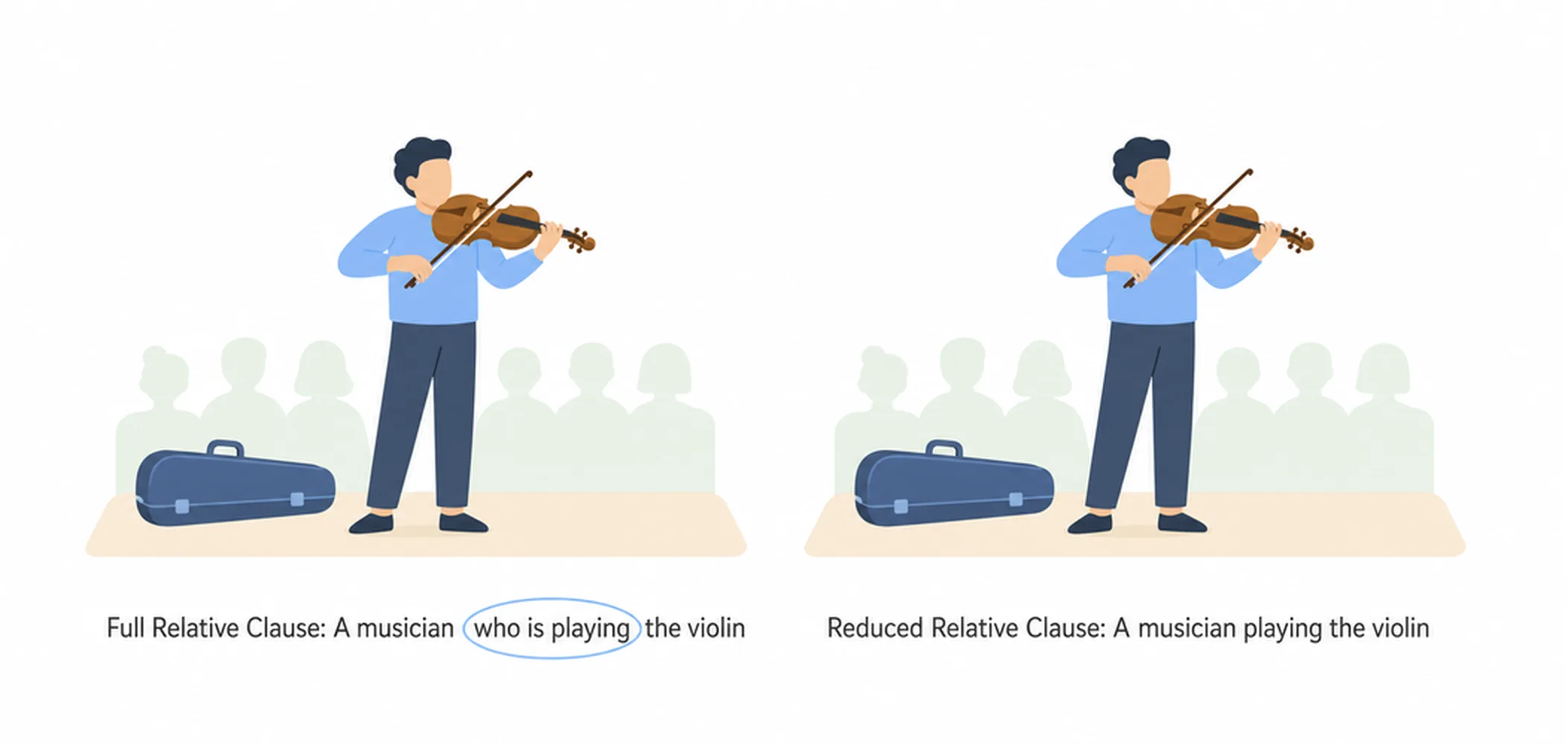
What Are Reduced Relative Clauses?
A reduced relative clause is a shorter way to write a relative clause. Instead of using the full relative clause with a relative pronoun (who, which, that) and a verb, we remove these words to make the sentence simpler and more concise. Reduced relative clauses are very common in English, especially in writing and formal speech. They help us communicate more efficiently without changing the meaning of the sentence.
How to Form Reduced Relative Clauses
There are two main ways to reduce a relative clause. First, you can remove the relative pronoun (who, which, that) and the auxiliary verb (is, are, was, were) when you have a continuous form. For example: 'The woman standing in the corner is my teacher' comes from 'The woman who is standing in the corner is my teacher.' Second, you can remove the relative pronoun and use the past participle when describing something that happened before. For example: 'The letter sent yesterday was important' comes from 'The letter that was sent yesterday was important.'
When to Use Reduced Relative Clauses
Reduced relative clauses are most useful when you want to make your writing more natural and easier to read. You can use them in formal writing like essays and reports, or in casual conversation. However, not all relative clauses can be reduced. You must be able to remove the relative pronoun and auxiliary verb without losing the meaning. If the sentence becomes confusing or unclear after reduction, keep the full relative clause instead.
Full vs. Reduced Relative Clauses: Side-by-Side Comparison
| Category | Full Relative Clause | Reduced Relative Clause |
|---|---|---|
| Form (Active) | Noun + who/that/which + is/are/was/were + present participle (-ing) e.g. who/that is running |
Noun + present participle (-ing) Remove the relative pronoun and auxiliary verb. e.g. running |
| Form (Passive) | Noun + who/that/which + is/are/was/were + past participle (-ed) e.g. which was built |
Noun + past participle (-ed) Remove the relative pronoun and be auxiliary verb. e.g. built |
| When to Use | Used in all registers — formal and informal — to add descriptive information about a noun using a full clause with a subject and verb. | Used when the subject of the relative clause is the same as the noun being modified. Common in formal writing and academic English to create concise, fluent prose. |
| Positive Example (Active) | The man who is sitting by the window is my uncle. The students who were waiting in the hall looked nervous. |
The man sitting by the window is my uncle. The students waiting in the hall looked nervous. |
| Positive Example (Passive) | The bridge that was built in 1920 is still in use. The documents that were signed yesterday are missing. |
The bridge built in 1920 is still in use. The documents signed yesterday are missing. |
| Negative Example | Anyone who does not hold a ticket cannot enter. The package that was not delivered is still at the warehouse. |
Anyone not holding a ticket cannot enter. The package not delivered is still at the warehouse. (Note: Place "not" directly before the participle.) |
| Question Example | Do you know the woman who is talking to the director? Can you find the report that was submitted last week? |
Do you know the woman talking to the director? Can you find the report submitted last week? |
| What Is Removed | Nothing is removed — the relative pronoun (who, that, which) and the auxiliary verb (is, are, was, were) are both present. | Active: Remove relative pronoun + be auxiliary → keep -ing form. Passive: Remove relative pronoun + be auxiliary → keep past participle (-ed/-en). |
| Key Signal Words | who, whom, whose, which, that followed by a conjugated verb form. Examples: who is, which are, that was, who were |
A participle placed directly after the noun with no pronoun or auxiliary. Active signals: -ing words (running, speaking, holding) Passive signals: -ed/-en words (built, written, signed, damaged) |
| Common Mistakes | Using a full clause when the context is formal and a reduced clause would sound more natural and academic. | Forgetting to remove both the pronoun and the auxiliary. Using the reduced form when subjects differ (e.g. the car hit the man walking to the shop — ambiguous). Using -ing for passive meaning (incorrect: the letter writing; correct: the letter written). |
Examples






What to Remember
- Reduced relative clauses shorten sentences by removing the relative pronoun and auxiliary verb.
- You can reduce clauses with who/which + be verb by deleting both words.
- Remove only the relative pronoun when the verb is active (not a be-verb).
- Reduced relative clauses are common in writing and formal speech for conciseness.
- The meaning stays the same after reduction; only the structure becomes simpler.