Understanding When, While, and As
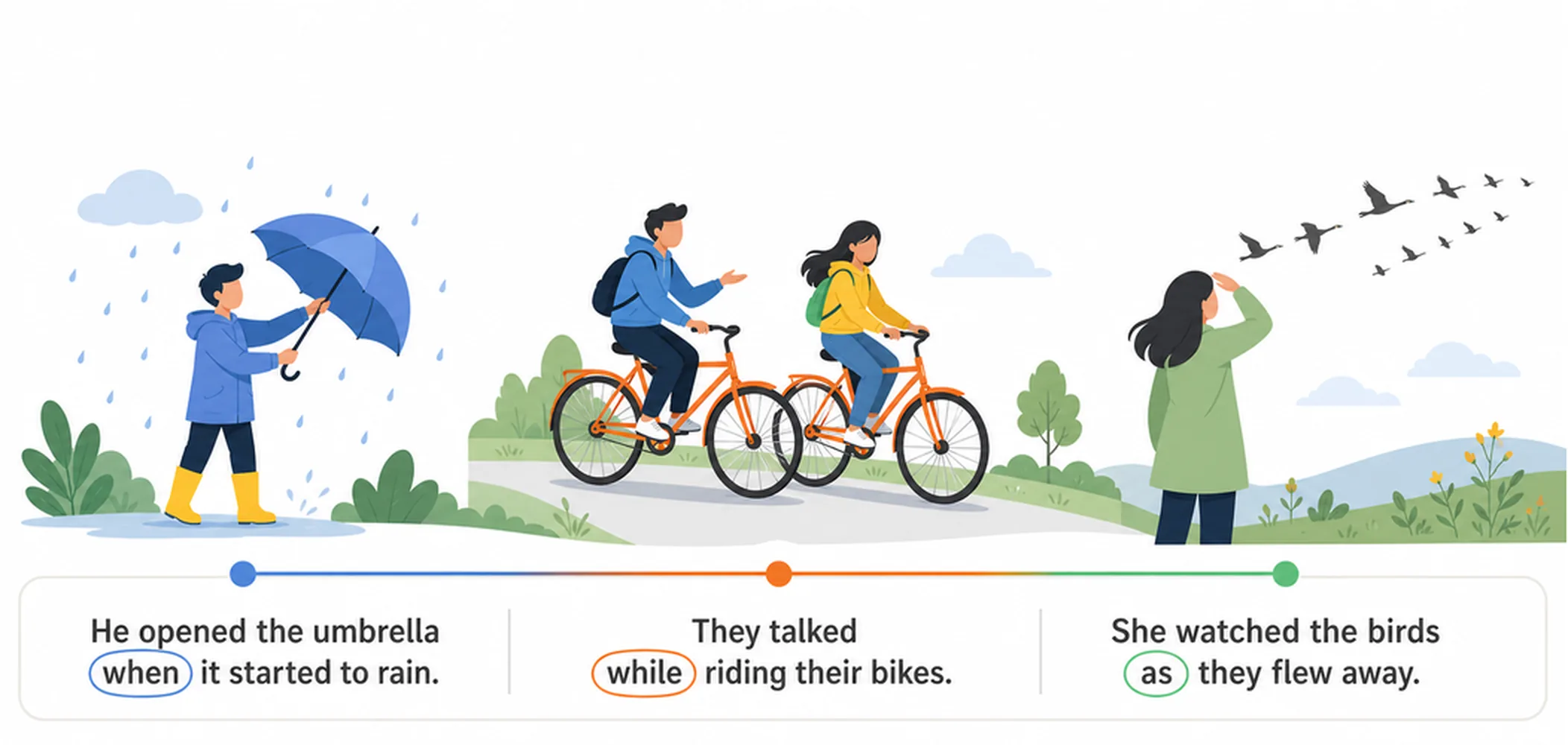
These three conjunctions all introduce time clauses, but they have different uses. When shows that one action happens at a specific moment or after another action. While describes two actions happening at the same time and suggests they overlap. As means 'during the time that' or 'at the moment that,' and can also mean 'because' in some contexts. Choosing the right one depends on whether actions happen at the same time, one after another, or at a specific moment.
When: Specific Moments or Sequence
Use when to talk about a specific moment in time or to show that one action happens after another. When focuses on the timing of an event, not how long it lasts. It is the most common and flexible of the three conjunctions.
While: Actions Happening Together
Use while when two actions happen at the same time. While emphasizes that both actions are ongoing and overlapping. The actions usually have the same duration or happen together during a period. While cannot be used to show one action happens after another.
As: Simultaneous or Causal Time
Use as to show that two actions happen at the same time, similar to while. However, as often suggests that one action happens because of or at the exact moment of another. As can also mean 'because' depending on context, which makes it less common in time clauses for beginners. It is more formal than when or while.
Quick Choice Guide
Remember: When = one action happens, then another (or at a specific moment). While = two actions at the same time. As = similar to while, but more formal and can mean 'because.' For B1 learners, focus on when and while first—they are more common and easier to use correctly.
When vs While vs As: Side-by-Side Comparison
| Dimension | When | While | As |
|---|---|---|---|
| Basic Meaning | At the time that; at the moment when a specific event occurs or occurred | During the time that; throughout the period that two actions overlap | At the same time as; used to show two actions developing or happening together simultaneously |
| Action Type | Sequential or simultaneous; one action typically triggers or follows another (point-in-time event) | Simultaneous only; both actions are ongoing and happening in parallel over a period | Simultaneous and progressive; two actions unfold at exactly the same moment, often both changing |
| Duration Focus | Short or instantaneous moments; can refer to habitual or repeated events; no strong sense of ongoing duration | Strong emphasis on duration; the background action is extended and continuous | Focuses on two things progressing together; often used with gradual or developing actions |
| Typical Verb Forms Used | Simple tenses (past simple, present simple, future); also used with past continuous as background | Continuous/progressive tenses strongly preferred (e.g., was working, is reading) | Continuous/progressive tenses; also used with verbs of gradual change (grew, became, got) |
| Can Express Cause | Rarely; "when" is primarily temporal, not causal | No; "while" is strictly temporal and can also express contrast between two actions | Yes; "as" can carry a causal meaning (e.g., "As it was raining, we stayed inside"), similar to "because" or "since" |
| Can Express Contrast | No; not used for contrast | Yes; "while" can contrast two simultaneous but opposing situations (e.g., "She is talkative while he is quiet") | Occasionally; less common than "while" for contrast |
| Formality Level | Neutral; suitable for both formal and informal contexts | Neutral to slightly formal; common in both spoken and written English | Slightly formal or literary; more common in written English; the causal use is more formal |
| Positive Example | "When the phone rang, she answered it immediately." | "While I was cooking dinner, my brother was watching TV." | "As she walked into the room, everyone turned to look." |
| Negative / Incorrect Use Example | ❌ "When I was studying, he was playing games." (possible but weak; "while" is preferred for parallel background actions) | ❌ "While the phone rang, she answered it." (incorrect; ringing is a point event, not a background duration — use "when") | ❌ "As I was a child, I loved cartoons." (incorrect; "as" cannot refer to a long life stage — use "when") |
| Question / Interrogative Use | "When did you arrive?" / "Can you call me when you're ready?" — very common in questions | "What were you doing while I was away?" — used in questions about parallel past actions | "What happened as the storm approached?" — less common in direct questions; more narrative |
| Key Signal Words / Contexts | A specific moment; a trigger event; habitual/repeated actions; point in time; "at the time that" | Two ongoing actions; background activity; contrast between two states; extended period; "during the time that" | Simultaneous development; gradual change; cause-and-effect; narrative progression; "at the very moment that" |
| Common Mistakes | Using "when" with continuous parallel actions when "while" is more natural; using "when" with gradual development where "as" fits better | Using "while" with short instantaneous events; confusing its contrast function with "whereas" in formal writing | Using "as" for long periods of time (e.g., childhood, years); overusing it in spoken English where "when" or "while" is more natural |
| 🔑 Key Difference: Use when for a specific point in time or a trigger moment (often with simple tenses). Use while to emphasise two extended, simultaneous actions happening in parallel (preferred with continuous tenses), or to contrast two situations. Use as when two actions are developing or unfolding at exactly the same moment — often with a sense of progression, change, or cause — and note that "as" is the only one of the three that can carry a clear causal meaning similar to "because." | |||
Examples





What to Remember
- Use when for actions at a specific moment or one action following another.
- Use while for two actions happening simultaneously with an emphasis on overlap.
- Use as to mean 'during the time that' or 'at the moment that.'
- Remember that as can mean 'because,' which may confuse its time conjunction function.
- Choose your conjunction based on whether actions overlap, happen together, or occur sequentially.