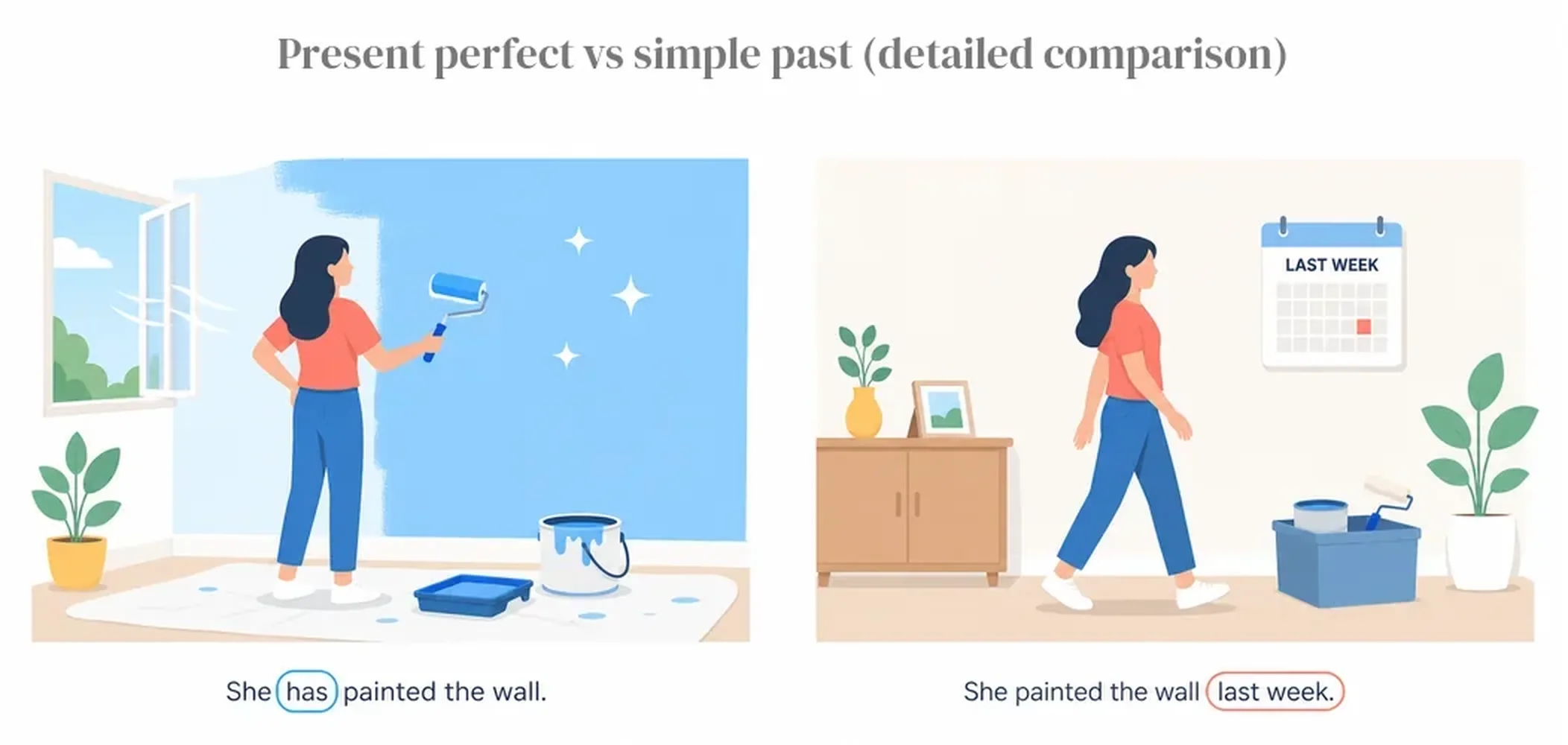
The Key Difference
The present perfect and simple past are both used for completed actions, but they focus on different things. The simple past describes finished actions at a specific time in the past (yesterday, last week, in 2019). The present perfect describes actions completed recently or at an unspecified time—and the result matters now. Think of it this way: simple past closes the door on the past. Present perfect keeps a connection to the present.

When to Use Each Tense
Use the simple past when you mention a specific time (last month, at 3 PM, in 1995) or when the time is clear from context. Use the present perfect when there is no specific time mentioned, when the action affects the present situation, or when you're talking about your experience up to now. The present perfect is common with time expressions like 'yet', 'already', 'just', 'ever', and 'never'.
Present Perfect vs Simple Past: Side-by-Side Comparison
| Dimension | Present Perfect | Simple Past |
|---|---|---|
| Form | Subject + have/has + past participle (e.g., have eaten, has gone, have seen) |
Subject + past tense verb (regular: verb + -ed; irregular: learned individually) (e.g., ate, went, saw) |
| When to use |
• Actions at an unspecified time in the past with present relevance • Experiences in one's lifetime • Actions that started in the past and continue to the present • Recent events whose results are still felt now |
• Completed actions at a specific, known point in the past • A sequence of finished past events • Situations that existed for a period but are now over • Historical facts with a defined time frame |
| Time reference | Unspecified or ongoing — the exact time is unknown, unimportant, or extends to now | Specific and finished — the time is known, stated, or clearly implied |
| Connection to present | Strong — the action or its result is linked to the present moment | Weak or none — the action is viewed as completely finished and detached from now |
| Positive example | She has visited Paris three times. (We don't know exactly when; it's part of her life experience.) |
She visited Paris in 2019. (The specific year is given; the trip is complete.) |
| Negative example | They haven't finished the project yet. (Still ongoing; the deadline may still apply.) |
They didn't finish the project last week. (A specific past period is referenced.) |
| Question example | Have you ever tried sushi? (Asking about life experience, no specific time.) |
Did you try sushi at that restaurant last night? (Asking about a specific past occasion.) |
| Key signal words | already, yet, just, ever, never, recently, lately, so far, up to now, since, for, this week/month/year, it's the first time… | yesterday, last night/week/month/year, ago, in [year], on [date], at [time], when I was…, once, that day, in the past |
| 🔑 Key Difference: Use the present perfect when the focus is on the result, experience, or relevance of a past action in the present — especially when no specific time is given. Use the simple past when the action is fully completed at a definite, known point in the past and you are simply reporting what happened. A helpful test: if you can naturally add a specific past time expression (e.g., yesterday, in 2010), the simple past is usually correct; if specifying the time feels unnatural or irrelevant, the present perfect is likely the better choice. | ||
Examples






What to Remember
- Use simple past for completed actions at a specific time (yesterday, last week, 2019).
- Use present perfect for recently completed actions or unspecified times with results now.
- Simple past closes the connection to the past; present perfect keeps it open.
- Present perfect requires "have/has" + past participle; simple past uses past tense only.
- Don't use present perfect with specific time expressions like "yesterday" or "last week."