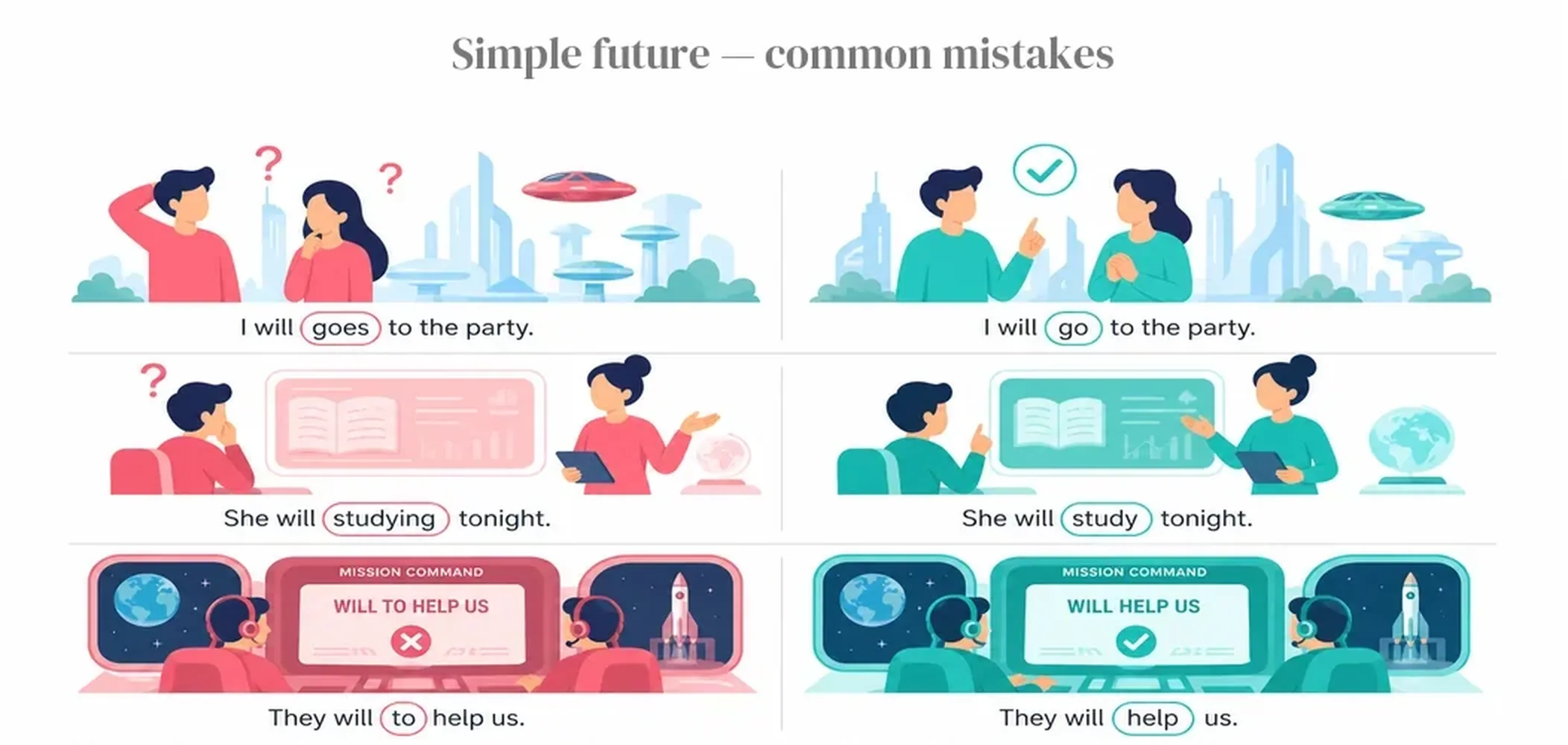
Why do learners make these mistakes?
The simple future in English has two main forms: 'will' and 'going to'. Many A2 learners mix them up because both talk about the future. Some mistakes happen because learners translate directly from their own language, or they forget the grammar rules. This article shows you the most common errors and how to fix them.

Will vs Going To — Common Mistakes at a Glance
| Category | Wrong Form (Common Mistake) | Correct Form | Why It's Wrong / Explanation |
|---|---|---|---|
| Form | Subject + will + to + base verb "She will to go home." "He will to study." |
Subject + will + base verb (bare infinitive) "She will go home." "He will study." |
Will is a modal verb. Modal verbs are always followed directly by the bare infinitive (base verb without to). Adding to after will is a very common error, often caused by confusion with other structures like want to or going to. |
| When to Use | Using will for pre-planned or scheduled future events. "I will see the doctor at 3 pm tomorrow." (appointment already made) "We will have a meeting on Monday." (already arranged) |
Use will for spontaneous decisions, predictions, offers, and promises — not fixed plans. "I'm going to see the doctor at 3 pm tomorrow." "We are having a meeting on Monday." |
For pre-arranged plans and scheduled events, be going to or the present continuous is more natural. Will is best reserved for spontaneous decisions made at the moment of speaking (e.g., "I'll get the door!"), predictions, offers, and promises. |
| Positive Example | "They will goes to the party." "She wills help you." "He will studied tonight." |
"They will go to the party." "She will help you." "He will study tonight." |
The base verb after will never changes. It does not take an -s ending for third person singular, it is not conjugated as wills, and it never takes a past tense form (studied). The form is always will + base verb for all subjects. |
| Negative Example | "I will not to call him." "She won't goes there." "They willn't come." |
"I will not call him." / "I won't call him." "She won't go there." "They won't come." |
The negative is formed with will not or the contraction won't — never willn't (this is not a valid contraction). Again, no to is used before the base verb in negatives, and the base verb does not inflect (no -s, -ed, -ing). |
| Question Example | "Will she goes to school?" "Will they to help us?" "Does he will come?" |
"Will she go to school?" "Will they help us?" "Will he come?" |
Questions are formed by inverting will and the subject: Will + subject + base verb? Do not use do/does as an auxiliary alongside will — will itself acts as the auxiliary. No to or inflected verb form follows. |
| Key Signal Words | Treating signal words as guarantees that will must always be used: "Tomorrow I will meet my friend." (planned arrangement — wrong tense choice) "Next week she will have a flight." (booked flight — wrong tense choice) |
Signal words like tomorrow, next week, soon, in the future, probably, I think, I believe, I'm sure, maybe, perhaps can accompany will for predictions and spontaneous decisions, but context matters. "I think it will rain tomorrow." "I'm meeting my friend tomorrow." (arrangement) |
Time expressions like tomorrow or next week do not automatically require will. The choice of future form depends on the context and speaker's intention (spontaneous decision vs. plan vs. schedule), not just the signal word alone. |
| Key Difference Summary | |||
|---|---|---|---|
| The simple future with will follows one fixed structure: will + bare infinitive (base verb, no to, no inflection) for all subjects and all sentence types (positive, negative, question). The most frequent mistakes are: (1) inserting to after will, (2) inflecting the following verb (-s, -ed, -ing), (3) using do/does as an auxiliary in questions, and (4) using will for pre-arranged plans instead of be going to or present continuous. Remember: will is the auxiliary — it does all the grammatical work, so the main verb stays in its simplest, unchanged form. |
Formula
✔ Positive
Subject
+
will
+
base verb
You will learn English fast.
✖ Negative
Subject
+
will not (won't)
+
base verb
She won't come to the party.
? Question
Will
+
subject
+
base verb
Will you help me with my homework?
Examples

I will buy a new phone next month.
A2 · Spontaneous decision or prediction

They are going to travel to Spain in July because they already booked the hotel.
A2 · Plan or intention with evidence

If you study hard, you will pass the exam.
A2 · Result or consequence · Present tense in 'if' clause

When I arrive at the station, I will call you immediately.
A2 · Future action after a time word · Present tense after 'when'
When to use it
Plans & Intentions
Use 'going to' when you have already decided to do something. You have a plan or evidence.
"I'm going to apply for that job because I have the qualifications."
Spontaneous Decisions
Use 'will' when you decide right now, in the moment, without preparation.
"The phone is ringing! I will answer it."
Predictions
Use 'will' to predict what you think will happen in the future based on your opinion.
"I think your team will win the match tomorrow."
Time & Condition Clauses
Use the present tense after 'when', 'before', 'after', and 'if'. Use 'will' in the main clause.
"When you finish your work, we will go to the park."
Signal words
tomorrow
next week / month / year
in a few days
soon
later
this weekend
tonight
when
if
after
before
I have decided
I have planned
already booked
Common Mistakes
✕
Wrong
I will going to visit my grandma tomorrow.
✓
Correct
I am going to visit my grandma tomorrow.
Don't mix 'will' and 'going to'. Use one form only. 'Am/is/are going to' = plan or intention.
✕
Wrong
She go to the party next week.
✓
Correct
She will go to the party next week.
The simple present 'go' is not future. Add 'will' or 'is going to' for future meaning.
✕
Wrong
Will you going to help me?
✓
Correct
Will you help me? / Are you going to help me?
With 'will', use the base verb form. With 'going to', use the correct auxiliary (am/is/are).
✕
Wrong
I will call you when I will arrive home.
✓
Correct
I will call you when I arrive home.
After 'when', 'before', 'after', use the present tense, not 'will'. The main clause has 'will'.
✕
Wrong
Tomorrow I will be going to the cinema.
✓
Correct
Tomorrow I'm going to go to the cinema.
Don't add 'be' before 'going to'. Use 'am/is/are going to', not 'will be going to'.
✕
Wrong
He will not goes to school.
✓
Correct
He will not go to school.
After 'will not', use the base verb. 'Goes' is present tense and wrong here.
✕
Wrong
What will happen if it will rain tomorrow?
✓
Correct
What will happen if it rains tomorrow?
In conditional sentences with 'if', use present tense in the 'if' clause, not 'will'.
KEY TAKEAWAYS
What to Remember
- Use 'will' for decisions made at the moment of speaking, not planned before.
- Use 'going to' for plans already decided or when you see present evidence of future.
- Don't use 'going to' without the verb 'be' — always say 'is going to', never 'is go to'.
- Use 'will' for predictions about the future with no present evidence or planning.
- Both forms can describe future actions, but 'going to' sounds more certain and planned.