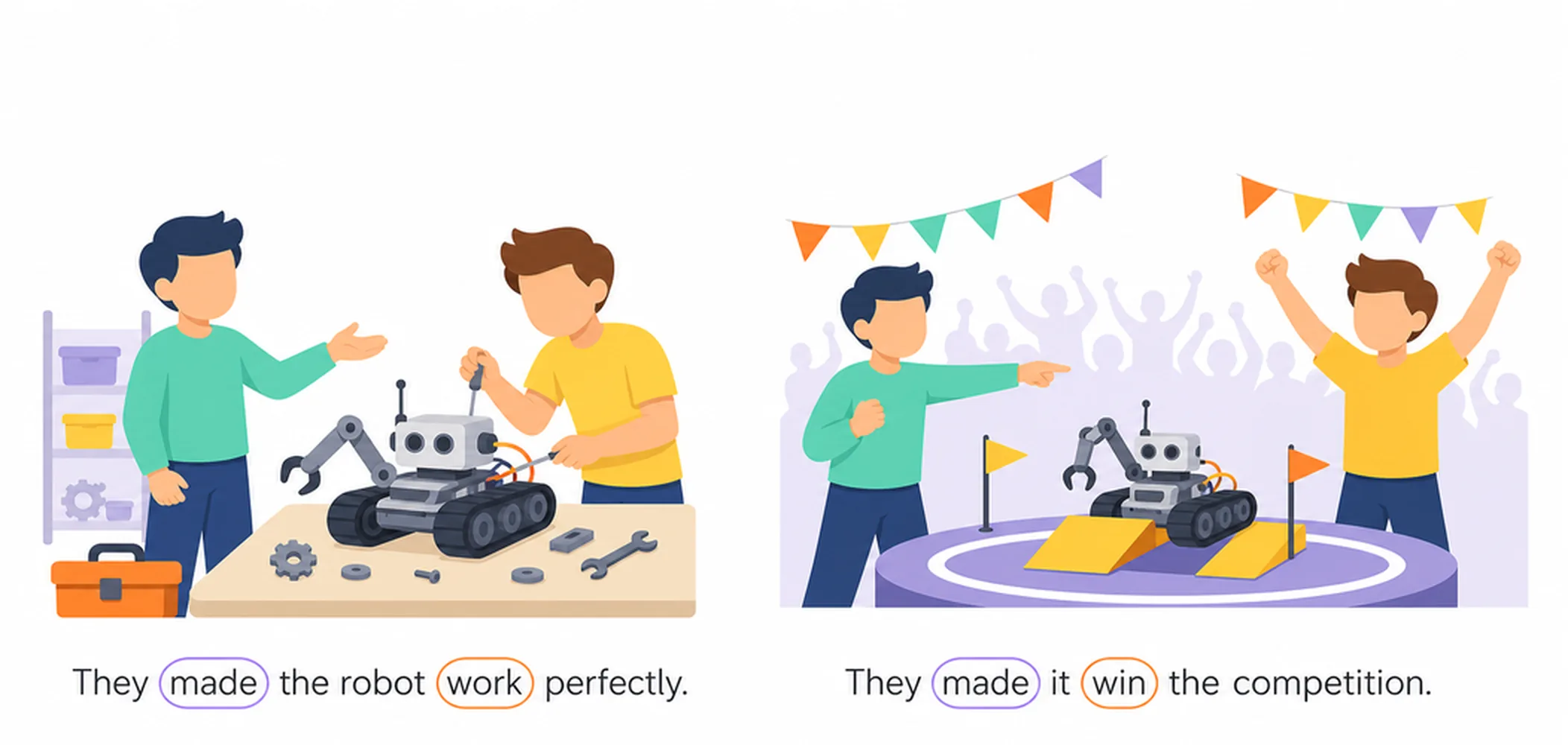
Understanding the Causative 'Make'
The causative construction 'make someone do something' expresses the idea that one person causes, forces, or compels another person to perform an action. This structure is fundamental in English and appears across registers, from conversational to academic. The key distinction is that 'make' emphasises compulsion or necessity—the object has little choice in the matter. This differs significantly from permissive structures (let, allow) or facilitative ones (help, enable), which carry different implications about volition and agency.
Structural Characteristics and Syntax
The causative 'make' takes the form: Subject + make + Object + Base Infinitive (without 'to'). The base infinitive is crucial; using the full infinitive with 'to' is grammatically incorrect in standard English. In passive voice constructions, the infinitive becomes 'to' form: 'She was made to sign the contract.' This shift occurs because the infinitive must attach to a finite verb (be). Active causative sentences focus on the agent's role in compelling the action, while passive constructions emphasise the subject's forced participation or the external pressure applied to them.
Semantic Nuances and Register Considerations
While 'make' fundamentally denotes compulsion, context determines its intensity. 'His parents made him study medicine' suggests parental authority and obligation, whereas 'The documentary made me reconsider my views' indicates persuasive influence without physical force. In professional and academic contexts, 'make' can also express logical inevitability: 'The evidence makes the conclusion inescapable.' At C1 level, understanding these subtle variations prevents misinterpretation and allows more precise expression. Consider also that 'make' is more forceful than synonymous structures; alternatives like 'get someone to do something' or 'have someone do something' imply negotiation or arrangement rather than compulsion.
Make vs. Other Causative Verbs: A Comparison
| Dimension | MAKE | LET | HAVE | GET |
|---|---|---|---|---|
| Form | make + person + bare infinitive (no "to") |
let + person + bare infinitive (no "to") |
have + person + bare infinitive (no "to") |
get + person + to + infinitive ("to" is required) |
| Core Meaning | Force or compel someone to do something; the person may not want to do it | Allow or permit someone to do something; giving permission | Arrange for someone to do something; delegate a task, often in a professional context | Persuade or convince someone to do something; involves more effort than have |
| Degree of Compulsion | 🔴 High — subject has authority or power to force action | 🟢 None — subject removes a restriction; it is an act of permission | 🟡 Neutral — subject arranges or instructs; the other person is expected to comply | 🟠 Moderate — subject must persuade; there may be initial reluctance |
| Subject's Role | Authority figure (parent, boss, law) | Person who controls access or rules | Manager, employer, or person delegating | Anyone who needs to influence or convince |
| Object's Willingness | Often unwilling or indifferent | Willing but was previously restricted | Expected to comply without argument | May be reluctant but is persuaded |
| Positive Example | "The teacher made the students rewrite their essays." | "She let her son stay up late on Friday." | "The manager had the assistant prepare the report." | "He finally got his colleague to cover his shift." |
| Negative Example | "They couldn't make him confess." | "His parents won't let him go to the party." | "She didn't have anyone check the figures." | "I couldn't get him to change his mind." |
| Question Example | "What made you apologise?" | "Did they let you leave early?" | "Did you have someone fix the leak?" | "How did you get her to agree?" |
| Passive Voice | Uses to in passive: "He was made to apologise." |
Rarely used in passive; allow is preferred instead | Passive uses past participle of main verb: "I had my car repaired." |
Passive uncommon; active form strongly preferred |
| Register / Formality | Neutral to formal; also common in everyday speech | Informal to neutral; very common in everyday speech | Neutral to formal; frequent in professional and business contexts | Informal to neutral; implies effort and negotiation |
| Key Signal Words / Synonyms | force, compel, require, oblige, cause | allow, permit, enable, give permission | arrange, delegate, instruct, commission | persuade, convince, talk into, encourage |
| 🔑 Key Difference: Make involves force or compulsion (no "to" in active, but "to" in passive). Let is about granting permission. Have is about arranging or delegating a task with an expectation of compliance. Get implies persuasion and effort, and is the only one of the four that requires "to" before the infinitive in the active form. All four are causative verbs — they express one person causing another to do something — but they differ critically in the relationship, the level of authority, and the degree of willingness involved. | ||||
Examples






What to Remember
- 'Make' + object + base verb (infinitive without 'to') expresses force or compulsion in causative constructions.
- The object of 'make' must perform the action with little or no choice involved.
- 'Make' differs from 'let' (permission) and 'allow' (permission); distinguish based on degree of compulsion.
- In passive voice, the infinitive requires 'to': "She was made to apologize" not "made apologize."
- 'Make' is stronger and more forceful than facilitative verbs like 'help' or 'enable' in tone.