The Core Difference
Infinitives and gerunds are both verb forms, but they function differently in sentences. An infinitive is the base form of a verb preceded by 'to' (to speak, to learn, to run), while a gerund is the -ing form of a verb used as a noun (speaking, learning, running). The key difference: infinitives often express purpose, intention, or future action, whereas gerunds are nouns that refer to actions as things. Many verbs in English require one form or the other, which is why choosing correctly matters for natural, accurate English.
Infinitives: Purpose & Intention
Use infinitives to show why someone does something or what they aim to achieve. Common patterns include 'verb + to-infinitive' with verbs like want, need, hope, decide, and manage.
Gerunds: Actions as Nouns
Gerunds turn actions into nouns. Use them after prepositions, as subjects, or after verbs like enjoy, avoid, finish, and consider. They describe the action itself as a thing or concept.
Memory Trick
Remember: infinitives point forward (purpose, plans, goals), while gerunds are grounded in the present moment (activities you do now). After prepositions (about, for, by, before), always use gerunds, never infinitives.
Infinitive vs Gerund: Side-by-Side Comparison
| Category | Infinitive | Gerund |
|---|---|---|
| Form | to + base verb e.g., to run, to eat, to speak |
base verb + -ing e.g., running, eating, speaking |
| When to Use | Use after verbs expressing desire, intention, plans, or decisions. Also used to express purpose or with adjectives. e.g., want, hope, decide, plan, need, agree |
Use after verbs expressing facts, habits, preferences, or completion. Also used as a subject or after prepositions. e.g., enjoy, avoid, finish, suggest, consider |
| Function in Sentence | Acts as a noun, adjective, or adverb. Often expresses a future or hypothetical action. e.g., "She wants to travel." (noun) "He bought tickets to see the show." (adverb) |
Acts as a noun. Often refers to an existing, real, or habitual action. e.g., "Swimming is healthy." (subject) "She enjoys reading." (object) |
| Position in Sentence | Typically follows certain verbs, adjectives, or nouns; can appear at the start of a sentence as a subject (less common). e.g., "It is important to listen." |
Can appear at the beginning as a subject, after a verb as an object, or after a preposition. e.g., "Listening is important." / "She is good at listening." |
| Positive Example | "I decided to leave early." "She hopes to become a doctor." |
"I enjoy leaving early." "She considered becoming a doctor." |
| Negative Example | "He refused not to sign the contract." "She chose not to answer." Note: "not" is placed before "to" |
"He regretted not signing the contract." "She avoided not answering." Note: "not" is placed before the gerund |
| Question Example | "Do you want to go out tonight?" "Did she agree to help?" |
"Do you enjoy going out?" "Did she mind helping?" |
| Verbs That Require This Form | want, hope, plan, decide, agree, promise, expect, offer, seem, pretend, refuse, manage, tend, fail, need | enjoy, avoid, finish, suggest, consider, keep, mind, admit, deny, recommend, practise, risk, miss, postpone |
| After Prepositions | Infinitives cannot follow prepositions. Incorrect: "She is good at to sing." |
Gerunds must be used after prepositions. Correct: "She is good at singing." "He is interested in learning." |
| Verbs That Change Meaning | "I stopped to smoke." = I paused in order to smoke. "She remembered to call." = She didn't forget to call. "He tried to fix it." = He made an attempt to fix it. |
"I stopped smoking." = I quit the habit. "She remembered calling." = She recalled having called. "He tried fixing it." = He experimented with fixing it. |
| Key Signal Words / Phrases | would like, in order to, too … to, enough … to, the first/last to, it is + adjective + to | look forward to, be used to, get used to, can't help, it's no use, it's worth, there's no point in |
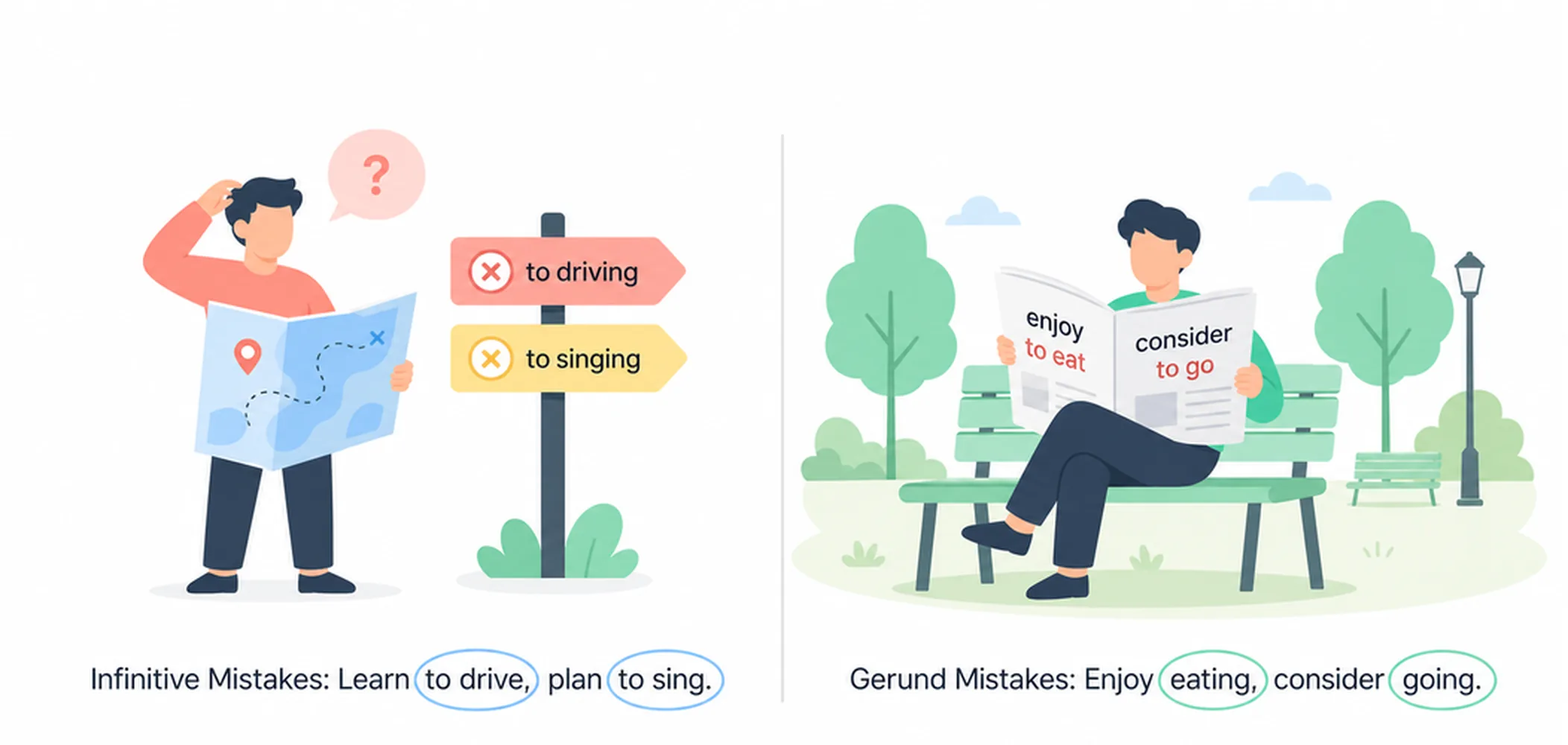
| Common Mistakes | "I want going home." → "I want to go home." "She hopes winning." → "She hopes to win." |
"I enjoy to read." → "I enjoy reading." "She is good at to cook." → "She is good at cooking." |
Examples






What to Remember
- Infinitives use 'to' + base verb and express purpose, intention, or future action.
- Gerunds are -ing forms functioning as nouns that name actions as things.
- Some verbs require infinitives (want, hope, decide), while others require gerunds (enjoy, avoid, finish).
- Certain verbs accept both forms but may change meaning (remember to do vs. remembering doing).
- Always check which form a verb requires rather than relying on intuition alone.