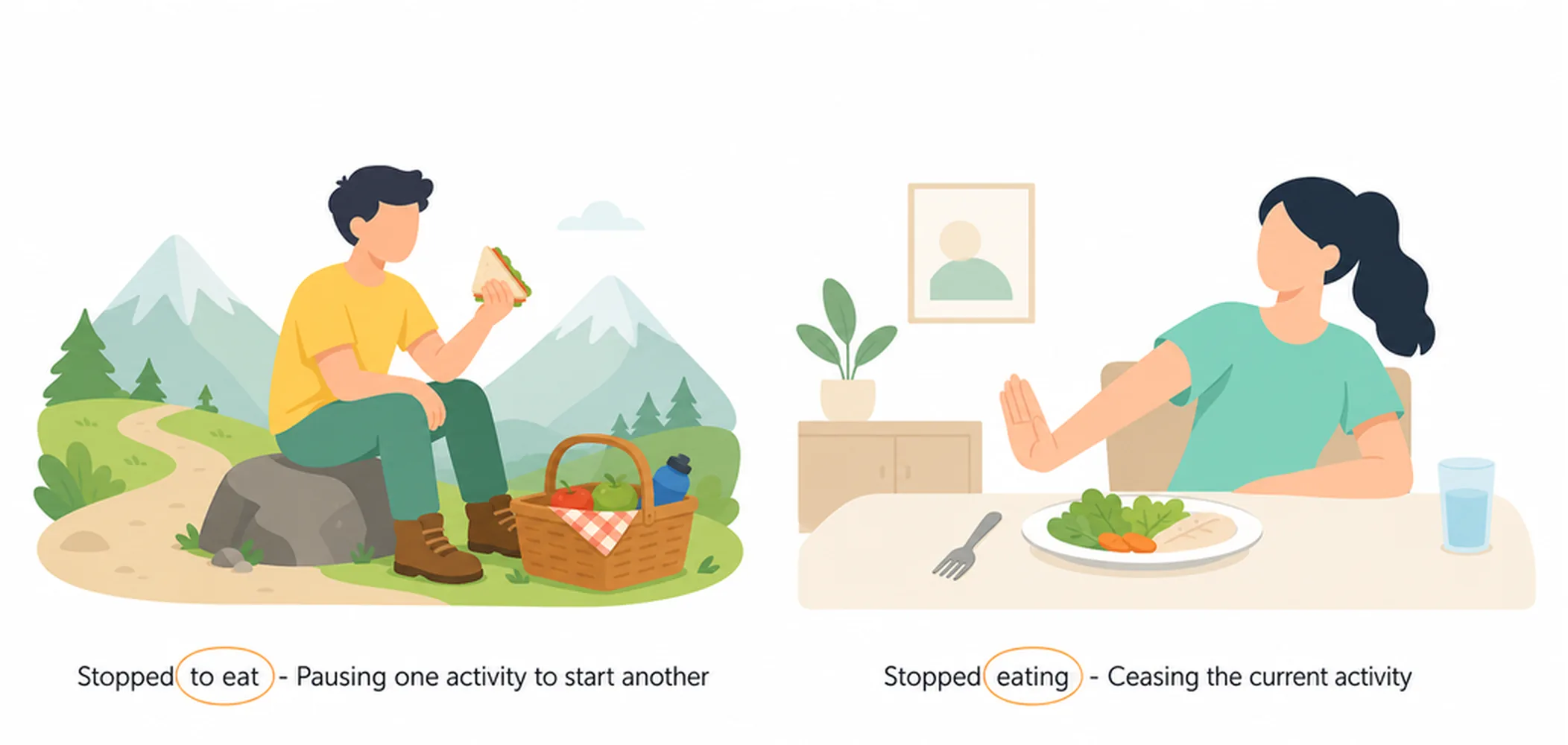
Introduction: Why Verbs Matter
Some English verbs can be followed by both the infinitive (to + verb) and the gerund (verb + -ing), but the meaning changes depending on which form you use. Understanding this distinction is crucial for expressing your intentions accurately. For example, 'I stopped smoking' means you no longer smoke, whereas 'I stopped to smoke' means you paused in order to smoke—completely opposite meanings. This article explores the most common verbs that change meaning based on the form that follows them.
Verbs That Change Meaning
Several high-frequency verbs shift meaning depending on whether they're followed by an infinitive or gerund. The gerund typically describes the action itself or something that happened, while the infinitive often expresses purpose, intention, or a future action. Other common verbs in this category include 'remember,' 'forget,' 'regret,' and 'try.' Each follows a predictable pattern once you understand the underlying logic. Learning these differences helps you avoid misunderstandings in both spoken and written communication.
Stop, Remember, Forget: Side-by-Side
STOP + infinitive = pause what you're doing in order to do something else. STOP + gerund = cease doing something; quit a habit. REMEMBER + infinitive = not forget to do something in the future. REMEMBER + gerund = recall a past action or event. FORGET + infinitive = fail to do something you intended. FORGET + gerund = cease to recall a past action. The key is recognizing whether the second action is in the future (infinitive) or past/present (gerund).
Meaning Differences at a Glance
| Verb | Infinitive (to + verb) | Gerund (verb + -ing) |
|---|---|---|
| stop |
stop to do
Meaning: Pause one activity in order to begin another (the infinitive expresses the purpose of stopping).
Example: She stopped to check her phone.
(She paused what she was doing so she could check her phone.)
Key idea: The action after stop is the new activity being started.
|
stop doing
Meaning: Cease or discontinue an activity that was already in progress.
Example: She stopped checking her phone during dinner.
(She no longer checks her phone at the table.)
Key idea: The gerund is the activity that comes to an end.
|
| remember |
remember to do
Meaning: Keep something in mind and then carry out an action in the future (obligation-like).
Example: Please remember to lock the door.
(Don't forget — you need to lock it later.)
Key idea: The action has not happened yet at the time of remembering.
|
remember doing
Meaning: Have a memory of a past action that was already completed.
Example: I remember locking the door this morning.
(I have a memory of doing it — it already happened.)
Key idea: The action occurred before the act of remembering.
|
| forget |
forget to do
Meaning: Fail to remember to carry out a future obligation or task.
Example: He forgot to send the report.
(He was supposed to send it but didn't because he didn't remember.)
Key idea: The task was not done because it slipped his mind.
|
forget doing
Meaning: Have no memory of a past event or experience (often used in negatives).
Example: I'll never forget seeing the Northern Lights.
(That past experience is unforgettable.)
Key idea: The experience already happened and the speaker has (or lacks) memory of it.
|
| try |
try to do
Meaning: Make an effort or attempt to do something, often implying difficulty or possible failure.
Example: She tried to open the jar but couldn't.
(She made an effort but did not succeed.)
Key idea: Emphasis is on the effort and the challenge involved.
|
try doing
Meaning: Experiment with an action as a potential solution or suggestion; test something out.
Example: Try adding a little more salt.
(See if adding salt improves the taste — it's worth experimenting.)
Key idea: Emphasis is on experimenting — success is possible with no special difficulty implied.
|
| regret |
regret to do
Meaning: Feel sorry about something you are doing right now, typically when delivering bad news (formal).
Example: We regret to inform you that your application was unsuccessful.
(We are sorry to tell you this now.)
Key idea: The action (informing) is happening at the present moment and the speaker is apologetic about it.
|
regret doing
Meaning: Feel sorry or wish you had not done something that already happened in the past.
Example: I regret saying those harsh words to her.
(I wish I hadn't said them — it already happened.)
Key idea: The regret is directed at a completed past action.
|
| Key Difference (Summary): With all five verbs, the infinitive (to + verb) generally points forward in time — to an action that has not yet happened, is about to happen, or is happening at the moment of speaking. The gerund (verb + -ing) generally points backward in time — to an action that was already in progress or has already been completed. Mastering this forward/backward time distinction is the single most reliable way to choose correctly between the two forms. | ||
Examples






What to Remember
- Some verbs change meaning when followed by infinitive versus gerund forms.
- Stop + infinitive means you pause to do something; stop + gerund means you cease doing something.
- Remember + infinitive means do something then recall it; remember + gerund means recall doing something previously.
- Try + infinitive means attempt to do something; try + gerund means experiment with or test something.
- Regret + infinitive apologizes for future action; regret + gerund expresses sadness about past actions.