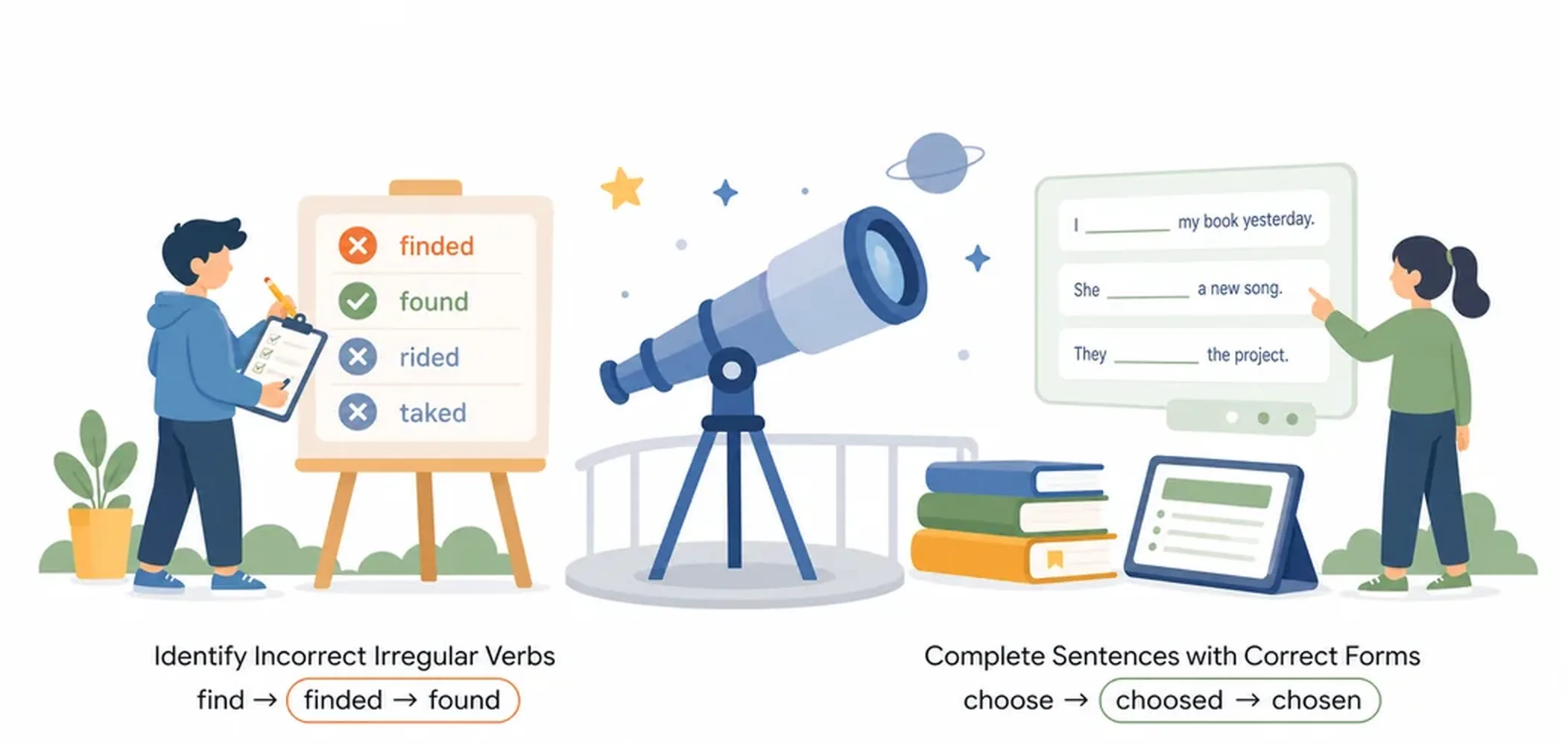
What Are Irregular Verbs?
Most English verbs follow a simple pattern. We add -ed to make the past tense: play → played, work → worked. But some verbs are different. Irregular verbs do not follow this pattern. They change in special ways in the past tense and past participle form. For example: go → went, eat → ate, see → saw. These verbs are very common in English, so it is important to learn them.
Common Irregular Verb Patterns
Some irregular verbs follow small patterns that can help you remember them. For example, some verbs change their vowel sound: sing → sang → sung, drink → drank → drunk. Other verbs stay the same in all forms: cut → cut → cut, put → put → put. Many very common verbs are irregular, like be (am/is/are → was/were → been), have (have/has → had → had), and do (do/does → did → done). Learning these common verbs first will help you speak and write English better.
How to Practice Irregular Verbs
The best way to learn irregular verbs is to practice them regularly. Read stories and listen to English. Notice irregular verbs in context. Write sentences using them. Make lists of verbs you use most often and focus on these first. Do not try to learn all irregular verbs at once—there are about 200 common ones. Start with the most important verbs and add new ones slowly. Use flashcards or apps to help you remember the past tense and past participle forms.
Irregular Verbs List: Base Form, Past Tense, and Past Participle
| Base Form | Past Tense | Past Participle | Example Sentence | Note |
|---|---|---|---|---|
| be | was / were | been | She was tired. They were late. | Two past tense forms depending on subject |
| begin | began | begun | The show began at eight. | Vowel changes: i → a → u |
| break | broke | broken | He broke the window. | Participle adds -en |
| bring | brought | brought | She brought lunch. | Past and participle are identical |
| buy | bought | bought | I bought a new phone. | Past and participle are identical |
| catch | caught | caught | He caught the ball. | Past and participle are identical |
| choose | chose | chosen | They chose the blue car. | Participle adds -n |
| come | came | come | She came home early. | Base and participle are the same |
| do | did | done | We did our homework. | Also an auxiliary verb |
| drink | drank | drunk | He drank the coffee. | Vowel changes: i → a → u |
| drive | drove | driven | She drove to work. | Participle adds -n |
| eat | ate | eaten | We ate dinner late. | Participle adds -en |
| fall | fell | fallen | The leaves fell early. | Participle adds -en |
| feel | felt | felt | I felt nervous. | Past and participle are identical |
| find | found | found | She found her keys. | Past and participle are identical |
| fly | flew | flown | The bird flew away. | Participle ends in -wn |
| forget | forgot | forgotten | I forgot my password. | Participle adds -ten |
Examples






What to Remember
- Most English verbs add -ed to form the past tense, but irregular verbs change in special ways.
- Irregular verbs do not follow the -ed pattern and must be learned individually or in groups.
- Common irregular verbs like go, eat, and see are very important to memorize and practice.
- Some irregular verbs follow small patterns, such as changing their vowel sound, which can aid memory.
- Both the past tense and past participle forms of irregular verbs need to be learned separately.