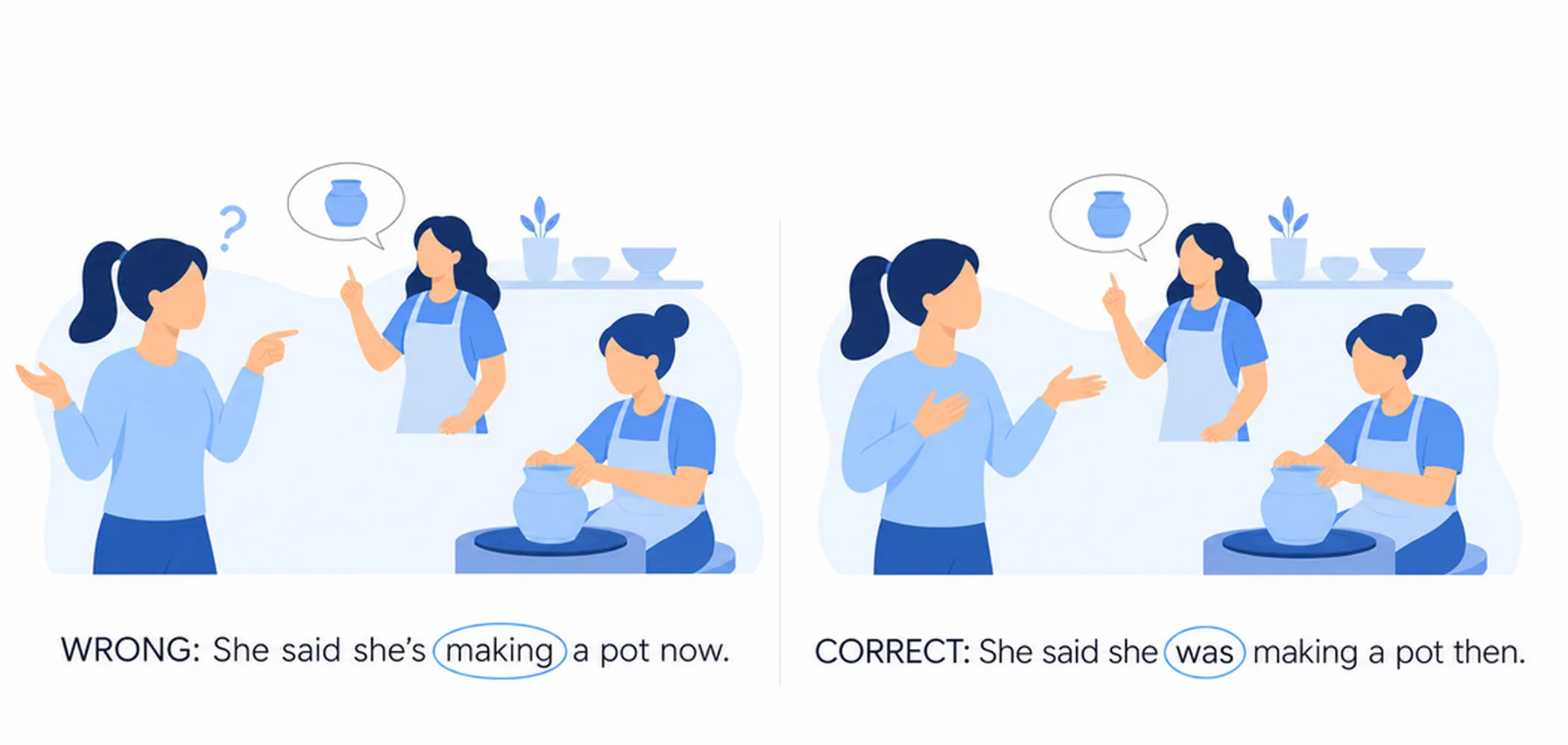
Why Reported Speech Is Tricky
Reported speech requires you to change tenses, pronouns, and time expressions simultaneously—that's why even advanced learners make mistakes. The biggest challenge is remembering the backshift rule (moving tenses backwards in time) while also adjusting who is speaking. Understanding these common errors will help you use reported speech confidently in both writing and speaking.
Direct Speech vs. Reported Speech: Side-by-Side
| Direct Speech — What Was Actually Said | Reported Speech — How We Report It |
|---|---|
| Form: Uses quotation marks; exact words of the speaker are preserved as spoken, including original tense, pronouns, and time expressions. | Form: No quotation marks; uses a reporting verb (e.g. said, told, asked) followed by a that-clause or infinitive; tense, pronouns, and time words are adjusted. |
| When to use: When quoting someone's exact words in writing or speech — common in dialogue, journalism, and storytelling where precision matters. | When to use: When conveying what someone said without quoting verbatim — standard in academic writing, news reporting, and everyday conversation. |
|
Positive example: She said, "I am tired today." He said, "We have finished the project." They said, "It will rain tomorrow." |
Positive example (with tense backshift): She said (that) she was tired that day. (present → past) He said (that) they had finished the project. (present perfect → past perfect) They said (that) it would rain the following day. (will → would) |
|
Negative example: He said, "I don't know the answer." She said, "I haven't seen that film." He said, "I won't be late." |
Negative example (with tense backshift): He said (that) he didn't know the answer. (don't → didn't) She said (that) she hadn't seen that film. (haven't → hadn't) He said (that) he wouldn't be late. (won't → wouldn't) |
|
Question example: She asked, "Are you coming tonight?" (yes/no question) He asked, "Where do you live?" (wh- question) She asked, "Can you help me?" |
Question example (word order changes): She asked if/whether I was coming that night. (auxiliary moves; no inversion) He asked where I lived. (wh-word kept; no auxiliary do) She asked if/whether I could help her. (can → could) |
|
Key time & place expressions (original): now, today, tonight, yesterday, tomorrow, here, last week, next week, this, these, ago Pronouns (original): I, me, my, we, us, our, you, your — used from the speaker's own point of view |
Key time & place expressions (adjusted): now → then; today → that day; tonight → that night; yesterday → the day before; tomorrow → the following day / the next day; here → there; last week → the week before; next week → the following week; this → that; these → those; ago → before Pronouns (adjusted): Shift according to who is speaking and who is being addressed: I → he/she; we → they; you → I/he/she/they depending on context |
Key Difference and Most Common Mistakes to Avoid:
The most frequent errors when converting to reported speech fall into four categories:
(1) Forgetting tense backshift — Always shift the tense one step into the past when the reporting verb is past tense (e.g. said, told, asked) unless reporting a general truth. Example: "I am tired" becomes "he said he was tired."
(2) Keeping question word order — Reported questions use statement word order with no auxiliary inversion. Incorrect: "She asked where did I live". Correct: "She asked where I lived."
(3) Not changing pronouns — The reporter's perspective must be reflected. If someone says "I am happy," when reporting it you must shift to the appropriate pronoun: "He said he was happy" (not "He said I was happy").
(4) Forgetting to change time and place expressions — Words like here, now, today, and tomorrow must be updated to match the new reporting context. Failing to do so makes the sentence ambiguous or incorrect.
Examples




What to Remember
- Always backshift the main verb tense one step backwards when reporting past statements.
- Change pronouns to match the listener's perspective in the reported clause.
- Adjust time expressions like 'tomorrow' to 'the next day' when the reporting is delayed.
- Use 'say' for direct statements but 'tell' when mentioning the person directly.
- Don't backshift tenses if the reported statement is still true or is a universal fact.