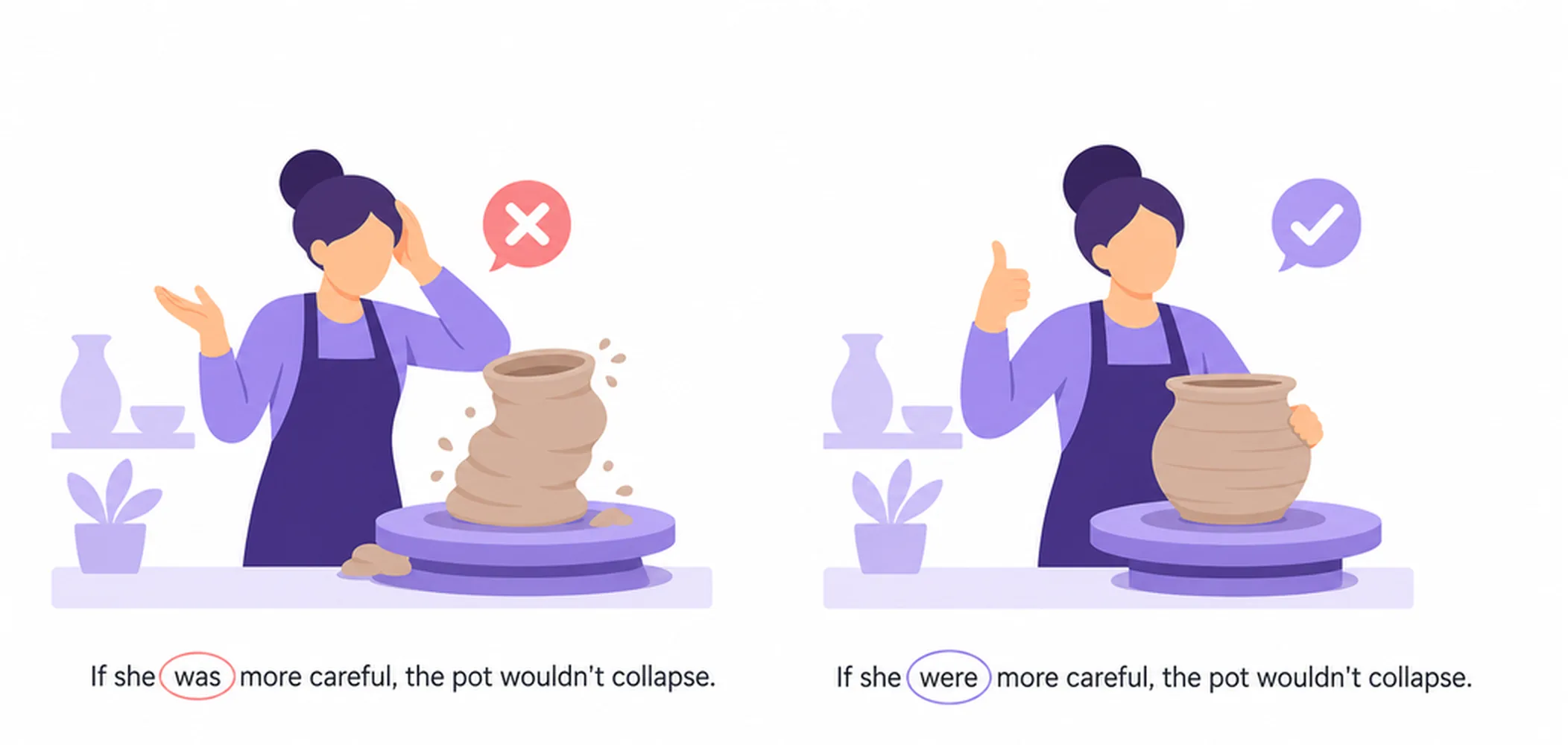
Why Subjunctive Mistakes Happen
The subjunctive mood is notoriously challenging for advanced learners because it operates differently across languages, has largely eroded from modern English, and exists in only fragmentary forms. Many C1 learners struggle because they either over-apply subjunctive structures learned from formal grammar rules, confuse subjunctive with conditional patterns, or fail to recognize when formal registers demand subjunctive forms. Additionally, the subtle differences between "if I were" versus "if I was" and the distinction between mandatory subjunctives (after certain verbs) and optional ones create persistent interference.
Correct vs. Incorrect Subjunctive Forms
| ❌ Incorrect Usage | ✅ Correct Form | 💡 Explanation |
|---|---|---|
| 🔹 Error Pattern 1: was / were Confusion in Hypothetical Conditions | ||
| "If I was you, I would apologise." | "If I were you, I would apologise." | In hypothetical or counterfactual conditions introduced by if, use were for all persons (I, he, she, it, we, they). Was is indicative; were is subjunctive. |
| "She acts as if she was the boss." | "She acts as if she were the boss." | After as if and as though expressing something unreal or imagined, the subjunctive were is required regardless of the subject. |
| "I wish he was here with us." | "I wish he were here with us." | After wish expressing an unreal or desired present state, use the past subjunctive were, not the indicative was. |
| "If it was warmer, we'd go outside." | "If it were warmer, we'd go outside." | Even with impersonal it, the subjunctive were is the correct form in an unreal conditional. The condition is imagined, not factual. |
| 🔹 Error Pattern 2: Indicative Instead of Subjunctive in That-Clauses | ||
| "The doctor recommended that he takes the medicine." | "The doctor recommended that he take the medicine." | After verbs of recommendation, suggestion, demand, and request (recommend, suggest, insist, demand, require, urge), use the base form of the verb (present subjunctive) in the that-clause — no -s ending for third person. |
| "It is essential that she is present at the meeting." | "It is essential that she be present at the meeting." | After impersonal expressions of necessity or importance (it is essential / vital / necessary / important), use the bare infinitive be in the that-clause, not is. |
| "They insisted that he apologises immediately." | "They insisted that he apologise immediately." | The verb insist triggers the mandative subjunctive. The base form apologise (without -s) is used regardless of the subject of the that-clause. |
| "The committee proposed that the rule is changed." | "The committee proposed that the rule be changed." | With passive constructions in mandative that-clauses, use be (not is/was) as the auxiliary. This is particularly common in formal and academic writing. |
| "We suggest that everyone brings their own materials." | "We suggest that everyone bring their own materials." | After suggest, the subjunctive base form bring is needed. Adding -s (indicative present) is incorrect here because the clause expresses a directive, not a fact. |
| 🔹 Error Pattern 3: Misuse of would in Hypothetical Conditions | ||
| "If I would have more time, I would help you." | "If I had more time, I would help you." | Do not use would in the if-clause of a second conditional. Use the past subjunctive (had) in the condition; would belongs only in the result clause. |
| "If she would study harder, she'd pass the exam." | "If she studied harder, she'd pass the exam." | The if-clause requires a simple past form (studied), not would + infinitive. Using would here is a direct translation error common among learners. |
| "If you would be taller, you could reach the shelf." | "If you were taller, you could reach the shelf." | With the verb be in a hypothetical if-clause, use the subjunctive were (all persons). Never use would be as the condition itself. |
| "If I would have known, I would have called." | "If I had known, I would have called." | In third conditionals (unreal past), use the past perfect (had known) in the if-clause — never would have + past participle. The latter belongs in the result clause only. |
| "I wish he would have listened to me then." | "I wish he had listened to me then." | To express regret about a past situation using wish, use the past perfect (had listened), not would have. Would have after wish can sound ungrammatical or overly informal. |
| 🔹 Error Pattern 4: Mixed & Additional Subjunctive Mistakes | ||
| "I wish it is Friday already." | "I wish it were Friday already." | Wish for present unreal states requires the past subjunctive. Using the present indicative is treats the wish as a fact rather than a hypothetical desire. |
| "It is time they go to bed." | "It is time they went to bed." | The expression it is (high) time is followed by a past subjunctive form, even when referring to the present or future. Using the present base form (go) is incorrect here. |
| "Suppose he is lying — what would you do?" | "Suppose he were lying — what would you do?" | Conjunctions such as suppose, supposing, and imagine introduce hypothetical scenarios and require the subjunctive or conditional past, not the simple present indicative. |
| "Long live the King!" → "Long lives the King!" | "Long live the King!" | Fixed formulaic subjunctives like long live, God save, so be it, and come what may use the base form without -s. Adding -s (indicative third person) breaks the formulaic subjunctive structure. |
| "I demand that he stops this behaviour." | "I demand that he stop this behaviour." | Demand is a strong directive verb that always triggers the mandative subjunctive. The base form stop (no -s) must be used, regardless of tense in the main clause. |
| "Whether she is guilty or not, she deserves a fair trial." | "Whether she be guilty or not, she deserves a fair trial." | In formal or literary English, whether…or not and concessive clauses can take the present subjunctive be. Using is is acceptable in informal speech but loses the formal subjunctive nuance. |
|
🔑 Key Difference — Summary: The subjunctive mood is used to express situations that are unreal, hypothetical, wished for, demanded, or required — as opposed to the indicative mood, which states facts. The three most common error patterns are: (1) using was instead of were in hypothetical and counterfactual clauses after if, wish, as if, and as though; (2) using a conjugated indicative verb (e.g. takes, is) instead of the base form (e.g. take, be) in mandative that-clauses after verbs and expressions of recommendation, necessity, or demand; and (3) incorrectly placing would inside the if-clause of conditional sentences, where only the past subjunctive (had, studied, were) is grammatically correct. Recognising which constructions trigger the subjunctive — and consistently applying the base form or were — is the key to avoiding these mistakes. |
||
Examples

The committee recommends that funding be allocated to renewable energy projects.
Formal recommendation · Subjunctive after 'recommend'

Were I to accept the position, I would need to relocate to Geneva.
Formal conditional · Inverted subjunctive structure

It is imperative that the witness testify truthfully during the trial.
Legal/formal register · Subjunctive after 'imperative'

She insisted that he apologize for his remarks, though he refused to do so.
Everyday formal speech · Bare subjunctive after 'insist'
When to use it
Legal & Formal Documents
Subjunctive forms are mandatory in legal language and formal institutional writing to express obligations, recommendations, and conditional scenarios.
"The contract requires that the lessee maintain the property in good condition."
Business Recommendations
In professional contexts, subjunctive frames suggestions diplomatically and emphasizes the hypothetical or necessary nature of actions.
"We propose that the budget be reviewed quarterly."
Academic Writing
Academic prose uses subjunctive to express requirements, hypothetical scenarios, and formal recommendations in research papers and proposals.
"It is crucial that researchers acknowledge potential limitations of their methodology."
Contrary-to-Fact Wishes
Subjunctive mood expresses regret about present or past realities that cannot be changed, creating emotional distance from reality.
"If I were financially independent, I would travel indefinitely."
Signal words
suggest
recommend
insist
demand
require
request
propose
stipulate
essential
crucial
vital
important
imperative
if
were
wish
God forbid
lest
Common Mistakes
✕
Wrong
If I would have known about the deadline, I would have submitted the proposal.
✓
Correct
If I had known about the deadline, I would have submitted the proposal.
Avoid 'would have' in the if-clause. Use past perfect (had + past participle) for contrary-to-fact conditionals.
✕
Wrong
I suggest that he goes to the conference next month.
✓
Correct
I suggest that he go to the conference next month.
After 'suggest, recommend, insist, propose,' use bare subjunctive (infinitive without 'to'). British English accepts 'goes' in informal contexts, but subjunctive is more formal.
✕
Wrong
It is essential that she will complete the research by Friday.
✓
Correct
It is essential that she complete the research by Friday.
After expressions of necessity/importance ('essential, crucial, vital, important'), use subjunctive, not future tense. The present subjunctive carries the future meaning.
✕
Wrong
If I was in your position, I would reconsider the investment.
✓
Correct
If I were in your position, I would reconsider the investment.
In formal writing and conditional statements contrary to fact, use 'were' (subjunctive) even with 'I'. Colloquially 'was' is common, but formal registers demand subjunctive.
✕
Wrong
The board demands that the project is completed on schedule.
✓
Correct
The board demands that the project be completed on schedule.
After 'demand, require, insist, request,' use subjunctive 'be' (or bare subjunctive). Avoid indicative 'is' in formal contexts.
✕
Wrong
I wish that he would be more attentive in meetings.
✓
Correct
I wish (that) he were more attentive in meetings.
For present wishes contrary to fact, use subjunctive past ('were'), not 'would be'. Use 'would' only for future wishes: 'I wish he would attend tomorrow.'
✕
Wrong
The regulation stipulates that employees submit their reports by Friday or they will face penalties.
✓
Correct
The regulation stipulates that employees submit their reports by Friday or face penalties.
In subjunctive clauses following stipulative verbs, maintain parallel subjunctive forms. Avoid mixing 'will face' (indicative) with the subjunctive; use the bare subjunctive 'face.'
KEY TAKEAWAYS
What to Remember
- Use the subjunctive "were" in counterfactual conditionals, not the indicative "was," even with singular subjects.
- The subjunctive survives mainly in formal written English and set phrases; modern spoken English rarely requires it.
- Avoid over-applying subjunctive structures by checking whether your context truly demands formal registers or expresses unreality.
- Distinguish subjunctive from conditional: subjunctive expresses hypothetical situations; conditional structures use would or other modals to show consequences.
- Key subjunctive forms appear in that-clauses after verbs of demand, suggest, or insist, where base forms replace conjugated verbs.