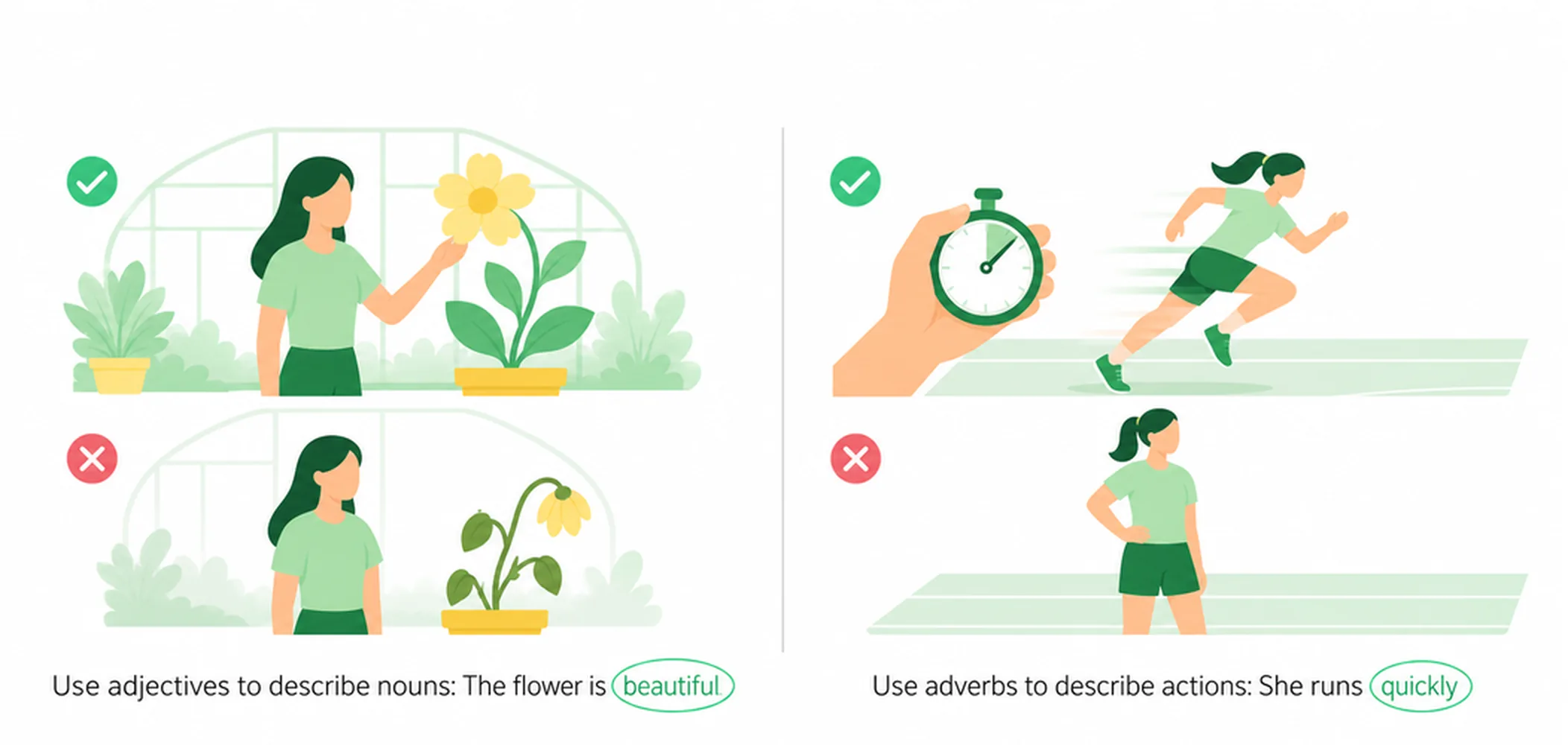
The Key Difference
Adjectives and adverbs are both descriptive words, but they describe different things. An adjective describes a noun (a person, thing, or idea). An adverb describes a verb (an action), an adjective, or another adverb. Many adverbs are formed by adding -ly to an adjective, but not all. Understanding which one to use makes your English clearer and more correct.
Adjective vs Adverb: Side-by-Side Comparison
| Dimension | Adjective | Adverb |
|---|---|---|
| What it modifies | Nouns and pronouns (describes or gives more information about a person, place, or thing) | Verbs, adjectives, other adverbs, or entire clauses (describes how, when, where, or to what degree something happens) |
| Typical form | Base form; no fixed ending (e.g., quick, happy, beautiful) | Often formed by adding -ly to an adjective (e.g., quickly, happily, beautifully); some are irregular (e.g., fast, well, hard) |
| Position in a sentence | Before the noun it modifies (attributive) or after a linking verb (predicative): "a tall man" / "He is tall" | Usually after the verb or at the beginning/end of a clause; can also appear before an adjective or another adverb: "She ran quickly" / "Extremely fast" |
| Positive example | "She is a careful driver." (modifies the noun driver) | "She drives carefully." (modifies the verb drives) |
| Negative example (common mistake) | ❌ "She drives careful." (using an adjective where an adverb is needed) | ❌ "She is a carefully driver." (using an adverb where an adjective is needed) |
| Question it answers | Which one? What kind? How many? How much? — "What kind of driver?" → a careful driver | How? When? Where? How often? To what extent? — "How does she drive?" → she drives carefully |
| Key signal words / examples | good, bad, fast, hard, early, late, high, deep, quick, slow, happy, bright, loud | well, badly, fast, hard, early, late, highly, deeply, quickly, slowly, happily, brightly, loudly |
| Tricky pairs to watch | "She looks good." (linking verb → adjective describes the subject) | "She sings well." (action verb → adverb describes the action); Note: "good" ≠ "well" as an adverb |
| 🔑 Key Difference: The core rule is simple — use an adjective when you are describing a noun or pronoun (what something is), and use an adverb when you are describing a verb, adjective, or another adverb (how something happens or to what degree). The most common mistake occurs after linking verbs (be, seem, look, feel, taste, smell, sound, become) — these require an adjective, not an adverb: "I feel bad" (not badly). Always ask: am I describing a thing or an action/quality? | ||
Examples

She is a careful driver.
Adjective · Describes the noun 'driver'

The food tastes delicious.
Adjective · Describes the noun 'food'

He wore an expensive suit.
Adjective · Describes the noun 'suit'
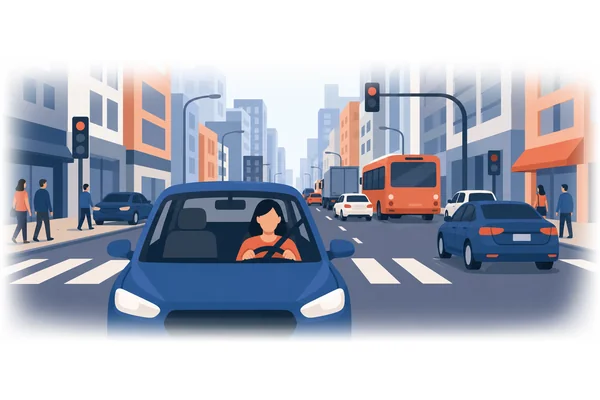
She drives carefully on busy roads.
Adverb · Describes the verb 'drives'

The music played loudly in the hall.
Adverb · Describes the verb 'played'

He spoke extremely well at the conference.
Adverb · Describes the adjective 'well'
When to use it
Describing a noun
Use an adjective when you want to say what someone or something is like. Adjectives often follow the verb 'be' or come before the noun.
"The tall building is modern and impressive."
Describing an action
Use an adverb when you want to describe how someone does something or how an action happens. Most adverbs end in -ly.
"She answered the question confidently and correctly."
Modifying adjectives
Use an adverb to describe another adjective. You often see adverbs like 'very', 'really', 'extremely', or 'quite' before adjectives.
"The movie was really interesting and surprisingly long."
Signal words
-ly ending (common adverb marker)
verb forms (use adverb nearby)
noun forms (use adjective nearby)
'be' verb (use adjective after)
very, really, extremely (usually before adjectives or adverbs)
Common Mistakes
✕
Wrong
She sings beautiful.
✓
Correct
She sings beautifully.
Use an adverb to describe the verb 'sings', not an adjective.
✕
Wrong
The weather is terribly today.
✓
Correct
The weather is terrible today.
Use an adjective after 'is' to describe the noun 'weather', not an adverb.
✕
Wrong
He runs quick to catch the bus.
✓
Correct
He runs quickly to catch the bus.
Use an adverb 'quickly' to describe the verb 'runs'. 'Quick' is an adjective.
KEY TAKEAWAYS
What to Remember
- Adjectives describe nouns; adverbs describe verbs, adjectives, or other adverbs.
- Most adverbs are formed by adding -ly to an adjective, but not all adverbs end in -ly.
- Use the adjective form after linking verbs like "be," "seem," and "feel."
- Common mistake: saying "I feel badly" instead of "I feel bad" after linking verbs.
- Choose adverbs to modify action verbs: "She spoke quickly" not "She spoke quick."