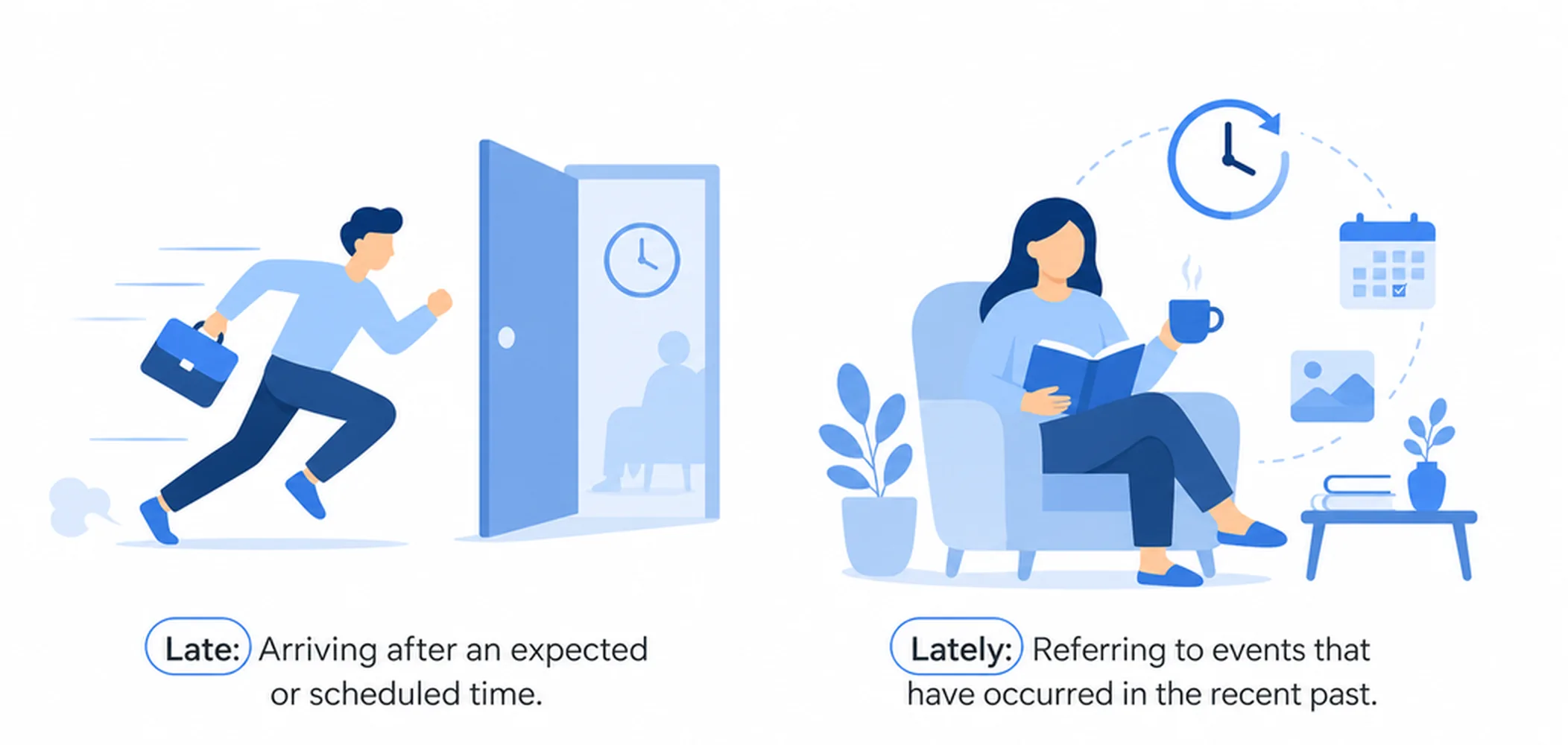
Key Difference
Late and lately are often confused because they look similar, but they have different meanings and uses. Late is an adjective or adverb that describes something happening after the expected time. Lately is an adverb that means 'recently' or 'in the recent past'. Understanding this difference will help you use both words correctly.
Late vs Lately at a Glance
Late describes being after the scheduled or normal time. It can be an adjective (modifying a noun) or an adverb (modifying a verb). Lately means 'in recent times' and is always an adverb. You cannot use lately to talk about being behind schedule.
Late vs Lately: Side-by-Side Comparison
| Feature | Late | Lately |
|---|---|---|
| Form | Adjective or adverb; can describe a noun or modify a verb directly | Adverb only; never used as an adjective |
| When to use | Use to say something happened after the expected or scheduled time, or to describe a time near the end of a period (e.g., late at night, late in the year) | Use to describe something that has been happening recently or in the near past, often over an unspecified period up to now |
| Typical sentence position | Directly after the verb it modifies, or before/after a noun when used as an adjective (e.g., a late arrival, arrived late) | Usually at the end of a sentence or clause, though it can appear at the beginning for emphasis (e.g., Lately, things have changed) |
| Positive example | "She arrived late to the meeting." "He catches the late train home every Friday." |
"She has been working very hard lately." "I have been feeling tired lately." |
| Negative example | "He never stays late at the office." | "I haven't slept well lately." |
| Question example | "Why were you late this morning?" | "Have you been exercising lately?" |
| Common companion tenses | Simple past, simple present, simple future — any tense focused on a specific point in time | Present perfect, present perfect continuous — tenses that link the recent past to the present |
| Key signal words | too late, stay late, run late, late arrival, late night, late in the day | recently, these days, of late, in recent times, have/has been |
| Common mistake to avoid | Do not use late when you mean "in recent times": ✗ "I have been busy late." | Do not use lately to mean after the scheduled time: ✗ "She arrived lately to the party." |
| 🔑 Key Difference: Late refers to timing relative to a schedule or expected moment (after the due time, or near the end of a period), while lately refers to a vague, recent stretch of time leading up to now. A quick test: if you can replace the word with "recently" and the sentence still makes sense, use lately; if you mean "after the expected time" or "not early," use late. | ||
Formula
✔ Positive
Subject
+
verb
+
late
The plane arrived late.
? Question
Have
+
Subject
+
verb (past participle)
+
lately
Have you travelled lately?
Examples
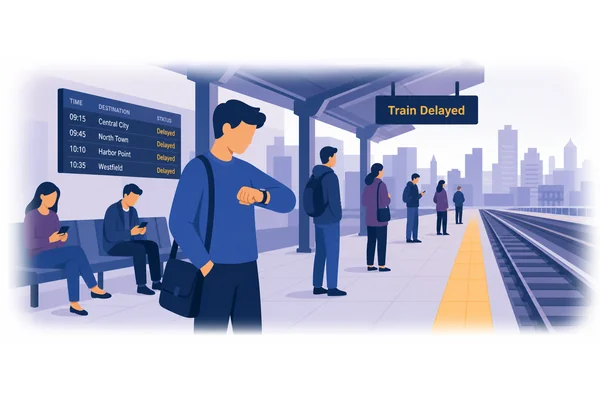
The train was late this morning.
Adjective · Describing a noun (train)

She arrived late to the meeting.
Adverb · Describing when she arrived

The late president was respected by many.
Adjective · Meaning 'deceased' or 'former'

Have you seen her lately?
Adverb · Meaning 'in recent times'

I haven't been to the gym lately.
Adverb · With negative/present perfect tense

Lately, the weather has been very cold.
Adverb · At the beginning of a sentence
When to use it
Describing time delays
Use late when someone or something is behind schedule or after the normal time.
"The bus was 10 minutes late."
Talking about recent events
Use lately when discussing something that happened in the recent past.
"Work has been stressful lately."
Referring to deceased people
Use late as an adjective before a name to mean 'deceased'.
"The late Queen Elizabeth was admired worldwide."
Signal words
recently
in recent times
over the last few days/weeks
after the scheduled time
behind schedule
deceased
former
Common Mistakes
✕
Wrong
I haven't seen him late.
✓
Correct
I haven't seen him lately.
Use lately (recently), not late, when talking about the recent past.
✕
Wrong
Lately, he arrived to work.
✓
Correct
Lately, he has been arriving to work late.
Lately means recently; it doesn't describe being behind schedule. Use late for that.
✕
Wrong
The meeting is very lately.
✓
Correct
The meeting is very late.
Lately is an adverb only; it cannot be used with 'is' as an adjective complement.
KEY TAKEAWAYS
What to Remember
- Late is an adjective or adverb meaning 'after the expected time'.
- Lately is only an adverb meaning 'recently' or 'in the recent past'.
- Use late to describe delayed arrivals, deaths, or events happening after schedule.
- Use lately in present perfect sentences to describe recent actions or situations.
- Don't confuse late (delayed) with lately (recently) despite their similar appearance.