What Are Adjectives and Adverbs?
Adjectives describe nouns. Adverbs describe verbs, adjectives, or other adverbs. Usually, adjectives and adverbs have different forms. For example: 'quick' (adjective) becomes 'quickly' (adverb). However, some common English words have the same form for both adjective and adverb. These are called invariable adjectives, and they include words like 'fast', 'high', 'near', 'late', 'early', 'hard', 'slow', and 'straight'.
How to Recognize These Words
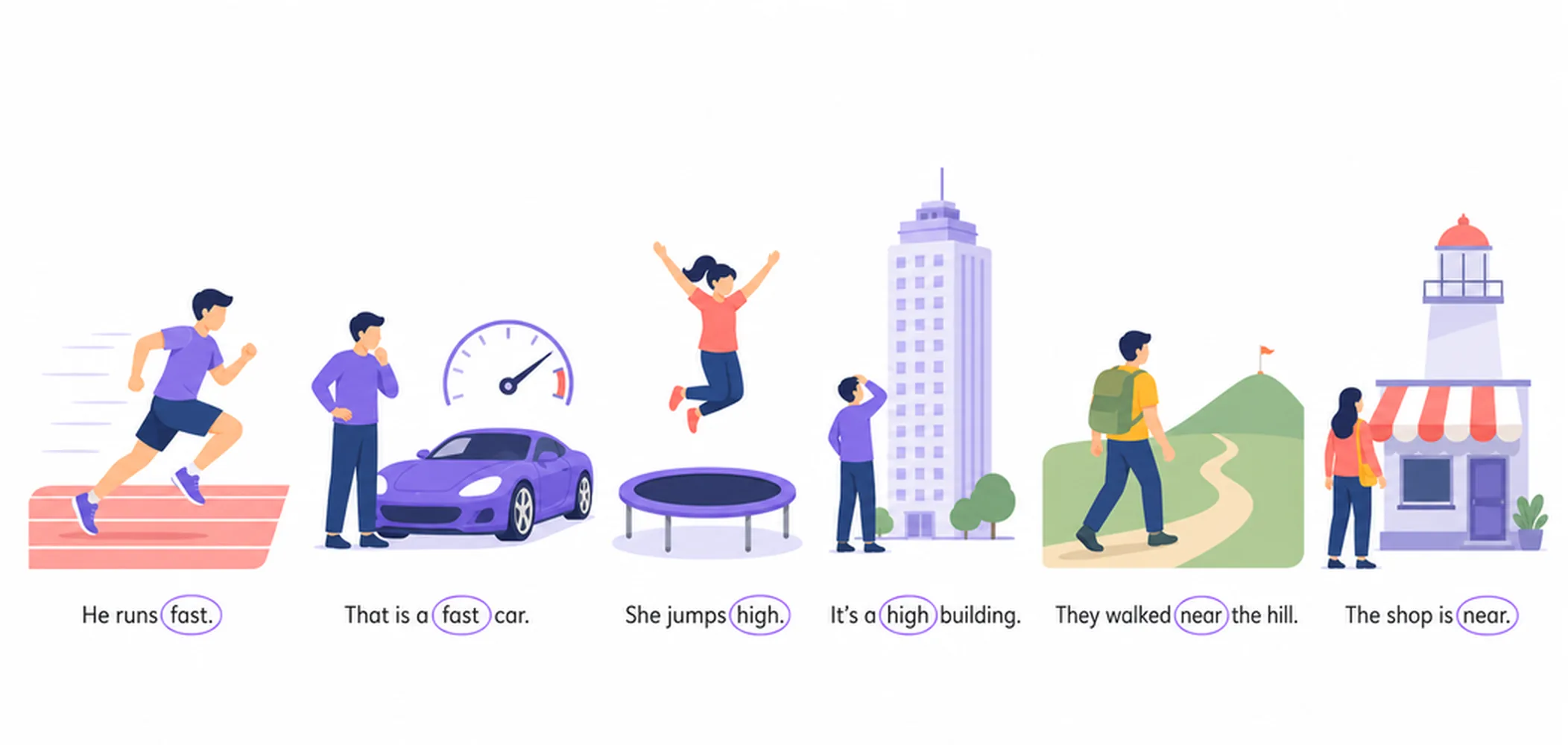
To know if a word is an adjective or adverb, look at what it describes. If it describes a noun, it is an adjective. If it describes a verb (showing how an action happens), it is an adverb. The word itself does not change, but its function in the sentence changes. For example, 'fast' in 'a fast car' is an adjective describing the noun 'car'. But 'fast' in 'he runs fast' is an adverb describing the verb 'runs'.
Common Words with the Same Form
The most useful words to remember are: fast, high, near, late, early, hard, slow, straight, wide, deep, and long. These words appear frequently in everyday English. Learning to recognize them will help you understand sentences better and write more naturally. Do not add '-ly' to these words—it would be incorrect to say 'hardly' when you mean 'in a hard way' (though 'hardly' does exist, it has a different meaning).
Fast, High, Near and More — Same Form as Adjective and Adverb
| Word | Adjective Phrase | Adverb Phrase | Note |
|---|---|---|---|
| fast | a fast car | drive fast | Fastly does not exist |
| high | a high shelf | jump high | Highly = to a great degree (abstract) |
| near | the near side | come near | Nearly = almost |
| late | a late train | arrive late | Lately = recently |
| early | an early flight | leave early | Same form for both functions |
| hard | a hard surface | work hard | Hardly = barely / scarcely |
| slow | a slow pace | go slow | Slowly also correct & more formal |
| straight | a straight road | go straight ahead | Same form for both functions |
| wide | a wide river | open wide | Widely = broadly / among many |
| deep | a deep lake | dig deep | Deeply = intensely (abstract) |
| long | a long journey | stay long | Same form for both functions |
Examples






What to Remember
- Adjectives describe nouns while adverbs describe verbs, adjectives, or other adverbs.
- Some common words like fast, high, and near have identical adjective and adverb forms.
- Determine if a word is adjective or adverb by checking what it describes.
- Words like quickly show the typical pattern where adverbs differ from their adjective forms.
- Fast, hard, late, early, and slow are invariable words used as both adjectives and adverbs.