
Why Learners Make Mistakes with Adverbs of Frequency
Adverbs of frequency (always, usually, often, sometimes, rarely, never) are tricky because they have specific positions in sentences. Many learners place them incorrectly or confuse them with other sentence structures. The main problem is word order—these adverbs must go in different places depending on whether you use a main verb or an auxiliary verb. Understanding these rules will help you write and speak more naturally.
Adverb Position at a Glance
| Adverb | Frequency | Position Rule | Correct Example | Incorrect Example | Note |
|---|---|---|---|---|---|
| always | 100% | Before main verb; after be | She always drinks coffee. | She drinks always coffee. | With be: He is always late. |
| usually | ~80% | Before main verb; after be | They usually walk to school. | They walk usually to school. | Can start a sentence for emphasis: Usually, I take the bus. |
| often | ~60% | Before main verb; after be | We often go to the gym. | We go often to the gym. | Also acceptable at sentence end: We go to the gym often. |
| sometimes | ~40% | Before main verb, start, or end of sentence | Sometimes I forget my keys. | I forget my keys sometimes not. | Most flexible adverb; beginning, middle, and end positions are all correct. |
| rarely | ~10% | Before main verb; after be | He rarely eats fast food. | He doesn't rarely eat fast food. | Already negative in meaning — do NOT add not or don't. |
| never | 0% | Before main verb; after be | I never smoke. | I don't never smoke. | Double negative error — never replaces not; never use both together. |
Examples
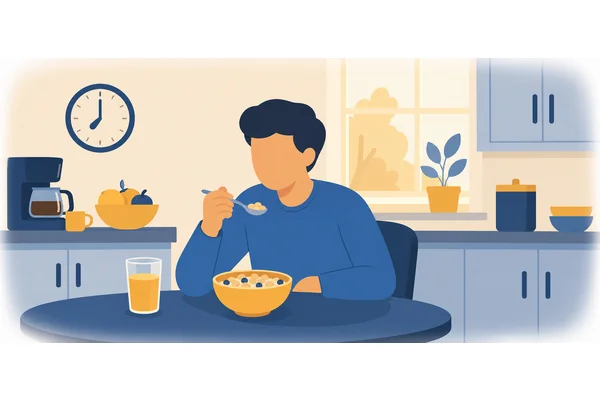
I usually eat breakfast at 7 o'clock.
Adverb before main verb · Present simple

She has never been to France.
Adverb after auxiliary verb · Present perfect

They are often tired after work.
Adverb after 'be' verb · Present continuous

You can always call me if you need help.
Adverb after modal verb · Modal verb structure
When to use it
Describing Daily Habits
Use frequency adverbs to talk about what you do regularly or routinely. This is the most common use in everyday conversation.
"I always check my email in the morning."
Asking About Routines
Place the adverb after the auxiliary verb in questions to ask about someone's habits or routines.
"Do you often exercise? How often do you go to the gym?"
Describing Facts or Patterns
Use frequency adverbs in both spoken and written English to describe things that happen repeatedly or patterns of behavior.
"She rarely complains. He is sometimes late."
Signal words
always
usually
often
sometimes
rarely
seldom
never
occasionally
Common Mistakes
✕
Wrong
I go always to the gym on Mondays.
✓
Correct
I always go to the gym on Mondays.
Adverbs of frequency come BEFORE the main verb, not after. 'Always' must be placed before 'go'.
✕
Wrong
She doesn't usually go to bed late.
✓
Correct
She usually doesn't go to bed late.
With auxiliary verbs (do/does), the adverb goes AFTER the auxiliary, not before 'go'.
✕
Wrong
You are sometimes late for work.
✓
Correct
You are sometimes late for work. OR You sometimes are late for work.
With 'be', adverbs of frequency go AFTER the verb. Both positions are correct with 'be', but after is more common.
✕
Wrong
Never I have seen such a beautiful sunset.
✓
Correct
I have never seen such a beautiful sunset.
With present perfect, the adverb comes AFTER the auxiliary verb 'have', not at the beginning.
✕
Wrong
Do you often like pizza?
✓
Correct
Do you often like pizza? OR Do you like pizza often?
In questions with auxiliary verbs, place the adverb after the auxiliary or at the end. Both are correct.
✕
Wrong
He rarely can finish his homework on time.
✓
Correct
He can rarely finish his homework on time.
With modal verbs (can, could, will, would), the adverb goes AFTER the modal, not before it.
✕
Wrong
Sometimes people are forgetting their keys.
✓
Correct
Sometimes people forget their keys. OR People sometimes forget their keys.
Don't overuse continuous forms. Simple present is more natural with adverbs of frequency.
KEY TAKEAWAYS
What to Remember
- Place frequency adverbs before main verbs but after auxiliary verbs like "is" or "have."
- Never put frequency adverbs between the auxiliary verb and main verb in continuous tenses.
- With "be" as the main verb, the frequency adverb goes after "be," not before it.
- Always, usually, often, sometimes, rarely, and never follow specific position rules; don't treat them identically.
- Frequency adverbs at sentence start or end are less common but grammatically correct in English.