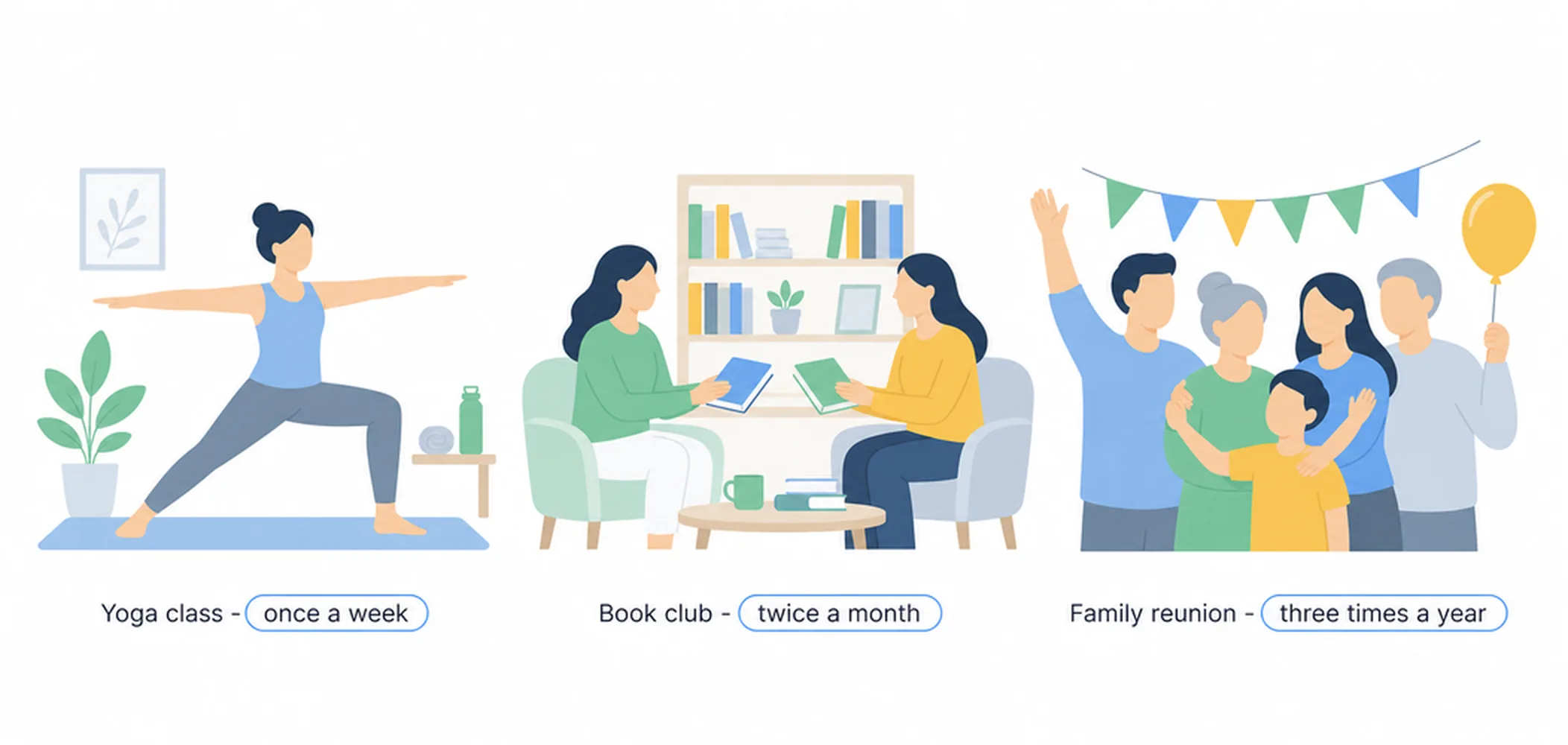
What are frequency expressions?
Frequency expressions tell us how often something happens. They answer the question 'How often?' and are useful for talking about habits, routines, and regular events. Unlike simple frequency adverbs (always, usually, never), frequency expressions use numbers and time periods combined together. They help you be more specific and precise about time patterns in daily life.
How to form frequency expressions
The basic structure is: NUMBER + TIME PERIOD. Common number words include once (1×), twice (2×), three times, four times, etc. Time periods are day, week, month, year, and hour. You can also use 'a' or 'an' before the time period, or use 'per' instead. For example: once a day, twice a week, three times a month, four times per year. These expressions usually come at the end of a sentence or after the main verb.
Position in sentences
Frequency expressions have flexible word order. They typically appear at the end of a sentence: 'I go to the gym twice a week.' However, you can also place them at the beginning for emphasis: 'Twice a week, I go to the gym.' In questions, they usually go at the end: 'How often do you visit your family?' 'Once a month.' Never place them between the subject and auxiliary verb like simple frequency adverbs.
Frequency Expressions at a Glance
| Number Word | Connector | Time Period | Full Expression | Example Sentence | Note |
|---|---|---|---|---|---|
| once | a / per | day | once a day | I take this pill once a day. | "once" = 1 time; informal preferred |
| twice | a / per | day | twice a day | She checks her email twice a day. | "twice" = 2 times; informal preferred |
| three times | a / per | day | three times a day | He eats three times a day. | 3+ uses "[number] times" |
| once | a / per | week | once a week | We have a meeting once a week. | "a" is more common in speech |
| twice | a / per | week | twice a week | I go to the gym twice a week. | "per" is more formal/written |
| three times | a / per | week | three times a week | She volunteers three times a week. | Pattern: [number] times a/per [period] |
| once | a / per | month | once a month | I visit my grandparents once a month. | Also: "monthly" (one-word adverb) |
| twice | a / per | month | twice a month | The report is due twice a month. | Also: "twice monthly" (adverb form) |
| four times | a / per | month | four times a month | We meet four times a month. | ≈ once a week |
| once | a / per | year | once a year | We take a holiday once a year. | Also: "annually" (formal) |
| twice | a / per | year | twice a year | Dentists recommend check-ups twice a year. | Also: "biannually" (formal) |
| once | every | other day / two days | once every other day | I water the plants once every other day. | "every other" = every 2nd; use "every" for irregular gaps |
Examples



What to Remember
- Frequency expressions combine a number word (once, twice, three times) with a time period to show how often something happens.
- Use the structure NUMBER + TIME PERIOD, like "twice a week" or "three times a month," for precise frequency statements.
- Place frequency expressions at the end of sentences or after the main verb, not at the beginning like simple adverbs.
- Remember that "once" means one time, "twice" means two times, and "three times" onwards follows the pattern for all other numbers.
- Frequency expressions are more specific than simple adverbs like "usually" or "often," so use them when you need exact time patterns.