What Are Adverbs of Frequency?
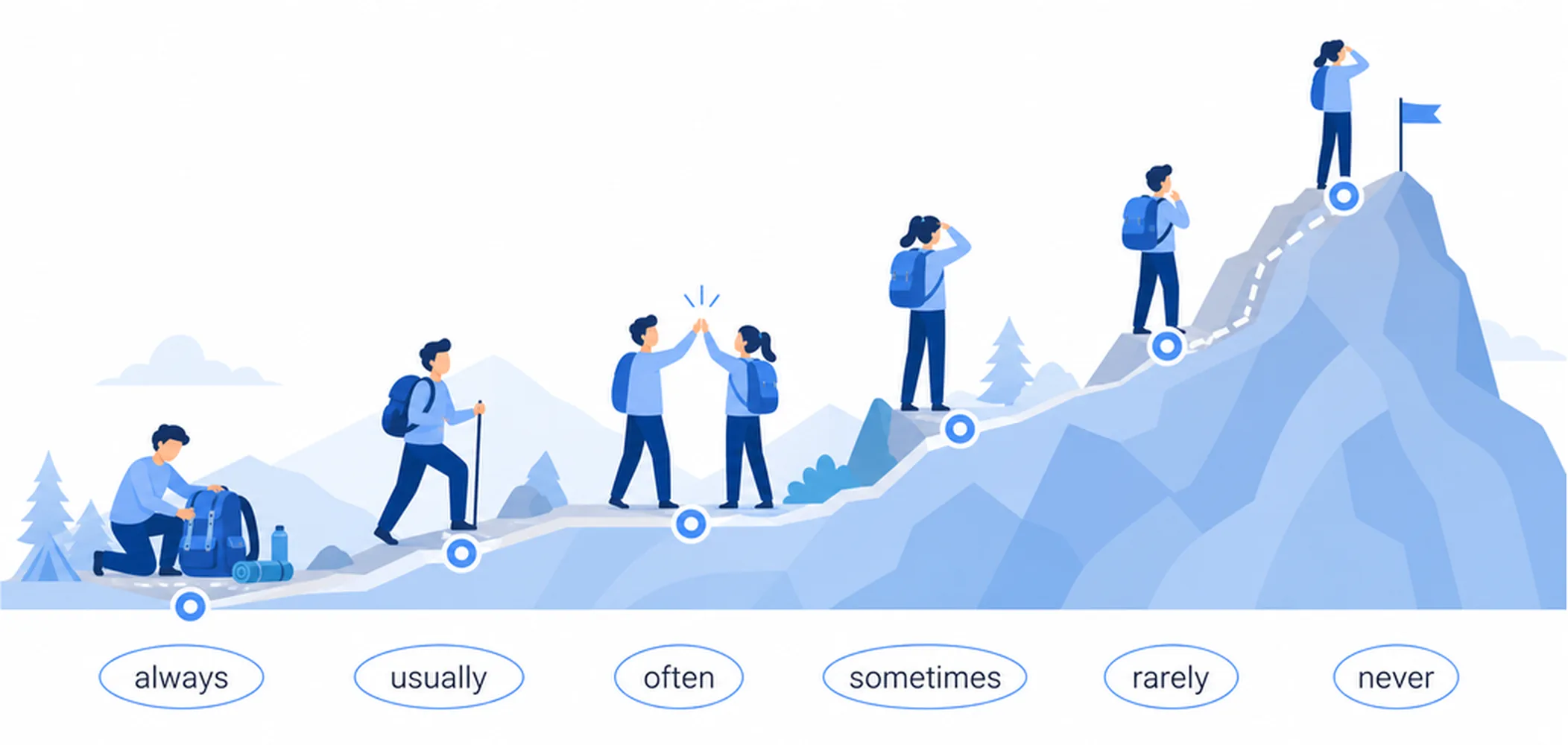
Adverbs of frequency tell us how often something happens. They describe the regularity of an action or state. In English, we use a scale from 'always' (100% of the time) to 'never' (0% of the time). These adverbs are essential for describing habits, routines, and general facts about how often things occur in daily life.
The Frequency Scale
Adverbs of frequency follow a clear scale of how often something happens: Always (100%) → Usually (75-90%) → Often (50-75%) → Sometimes (25-50%) → Rarely (5-25%) → Never (0%). This scale helps you choose the right adverb based on how frequently an action occurs. Understanding this scale makes it easier to express the exact regularity you want to communicate.
Word Order Rules
The placement of adverbs of frequency depends on the verb type. With simple present verbs, place the adverb between the subject and main verb: 'I usually drink coffee.' With the verb 'to be', place it after the verb: 'She is always late.' With modal verbs and auxiliaries, place it after the auxiliary: 'He has never seen snow.' This placement creates natural, correct English sentences.
The Frequency Scale at a Glance
| Adverb | Frequency % | Real-Life Example | Position in Sentence | Note |
|---|---|---|---|---|
| Always | 100% | She always brushes her teeth before bed. | Before main verb; after "to be" | No exceptions — every single time |
| Usually | 80–90% | He usually takes the bus to work. | Before main verb; can also start a sentence | Rare exceptions allowed |
| Often | 60–70% | We often eat out on Fridays. | Before main verb; flexible placement | More than half the time but not a fixed rule |
| Sometimes | 30–50% | I sometimes forget where I put my keys. | Most flexible — start, middle, or end | Roughly half the time; no strong pattern |
| Rarely | 5–15% | They rarely argue about money. | Before main verb; after "to be" | Negative meaning — no "not" needed; "seldom" is a synonym |
| Never | 0% | She never drinks coffee after 3 pm. | Before main verb; after "to be" | Strong negative — do NOT use with "not" (double negative) |
Examples






What to Remember
- Adverbs of frequency describe how often actions happen on a scale from always to never.
- Place adverbs of frequency before the main verb, but after the verb "to be."
- Always means 100% of the time, while never means 0% of the time.
- Usually, often, sometimes, and rarely fall between always and never on the frequency scale.
- Use these adverbs to describe habits, routines, and general facts about daily life patterns.