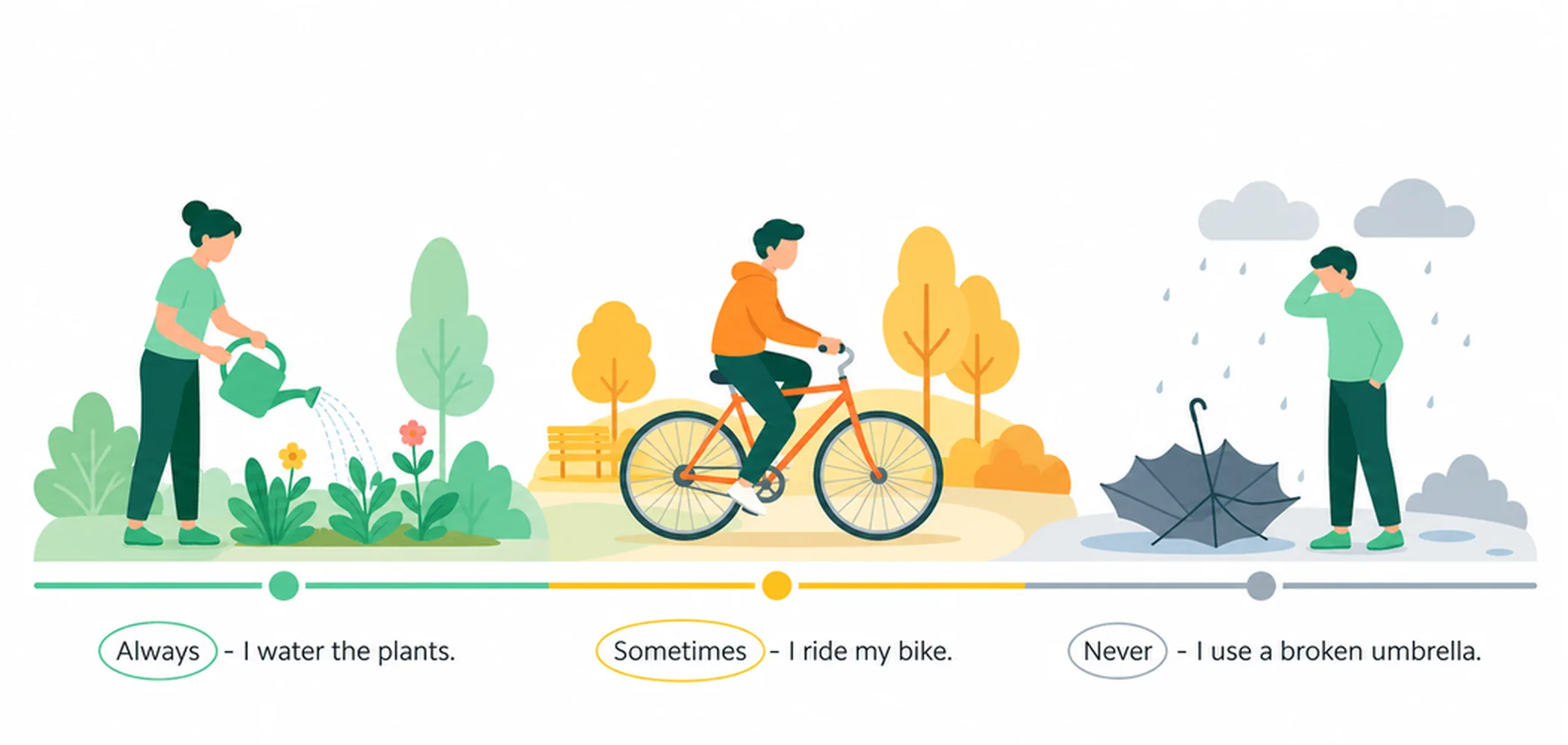
What are adverbs of frequency?
Adverbs of frequency tell us how often something happens. They answer the question 'How often?' and describe whether an action is rare, common, or happens all the time. Common adverbs of frequency include: always, usually, often, sometimes, rarely, hardly ever, and never. These words are essential for describing habits, routines, and regular activities in English.
Where do adverbs of frequency go in a sentence?
The position of an adverb of frequency depends on the type of verb in the sentence. With simple verbs (like 'go' or 'eat'), place the adverb between the subject and the main verb: 'I usually drink coffee.' With the verb 'to be' (is, are, was, were), place the adverb after the verb: 'She is always late.' With auxiliary verbs (do, have, will), place the adverb after the auxiliary verb: 'I have never seen that film.' Adverbs of frequency can also appear at the beginning or end of a sentence for emphasis: 'Sometimes I work late' or 'I go swimming often.'
Frequency scale: from 0% to 100%
It helps to think of adverbs of frequency on a scale from 0% to 100%. 'Never' means 0% (it never happens), while 'always' means 100% (it happens every time). 'Hardly ever' is very close to 0%, 'rarely' is low, 'sometimes' is in the middle (around 50%), 'often' and 'usually' are high, and 'always' is at the top. Understanding this scale helps you choose the right word to express exactly how often something happens.
List of Common Adverbs of Frequency
| Adverb | Frequency | Meaning | Example Sentence | Typical Position |
|---|---|---|---|---|
| always | ~100% | Every time, without exception | She always drinks coffee in the morning. | Before main verb; after "be" |
| almost always | ~95% | Nearly every time | He almost always arrives on time. | Before main verb |
| usually | ~80% | Most of the time; as a habit | They usually eat dinner at 7 p.m. | Before main verb; can start sentence |
| normally | ~75% | Under normal circumstances | I normally walk to work. | Before main verb; can start sentence |
| often | ~60% | Many times; frequently | We often go hiking on weekends. | Before main verb; can start/end sentence |
| frequently | ~60% | Happening at short intervals | She frequently checks her email. | Before main verb; can end sentence |
| sometimes | ~50% | On some occasions; not always | He sometimes forgets his keys. | Flexible — start, middle, or end |
| occasionally | ~30% | From time to time; not often | They occasionally eat out on Fridays. | Flexible — start, middle, or end |
| rarely | ~10% | Not very often; seldom | I rarely watch television. | Before main verb; after "be" |
| seldom | ~10% | Hardly ever; infrequently (formal) | She seldom misses a deadline. | Before main verb; more formal tone |
| hardly ever | ~5% | Almost never; very infrequently | He hardly ever reads the news. | Before main verb; after "be" |
| never | 0% | Not at any time; not ever | They never eat fast food. | Before main verb; after "be" — no "not" needed |
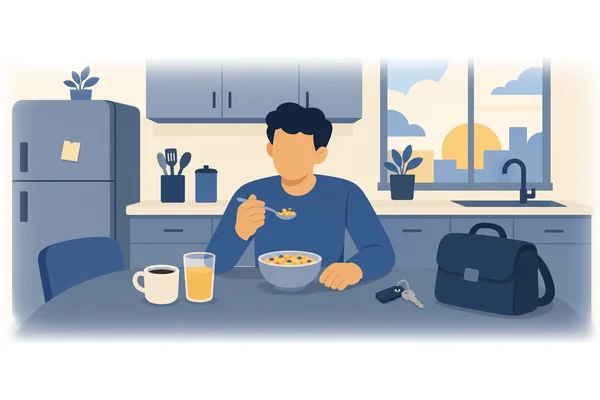
Examples





What to Remember
- Adverbs of frequency answer 'How often?' and describe how rare or common an action is.
- Common adverbs of frequency include: always, usually, often, sometimes, rarely, hardly ever, and never.
- With simple verbs, place the adverb of frequency before the main verb in the sentence.
- With the verb 'be', the adverb of frequency comes after 'be', not before it.
- Never place an adverb of frequency at the end of a sentence in standard English.