
Why Learners Struggle with Adverbs of Manner
Adverbs of manner describe how an action happens, but B1 learners often make mistakes because they confuse adverbs with adjectives, place them incorrectly in sentences, or forget to add the -ly ending. These errors happen because your native language may form adverbs differently, or you might not recognise when an adverb is needed instead of an adjective. Understanding the most common mistakes will help you use adverbs of manner accurately and naturally.
Common Mistakes at a Glance
| Mistake Type | ❌ Incorrect | ✅ Correct | Why the Error Occurs |
|---|---|---|---|
| Using adjective instead of adverb | She sings beautiful. | She sings beautifully. | Learners use the adjective form to modify a verb instead of adding -ly to form the adverb. |
| Irregular adverb — good / well | He plays football good. | He plays football well. | Good is an adjective; its adverb form is the irregular word well. |
| Irregular adverb — fast / fastly | She ran fastly. | She ran fast. | Learners apply the regular -ly rule, but fast is both adjective and adverb — no -ly needed. |
| Irregular adverb — hard / hardly | He studied hardly for the exam. | He studied hard for the exam. | Hard (= with effort) is already an adverb. Hardly is a different word meaning "almost not." |
| Irregular adverb — late / lately | The train arrived lately. | The train arrived late. | Late modifies arrival time. Lately means "recently" and refers to time period, not manner. |
| Wrong adverb placement | She quickly is eating lunch. | She is eating lunch quickly. | Adverbs of manner usually follow the main verb or object, not split auxiliary and main verbs. |
| Spelling error — -le adjectives | He spoke gentlely. | He spoke gently. | Adjectives ending in -le drop the e and add -y (not -ely) to form the adverb. |
| Using adverb to modify a noun | She is a highly woman. | She is a tall woman. / She is highly skilled. | Adverbs modify verbs, adjectives, or other adverbs — not nouns. Use an adjective to describe a noun. |
| Double adverb marking | He did it more quickly and more faster. | He did it more quickly and faster. | Irregular comparative adverbs (fast → faster) don't also take more. Avoid double comparatives. |
| Omitting -ly from regular adverb | She answered the question calm. | She answered the question calmly. | Unlike a few flat adverbs (e.g., fast, hard), most manner adverbs require the -ly suffix. |
Formula
✔ Positive
Subject
+
verb
+
adverb of manner
She danced gracefully across the stage.
✖ Negative
Subject
+
do/does not
+
verb
+
adverb of manner
They don't speak English fluently.
Examples

She answered the question correctly and carefully.
Two adverbs of manner together · Present tense

The athlete ran quickly towards the finish line.
Adverb describes how the action happened · Common mistake area

He spoke to me politely and respectfully throughout the meeting.
Multiple adverbs describing the same verb · Formal context
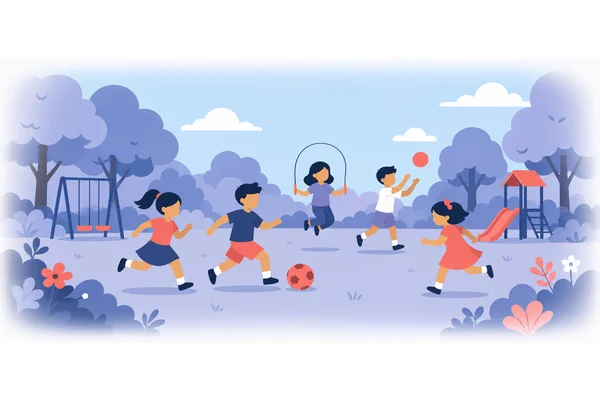
The children played happily in the garden all afternoon.
Adverb of manner with time expression · Everyday usage
Signal words
quickly
carefully
slowly
happily
angrily
politely
roughly
gently
loudly
softly
badly
well
easily
difficultly
Common Mistakes
✕
Wrong
She speaks English fluent.
✓
Correct
She speaks English fluently.
Adverbs of manner need -ly ending. Use the adverb form, not the adjective, to describe how she speaks.
✕
Wrong
He walked quick to the station.
✓
Correct
He walked quickly to the station.
The adverb 'quickly' (not 'quick') describes the manner of walking. Adjectives cannot modify verbs.
✕
Wrong
She sings beautiful in the choir.
✓
Correct
She sings beautifully in the choir.
After the verb 'sing', use the adverb 'beautifully' to show how she sings, not the adjective 'beautiful'.
✕
Wrong
They worked hardly all day.
✓
Correct
They worked hard all day.
'Hard' is both adjective and adverb. 'Hardly' means 'barely' or 'almost not'. Use 'hard' here.
✕
Wrong
The driver stopped sudden when he saw the red light.
✓
Correct
The driver stopped suddenly when he saw the red light.
The adverb form is 'suddenly' (with -ly), not 'sudden'. Adverbs describe how the action happened.
✕
Wrong
She answered the question correct.
✓
Correct
She answered the question correctly.
Use the adverb 'correctly' after the verb 'answered' to describe the manner of answering.
✕
Wrong
He played the piano good at the concert.
✓
Correct
He played the piano well at the concert.
'Well' is the adverb form of 'good'. Never use 'good' to describe how an action is done.
KEY TAKEAWAYS
What to Remember
- Adverbs of manner describe how an action happens, formed by adding -ly to most adjectives.
- Place adverbs of manner after the verb or at the end of the sentence.
- Do not confuse adjectives with adverbs; use adverbs to modify verbs, not nouns.
- Some adverbs of manner are irregular and do not follow the -ly pattern.
- Avoid placing adverbs of manner between the verb and its direct object in English.