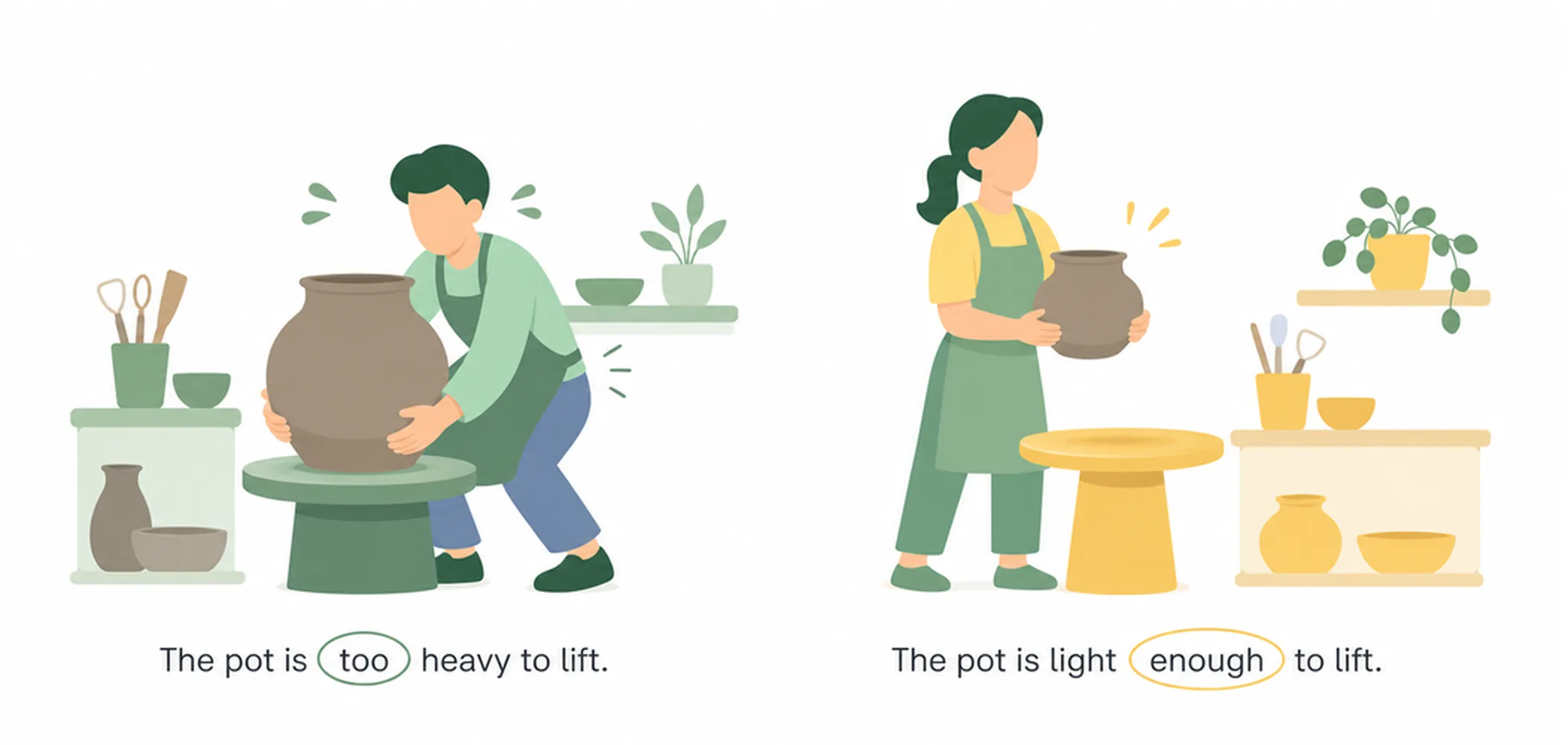
Too vs Enough: The Key Difference
Both 'too' and 'enough' are adverbs of degree that modify adjectives and adverbs, but they express opposite meanings. Use 'too' when something is excessive or more than needed. Use 'enough' when something is sufficient or satisfactory. The position in a sentence also differs: 'too' comes before the adjective, while 'enough' comes after.
Too vs Enough: Side-by-Side Comparison
| Dimension | Too | Enough |
|---|---|---|
| Meaning | More than necessary or desirable; an excessive amount | As much or as many as required; a sufficient amount |
| Form | too + adjective / adverb (e.g., too hot, too quickly) |
adjective / adverb + enough noun: enough + noun or noun + enough (e.g., fast enough, enough time) |
| Position in Sentence | Placed before the adjective or adverb it modifies | Placed after the adjective or adverb it modifies; before a noun |
| Implication | Negative — suggests a problem, obstacle, or undesirable excess | Neutral to positive — suggests adequacy or sufficiency; negative when used with not |
| Modifier Type | Modifies adjectives and adverbs only (not nouns directly) | Modifies adjectives, adverbs, and nouns |
| When to Use | Use when something exceeds an acceptable limit and causes a negative result or prevents an action | Use when something meets the required standard or level; use not enough when it falls short |
| Positive Example | The soup is too hot to eat right now. | She is experienced enough to lead the project. |
| Negative Example | He drives too fast for me to feel safe. | There is not enough time to finish the exam. |
| Question Example | Is this bag too heavy to carry on the plane? | Do we have enough money to buy the tickets? |
| Key Signal Words | too … to (infinitive); excessively, overly (synonyms) | enough … to (infinitive); sufficient, adequate (synonyms); not enough = insufficient |
| Key Difference: Too always signals excess and carries a negative meaning — something is beyond an acceptable limit and therefore a problem. Enough signals sufficiency — something meets the required standard. While too always comes before the word it modifies, enough comes after adjectives and adverbs but before nouns. Both words are commonly followed by an infinitive (to + verb) to explain the consequence or purpose. | ||
Formula
✔ Positive
Subject
+
verb
+
too
+
adjective/adverb
The exam is too difficult.
✖ Negative
Subject
+
verb
+
negation
+
adjective/adverb
+
enough
The salary is not high enough.
? Question
Is
+
subject
+
adjective
+
enough
Is the food tasty enough?
Examples

This coffee is too hot to drink right now.
Excessive quality · Adjective modification

The music was too loud for the small café.
Problem situation · Adjective modification

You're driving too fast on this narrow road.
Adverb modification · Safety concern

She has enough experience for this senior position.
Sufficient quality · Noun modification

Is the water warm enough for swimming?
Satisfactory level · Question form

He doesn't speak English well enough to attend the meeting.
Adverb modification · Negative context
When to use it
Expressing Problems
Use 'too' when describing something negative or excessive that creates a problem.
"The hotel room is too noisy to sleep."
Expressing Satisfaction
Use 'enough' when confirming that something meets your needs or is acceptable.
"The salary is enough to live comfortably in this city."
Asking About Sufficiency
Use 'enough' in questions to ask whether something is satisfactory or adequate.
"Do you have enough energy for the hike?"
Signal words
too hot/cold/big/small
too much/many
too + adverb (too quickly, too slowly)
adjective + enough
enough + noun (enough time, enough money)
not + adjective + enough
well enough
good enough
Common Mistakes
✕
Wrong
This box is enough heavy to carry.
✓
Correct
This box is too heavy to carry.
'Enough' comes after the adjective, not before. Use 'too' for excessive weight.
✕
Wrong
She speaks too well for this job.
✓
Correct
She speaks well enough for this job.
'Too' suggests a problem, but 'well' is a positive quality. Use 'enough' instead.
✕
Wrong
We don't have enough time too complete the project.
✓
Correct
We don't have enough time to complete the project.
'Too' is an adverb of degree; 'to' is a preposition/infinitive marker. Don't confuse them.
KEY TAKEAWAYS
What to Remember
- Use 'too' for excessive amounts and 'enough' for sufficient or satisfactory amounts.
- 'Too' comes before the adjective or adverb it modifies in sentences.
- 'Enough' comes after the adjective or adverb it modifies in sentences.
- Both 'too' and 'enough' are adverbs of degree that modify adjectives and adverbs.
- Common mistake: placing 'enough' before the adjective instead of after it.