What are adverbs of degree?
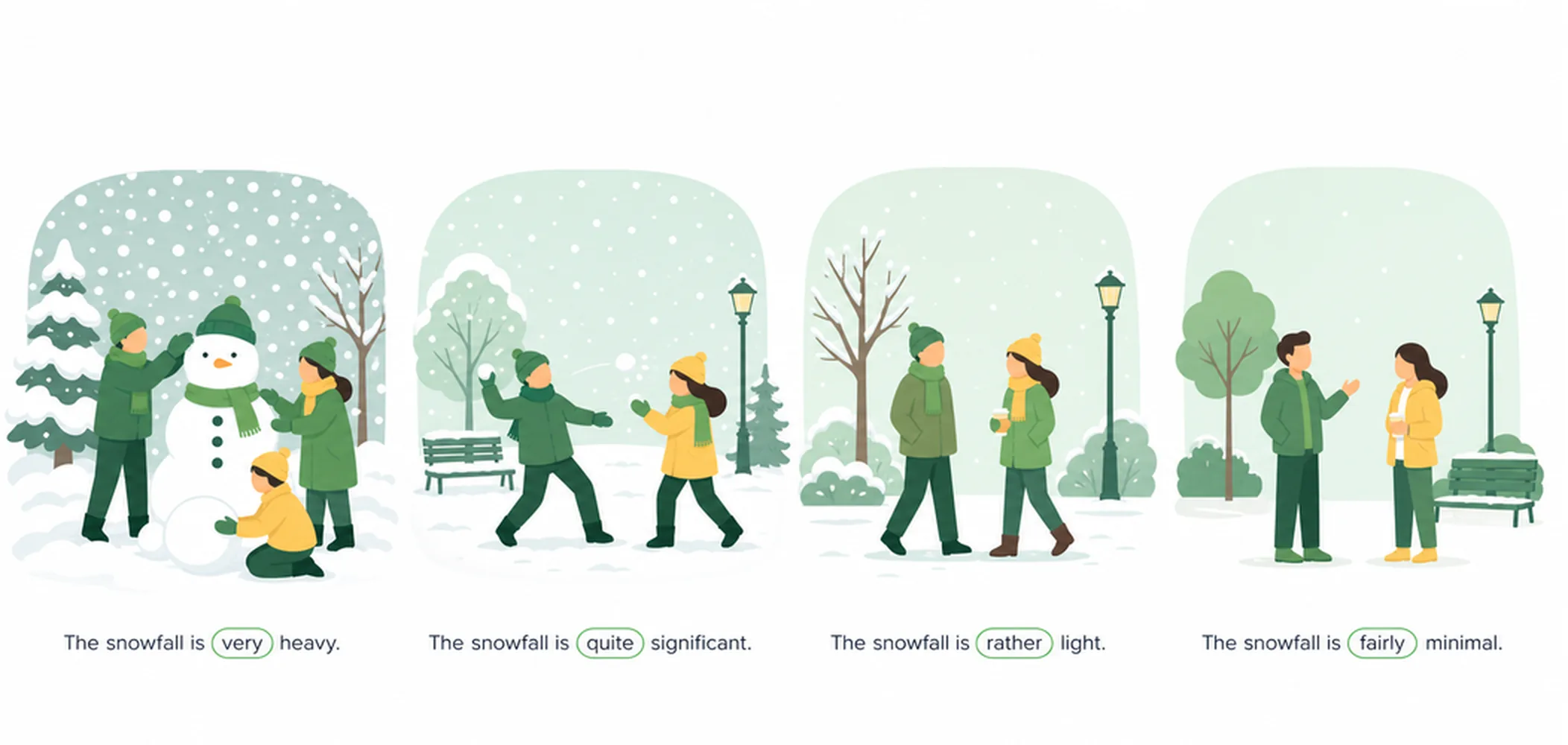
Adverbs of degree are words that tell us how strong or intense an adjective or adverb is. They modify adjectives and adverbs to show the level or intensity of a quality. The most common adverbs of degree are: very, quite, rather, and fairly. These words come before the adjective or adverb they modify and help you express nuances in English.
Understanding each adverb of degree
Very is the strongest and most common. Use it to say something is at a high level: very good, very hot, very quickly. Quite is weaker than very and means 'fairly' or 'rather' in British English, though it can mean 'completely' in American English. Rather suggests something is more than average but not extreme—it often has a slightly negative feeling. Fairly is mild and means 'more or less' or 'moderately'—it suggests a reasonable amount but not extreme.
Comparing very, quite, rather, and fairly
| Feature | Very | Quite | Rather | Fairly |
|---|---|---|---|---|
| Intensity Level | ⬛⬛⬛⬛ Highest / Strongest | ⬛⬛⬛☐ High to moderate (context-dependent) | ⬛⬛⬛☐ Moderate to high (often negative nuance) | ⬛⬛☐☐ Low to moderate / Weakest |
| Typical Meaning | To a great degree; emphasises the adjective strongly with no ambiguity | Meaning shifts by dialect: "completely / entirely" (BrE with gradable adj.) or "moderately" (AmE) | More than expected; often carries a slightly critical or surprised tone | To a reasonable but not exceptional degree; neutral and mild |
| Register / Style | Neutral; used freely in all registers — formal, informal, spoken, written | Common in both BrE and AmE but with different intensities; slightly formal in some BrE uses | More common in BrE; can sound old-fashioned or literary in AmE; mild formality | Neutral and understated; typical in everyday BrE and AmE; avoids exaggeration |
| British English Note | Universally understood and used; no regional variation in meaning | "Quite good" in BrE often means fairly good (less positive than it sounds); "quite perfect" means completely perfect | Widely used in BrE; can express polite disapproval: "It's rather expensive" implies mild complaint | Clearly signals moderation in BrE; avoids overstating a quality |
| American English Note | Same strong meaning as BrE; frequently paired with intensifiers like "very, very" | In AmE, "quite good" usually means very good — the opposite of BrE usage; source of misunderstanding | Less common; can sound affected or British to American ears; sometimes replaced by "pretty" | Used similarly to BrE; sometimes replaced informally by "pretty" (e.g. "pretty good") |
| Positive Example | "The film was very entertaining." (strong endorsement) |
"The film was quite good." (BrE: moderately good; AmE: very good) |
"The film was rather good, I must say." (pleasantly surprised) |
"The film was fairly enjoyable." (mild approval, not enthusiastic) |
| Critical / Negative Example | "The exam was very difficult." (strongly emphasises difficulty) |
"The exam was quite hard." (BrE: somewhat hard; softens the complaint) |
"The exam was rather unfair." (implies mild irritation or criticism) |
"The exam was fairly straightforward." (neutral; neither hard nor very easy) |
| Typical Adjective Partners | Works with most gradable adjectives: very tall, very cold, very happy | Works with gradable AND absolute adjectives: quite nice, quite certain, quite exhausted | Works with gradable adjectives, especially negative or unexpected ones: rather rude, rather odd, rather beautiful | Works with gradable adjectives in neutral contexts: fairly easy, fairly warm, fairly clear |
| Can Precede a Noun? | No — very does not directly precede nouns | Yes — "quite a surprise", "quite an achievement" | Yes — "rather a shame", "rather a good idea" | No — fairly does not directly precede nouns |
| Tone / Connotation | Emphatic, direct, enthusiastic or alarming depending on context; no hedging | Ambiguous across dialects; can be diplomatic or emphatic; polite in BrE understatement | Often implies unexpectedness or mild surprise; slightly opinionated; sometimes patronising | Neutral and measured; avoids strong emotion; factual and balanced |
| Common Mistakes | Overuse weakens impact; avoid with absolute adjectives: ✗ "very perfect", ✗ "very unique" | BrE/AmE confusion: saying "quite good" to an American when you mean "only moderately good" | Can sound rude if tone is not careful: "You're rather loud" may offend | Using fairly when strong praise is needed — it may undersell a quality unintentionally |
| 🔑 Key Difference: These four adverbs form a scale of intensity — fairly (weakest) → quite → rather → very (strongest) — but their exact positions shift with dialect and context. Very is always strong and unambiguous. Fairly is always moderate and neutral. Quite is the trickiest: in British English it often weakens a compliment ("quite nice" = only somewhat nice), whereas in American English it strengthens it ("quite nice" = very nice). Rather typically adds a tone of mild surprise, criticism, or unexpectedness and is more characteristic of British English. When precision matters — especially in cross-cultural communication — favour very or fairly to avoid misinterpretation. | ||||
Examples






What to Remember
- Adverbs of degree (very, quite, rather, fairly) modify adjectives and adverbs to show intensity.
- Place these adverbs directly before the adjective or adverb they modify.
- Very is the strongest; quite, rather, and fairly are progressively weaker in intensity.
- Use very for the highest level of intensity in most contexts.
- Quite can mean "completely" with some adjectives or "somewhat" with others; context matters.