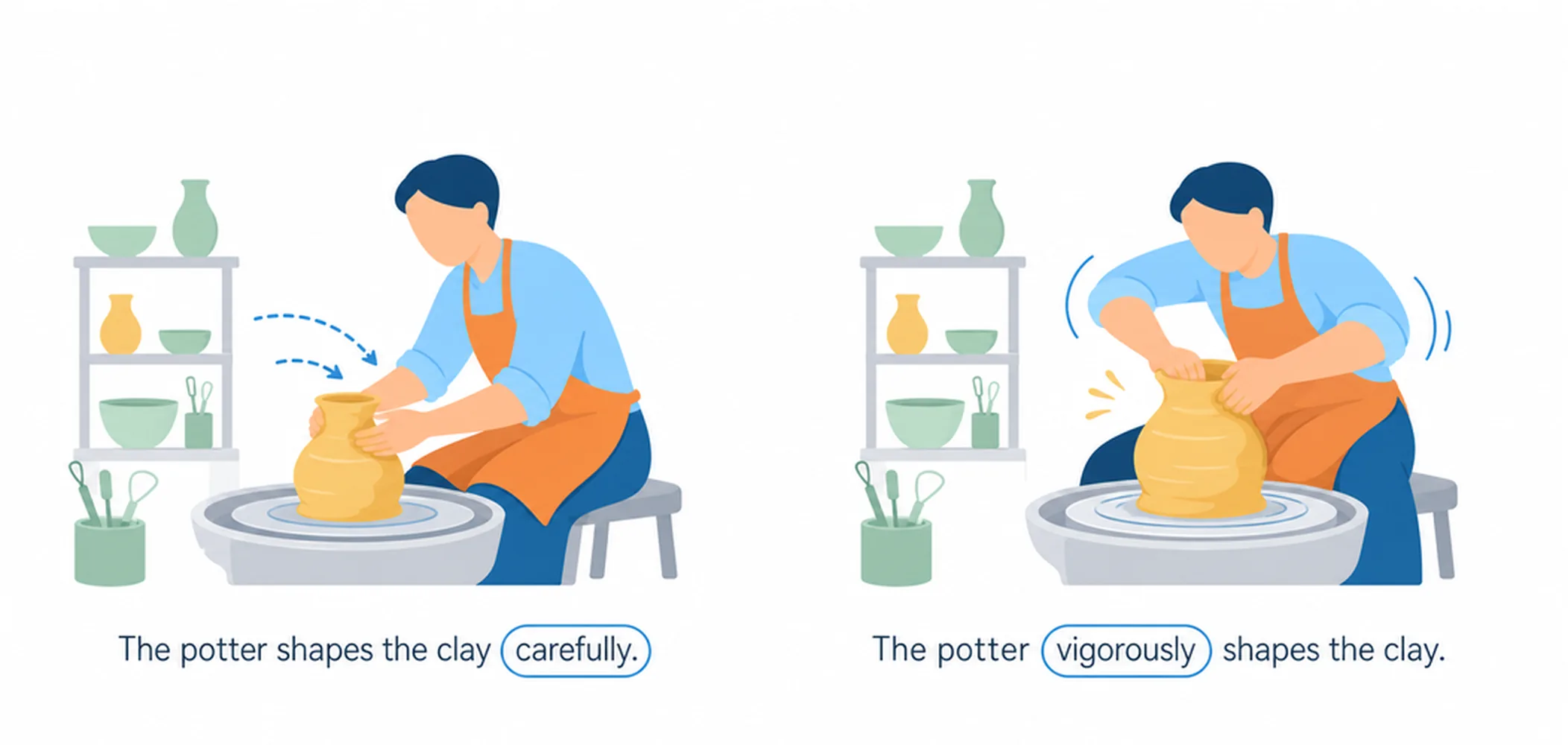
What are adverbs of manner?
Adverbs of manner describe how an action is performed. They tell us the way or style in which something happens. Most adverbs of manner are formed by adding '-ly' to an adjective: quick → quickly, careful → carefully, slow → slowly. However, some adverbs of manner have irregular forms, like 'well' (from good) and 'fast' (same form as the adjective). These adverbs are essential for adding detail and clarity to your sentences.
The main positions for adverbs of manner
Adverbs of manner can appear in three main positions in a sentence. They can come after the main verb (most common), between the auxiliary verb and main verb, or at the beginning of a sentence for emphasis. The position depends on the sentence structure and what you want to emphasize. Understanding these patterns will help you write more naturally and correctly.
Key positioning rules
Place the adverb directly after the main verb. If there is an object, place the adverb after the object.
When a sentence contains an auxiliary verb (have, has, had, is, are, was, were), place the adverb of manner after the main verb, not between the auxiliary and main verb.
Place the adverb at the start of the sentence to create emphasis or a more formal tone. This structure is common in narrative writing.
Sentence Position Formulas
Sentence Position Formulas
Position 1: After an Intransitive Verb (No Object)
PositivePosition 2: After the Object (Transitive Verb)
PositivePosition 3: At the Beginning of the Sentence (For Emphasis)
PositiveExamples





What to Remember
- Adverbs of manner describe how an action is performed and usually end in '-ly'.
- Form adverbs of manner by adding '-ly' to adjectives: quick → quickly, careful → carefully.
- Remember irregular adverbs of manner like 'well' (from good) and 'fast' (unchanged form).
- Adverbs of manner can appear in three main positions within a sentence structure.
- Place adverbs of manner after the verb, after the object, or at the sentence start.