Grammar B1 Adverbs of Manner & Degree

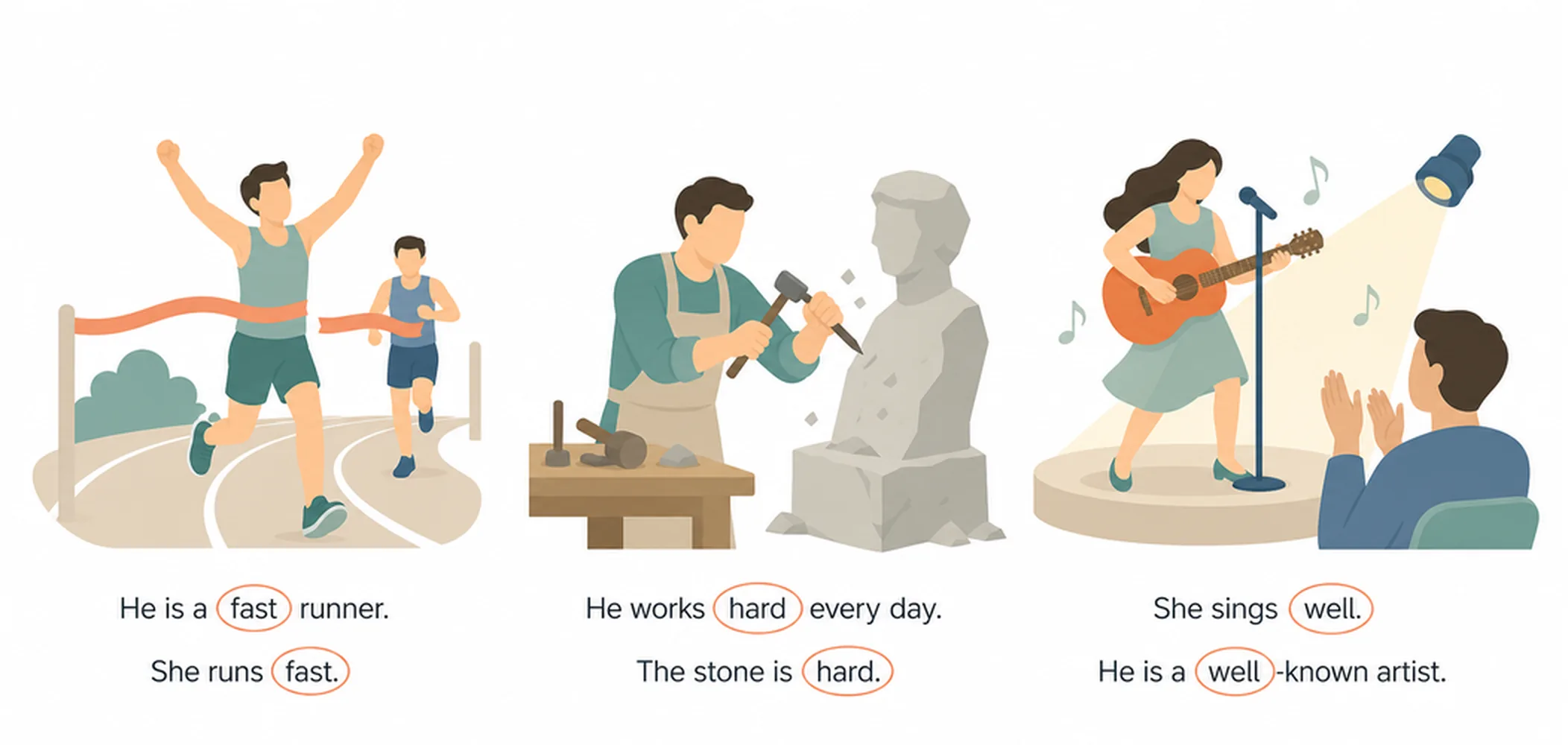
Irregular adverbs (fast, hard, late, well)

Irregular adverbs (fast, hard, late, well)

What Are Irregular Adverbs?

Most adverbs of manner are formed by adding -ly to an adjective: quick → quickly, slow → slowly. However, some common adverbs do not follow this pattern. These are called irregular adverbs. They have unique forms that you must learn and memorize. The most common irregular adverbs are fast, hard, late, well, and a few others. Understanding these exceptions is important because they appear frequently in English conversation and writing.

Common Irregular Adverbs

Fast is both an adjective and an adverb with the same form: "a fast car" (adjective) and "He drives fast" (adverb). Hard can be an adjective or adverb: "a hard problem" and "She works hard." Late functions as both adjective and adverb: "the late train" and "The train arrived late." Well is the irregular adverb form of good and is used differently: "She is a good student" (adjective) but "She studies well" (adverb). These words do not take -ly endings in their adverb forms, which makes them stand out from regular adverbs.

Why These Forms Matter

Confusing irregular adverbs with their regular forms is a common mistake. For example, "hardly" exists but means "almost not," which is very different from "hard." Similarly, "lately" means "recently," not the adverb form of the adjective "late." Recognizing these distinctions helps you communicate more clearly and avoid misunderstandings. Pay special attention when you encounter these words in context to understand their exact meaning.

Irregular Adverbs at a Glance

Adjective Irregular Adverb Example -ly Look-alike -ly Meaning & Example
fast fast She runs fast. fastly ✗ Fastly does not exist in standard English. Use fast only.
hard hard He works hard. hardly ✓ Hardly = scarcely / almost not.
I could hardly hear her.
late late The train arrived late. lately ✓ Lately = recently.
I haven't seen him lately.
good well She speaks English well. well ✓ (also adjective) Well as adjective = healthy.
I don't feel well today.
Good cannot be used as an adverb in standard English.
Formula
✔ Positive
Subject + verb + irregular adverb
She works hard.
✖ Negative
Subject + do not + verb + irregular adverb
They do not work hard on this project.

Examples

She runs fast in the morning.
Adverb of manner · speed of action
He works hard every day to improve his English.
Adverb of manner · effort or intensity
The bus arrived late because of traffic.
Adverb of manner · timing
She speaks English very well after living in London for two years.
Adverb of manner · quality of action
He plays guitar well, but his singing is not as good.
Contrasts with adjective 'good'
I have hardly eaten anything today, so I am very hungry.
Different from 'hard' · means 'almost not'
When to use it
Describing Speed or Effort
Use fast and hard to describe how quickly or intensively someone does something.
"She learns fast" or "He studies hard for his exams."
Describing Timing
Use late to describe when something happens, usually after the expected time.
"The train is running late again."
Describing Quality of Performance
Use well to describe how well someone does an activity or performs a skill.
"She dances well" or "He doesn't play football very well."
Contrasting with Adjectives
Use irregular adverbs to show the difference between adjectives and how actions are performed.
"Good food tastes good, but he cooks well."
Signal words
fast hard late well slowly quickly hardly lately
Common Mistakes
Wrong
She speaks English quickly well.
Correct
She speaks English well.
Well is already an adverb; do not add -ly. Well functions as a complete adverb on its own.
Wrong
He runs hardly every morning.
Correct
He runs hard every morning.
Hardly means 'almost not,' not the adverb of hard. Hard is the correct form for describing effort.
Wrong
The meeting started fastly at 9 AM.
Correct
The meeting started at 9 AM. OR We started the meeting fast.
Fast does not take -ly. Fast is already an adverb when needed, or use 'quickly.'
Wrong
She is a well student.
Correct
She is a good student.
Well is an adverb, not an adjective. Use good for adjectives describing nouns.
Wrong
He arrived lately to the party.
Correct
He arrived late to the party.
Lately means 'recently.' Late is the adverb for timing. 'Lately' is used differently: 'He has been busy lately.'
KEY TAKEAWAYS

What to Remember

  • Most adverbs of manner are formed by adding -ly to adjectives, but some are irregular.
  • Irregular adverbs like fast, hard, late, and well do not follow the standard -ly pattern.
  • Fast, hard, and late can be both adjectives and adverbs with identical forms.
  • Well is the irregular adverb form of the adjective good and cannot use -ly.
  • Irregular adverbs must be memorized individually because they appear frequently in everyday English.
← Previous
How to form adverbs from adjectives (-ly)
Next →
Position of adverbs of manner in a sentence