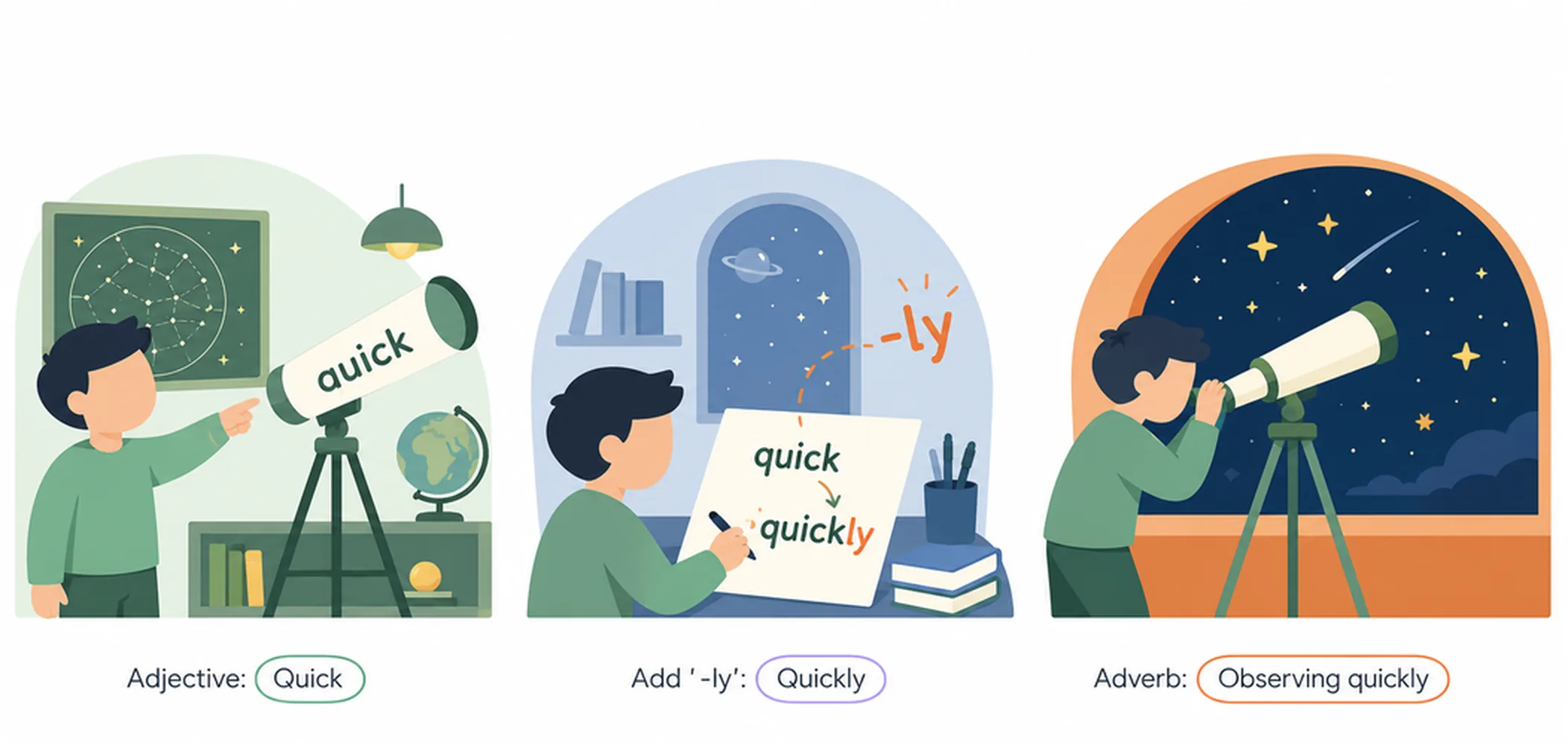
Introduction to Adverb Formation
Adverbs of manner describe how an action happens. Most English adverbs are formed by adding the suffix -ly to an adjective. For example: quick → quickly, slow → slowly. However, there are important spelling rules you must follow when adding -ly, especially when the adjective ends in certain letters. Learning these rules will help you form adverbs correctly and speak more naturally.
Spelling Rules for Forming Adverbs with -ly
| Adjective Ending | Spelling Rule | Adjective → Adverb | Note |
|---|---|---|---|
| -y | Change -y to -i, then add -ly | happy → happily angry → angrily easy → easily |
Applies when -y follows a consonant |
| -le | Drop the -e, replace with -y | gentle → gently simple → simply possible → possibly |
The -le ending is replaced entirely by -ly |
| -ll | Simply add -y (no extra l) | full → fully dull → dully |
Do not add a third l |
| -ic | Add -ally instead of just -ly | basic → basically tragic → tragically automatic → automatically |
Exception: public → publicly (not publically) |
| -e (most) | Keep the -e and add -ly | brave → bravely safe → safely late → lately |
Do not drop the -e (unlike -le words) |
| Default (consonant ending) | Add -ly directly to the adjective | slow → slowly quick → quickly loud → loudly |
The most common rule; no spelling change needed |
| Irregular | Must be memorised individually | good → well fast → fast hard → hard |
Some adverbs look identical to their adjective; hardly ≠ "in a hard way" |
Formula
✔ Positive
Adjective
+
+ -ly
She spoke clearly about her ideas.
Examples

She answered the question correctly during the exam.
Regular formation: correct + -ly

The athlete moved gracefully across the floor.
Remove -e: grace + -ly

They worked happily together on the project.
Change -y to -i: happy → happi + -ly

He finished his homework responsibly every evening.
Remove -le: responsible + -ly
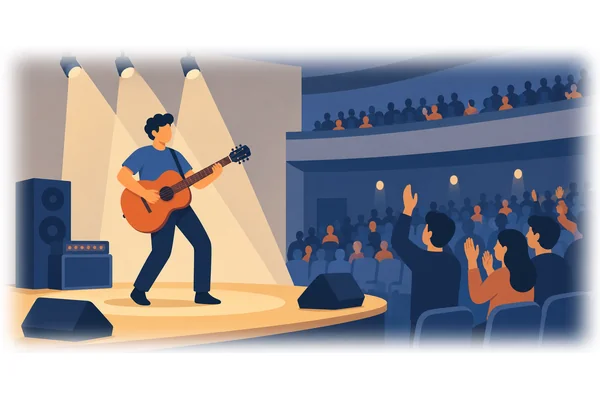
The musician played beautifully at the concert.
Change -y to -i: beauty → beauti + -ful + -ly
When to use it
Describing Actions in Classroom
Use manner adverbs to explain how students or teachers complete tasks. This helps give clear, detailed descriptions of behaviour or performance.
"The teacher explained the grammar slowly and carefully."
Talking About Movement
Adverbs of manner are essential when describing how someone moves or travels. They add detail to everyday conversations.
"He walked quickly to catch the bus."
Describing Communication
Use -ly adverbs to describe how people speak, listen, or communicate with each other in social situations.
"She spoke softly so nobody would hear her."
Signal words
clearly
slowly
quickly
carefully
happily
sadly
easily
gracefully
loudly
quietly
beautifully
responsibly
Common Mistakes
✕
Wrong
She speaks very loud in meetings.
✓
Correct
She speaks very loudly in meetings.
Use the adverb 'loudly' (not 'loud') to describe how she speaks.
✕
Wrong
He moved carefuly across the room.
✓
Correct
He moved carefully across the room.
When adjective ends in -e, remove it before adding -ly: careful → carefully (not carefuly).
✕
Wrong
They answered quickely to all questions.
✓
Correct
They answered quickly to all questions.
Change -y to -i before adding -ly: quick → quickly (not quickely).
KEY TAKEAWAYS
What to Remember
- Most adverbs are formed by adding -ly to an adjective to describe how an action happens.
- When an adjective ends in -y, change the y to i before adding -ly: happy → happily.
- For adjectives ending in -le, drop the e and add -y: simple → simply, not simpley.
- Adjectives ending in -ll only need -y added: full → fully, not fullly.
- Some common adjectives have irregular adverb forms that don't follow -ly rules: good → well, fast → fast.