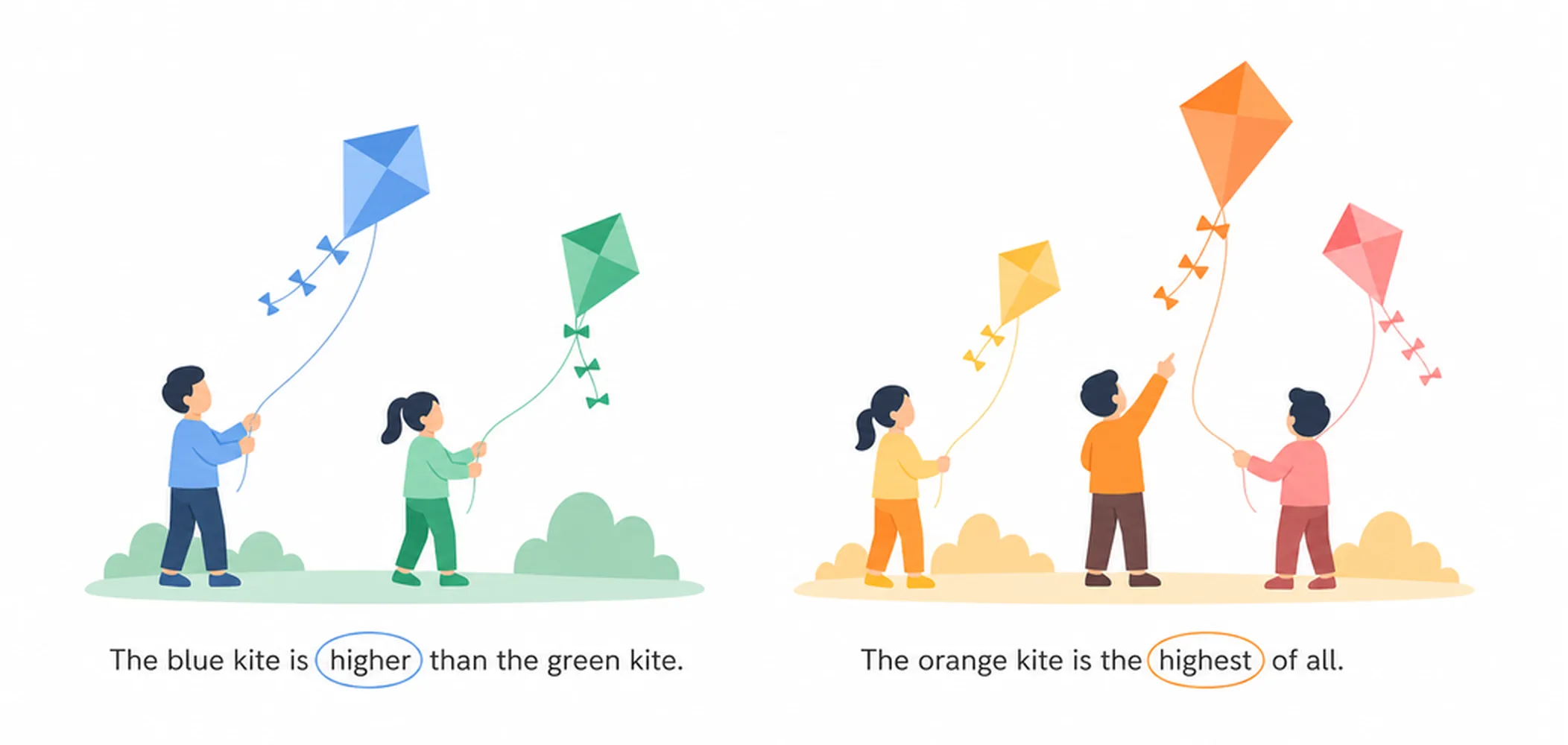
The Key Difference
Comparatives and superlatives are both used with adjectives to show differences, but they compare different numbers of things. A comparative compares two people, things, or groups. A superlative compares three or more people, things, or groups and shows which one is the most or least. Understanding when to use each one is essential for accurate English.
Comparatives vs Superlatives at a Glance
Comparatives use the structure 'more/—er + adjective + than' and compare exactly two items. Superlatives use the structure 'the most/—est + adjective' and show the extreme quality among three or more items. Both follow consistent patterns based on adjective length, but superlatives always need the definite article 'the' before them.
Comparatives in Action
Use comparatives when you are directly comparing two people, things, or situations.
Superlatives in Action
Use superlatives when you want to identify the single best, worst, highest, or lowest example from a group of three or more.
Common Confusion Mistakes
These errors happen when learners mix up when to use each form or apply the wrong structure.
Quick Memory Tip
Remember: Comparatives have a partner (two things being compared), so they often come with 'than.' Superlatives stand alone as the winner or extreme, so they always use 'the.'
Comparatives vs Superlatives: Side-by-Side Comparison
| Dimension | Comparatives | Superlatives |
|---|---|---|
| Purpose | Compares two people, things, or groups, showing that one has more or less of a quality than the other. | Identifies the item that has the highest or lowest degree of a quality within a group of three or more. |
| Number of Items Compared | Exactly two items, people, or groups. | Three or more items, people, or groups (or a whole set/category). |
| Form — Short Adjectives (1–2 syllables) | Add -er to the adjective. e.g. fast → faster, tall → taller, big → bigger |
Add -est to the adjective + use the. e.g. fast → the fastest, tall → the tallest, big → the biggest |
| Form — Long Adjectives (3+ syllables) | Use more or less before the adjective. e.g. expensive → more expensive, comfortable → less comfortable |
Use the most or the least before the adjective. e.g. expensive → the most expensive, comfortable → the least comfortable |
| Article Usage | No definite article required. e.g. She is taller than her brother. |
Always preceded by the definite article the. e.g. She is the tallest in her family. |
| Typical Linking Word | Followed by than when the second item is mentioned. e.g. This road is longer than that one. |
Followed by in (for places/groups) or of (for sets). e.g. This is the longest road in the county. / the best of all. |
| Positive Example | This laptop is more powerful than my old one. | This is the most powerful laptop in the store. |
| Negative Example | The bus is less comfortable than the train. | The bus is the least comfortable option available. |
| Question Example | Is summer hotter than spring where you live? | Which season is the hottest of the year? |
| Irregular Forms | good → better; bad → worse; far → farther / further; little → less | good → the best; bad → the worst; far → the farthest / furthest; little → the least |
| Common Mistakes to Avoid | ❌ Using a superlative when only two things are compared: "She is the oldest of the two." ✅ "She is older of the two." | ❌ Omitting the: "He is tallest player." ✅ "He is the tallest player." ❌ Double superlative: "the most greatest." |
| Key Signal Words / Phrases | than, more, less, -er, compared to, as … as (equal comparison) | the, most, least, -est, ever, of all, in the world, by far |
| 🔑 Key Difference: Use a comparative (-er / more / less … than) when placing two things side by side to show which has more or less of a quality. Use a superlative (the -est / the most / the least) when singling out one item from a group of three or more as having the highest or lowest degree of that quality. The presence of the and the size of the group being discussed are the clearest signals of which form is needed. | ||
Examples






What to Remember
- Use comparatives when comparing exactly two people, things, or groups.
- Use superlatives when comparing three or more people, things, or groups.
- Comparatives show which one is more or less; superlatives show which is most or least.
- Add -er to short adjectives for comparatives and -est for superlatives.
- Use more/less for long adjectives in comparatives and most/least in superlatives.