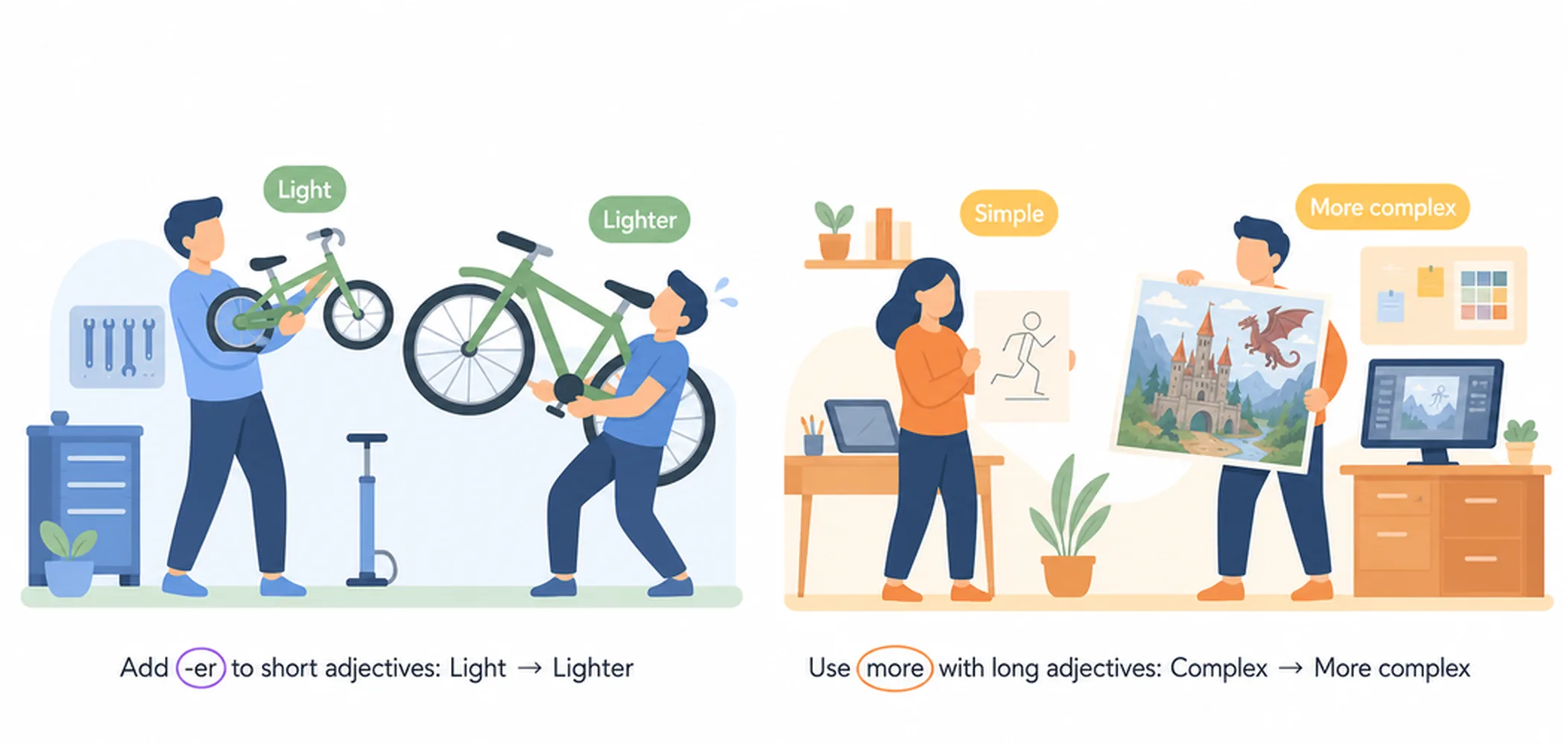
Introduction to Comparative Adjectives
Comparative adjectives are used to compare two people, things, or groups. In English, we form comparatives in two main ways: adding the suffix -er to short adjectives, or using the word more before longer adjectives. The choice depends on how many syllables the adjective has. Understanding these rules will help you describe differences clearly and naturally.
How to Choose: -er or more?
Choosing between -er and more depends on the length and type of adjective. Here's the rule:
| Use -er | Use more |
|---|---|
|
One-syllable adjectives: tall → taller fast → faster old → older |
Three or more syllable adjectives: beautiful → more beautiful interesting → more interesting expensive → more expensive |
|
Most two-syllable adjectives ending in -y: happy → happier easy → easier busy → busier |
Two-syllable adjectives ending in -ful, -less, -ous, -able: careful → more careful hopeless → more hopeless famous → more famous |
|
Some common two-syllable adjectives: clever → cleverer simple → simpler narrow → narrower |
Other two-syllable adjectives: modern → more modern common → more common perfect → more perfect |
She is taller than her brother.
This solution is simpler than the last one.
That film is more interesting than this one.
This approach is more careful than the previous method.
Note: A few adjectives have irregular comparative forms and do not follow these rules: good → better, bad → worse, far → farther/further, little → less.
Examples





What to Remember
- Use -er with one-syllable adjectives: tall → taller, fast → faster.
- Use -er with two-syllable adjectives ending in -y: happy → happier, easy → easier.
- Use more with longer adjectives and most two-syllable adjectives: beautiful → more beautiful, interesting → more interesting.
- Always compare two things or people, never three or more, with comparative forms.
- Some adjectives are irregular and don't follow -er or more rules: good → better, bad → worse.