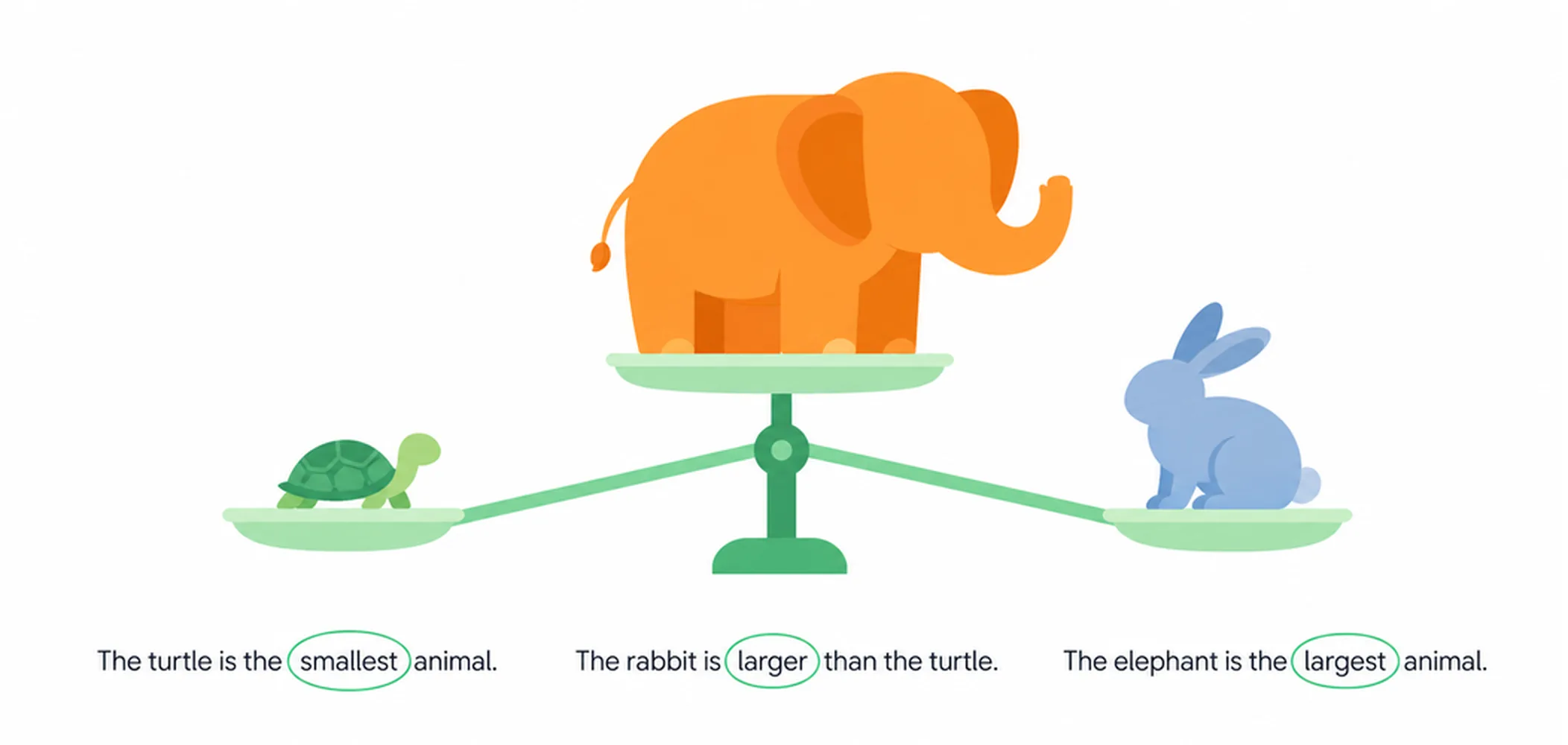
What Are Superlatives?
A superlative is an adjective or adverb that shows that something has the highest or lowest degree of a quality compared to all others in a group. For example, if you say 'This is the fastest car,' you mean it is faster than all other cars you are comparing it to. Superlatives help us describe things in the most extreme way possible—the best, the worst, the biggest, the smallest, and so on.
Forming Superlatives
There are two main ways to form superlatives in English. For short adjectives (usually one or two syllables), you add -est to the end: tall becomes tallest, big becomes biggest, happy becomes happiest. For longer adjectives (three or more syllables), you use the word 'most' before the adjective: beautiful becomes most beautiful, expensive becomes most expensive. Some adjectives are irregular and don't follow these rules, like good (best), bad (worst), and little (least).
Using Superlatives in Sentences
Superlatives usually come after the definite article 'the' in a sentence. You say 'the tallest building' or 'the most interesting book,' not 'a tallest building.' Superlatives can also be used with possessive words: 'my best friend' or 'their worst experience.' Understanding when and how to use superlatives will help you express comparisons more precisely and effectively in English.
The Superlative Scale: From Positive to Comparative to Superlative
| Category | Positive (Base) | Comparative (More) | Superlative (Most / Extreme) |
|---|---|---|---|
| Degree on Scale | Neutral — no comparison made | Middle — comparing two things | Extreme end — comparing three or more things |
| Short Adjective (1 syllable) | tall She is tall. | taller She is taller than her brother. | the tallest She is the tallest in the class. |
| Short Adjective (CVC — double consonant) | big That is a big dog. | bigger That dog is bigger than mine. | the biggest That is the biggest dog I have ever seen. |
| Adjective Ending in -y | happy The child is happy. | happier She is happier today than yesterday. | the happiest This is the happiest day of my life. |
| Long Adjective (2+ syllables) | expensive This watch is expensive. | more expensive This watch is more expensive than that one. | the most expensive This is the most expensive watch in the shop. |
| Long Adjective (2+ syllables) | beautiful The garden is beautiful. | more beautiful This garden is more beautiful than the park. | the most beautiful This is the most beautiful garden I have visited. |
| Irregular Adjective | good The food is good. | better This restaurant is better than the last one. | the best This is the best meal I have ever had. |
| Irregular Adjective | bad The weather is bad. | worse Today's weather is worse than yesterday's. | the worst This is the worst storm of the year. |
| Irregular Adjective | far The school is far. | farther / further The station is farther than the school. | the farthest / furthest That star is the farthest object visible tonight. |
| Formation Rule | Use the adjective in its base form. No article needed. | Add -er (short) or use more (long). Use than to name the second item. | Add -est (short) or use most (long). Always use the definite article the before the superlative. |
| Key Signal Words | very, quite, rather, so, extremely | than, compared to, slightly, much, a lot | the … of all, in the world, ever, of the group, by far the |
| Key Difference: The three degrees form a graded scale. The positive simply describes a quality with no comparison. The comparative moves along the scale to show that one thing has more of a quality than another (always involving exactly two items or groups). The superlative reaches the extreme end of the scale, showing that one thing has the most (or least) of a quality within a group of three or more — and it always requires the definite article the. Irregular adjectives (good → better → best; bad → worse → worst; far → farther → farthest) do not follow the standard rules and must be memorised. | |||
Examples



What to Remember
- A superlative shows that something has the highest or lowest degree of a quality in a group.
- Short adjectives (1-2 syllables) add -est; long adjectives use "most" or "least" before the adjective.
- Always use the definite article "the" before a superlative adjective or adverb.
- Irregular adjectives like "good," "bad," and "far" have special superlative forms: best, worst, farthest.
- Superlatives compare one thing to all others in a group, while comparatives compare only two things.