What is the Order of Adjectives?
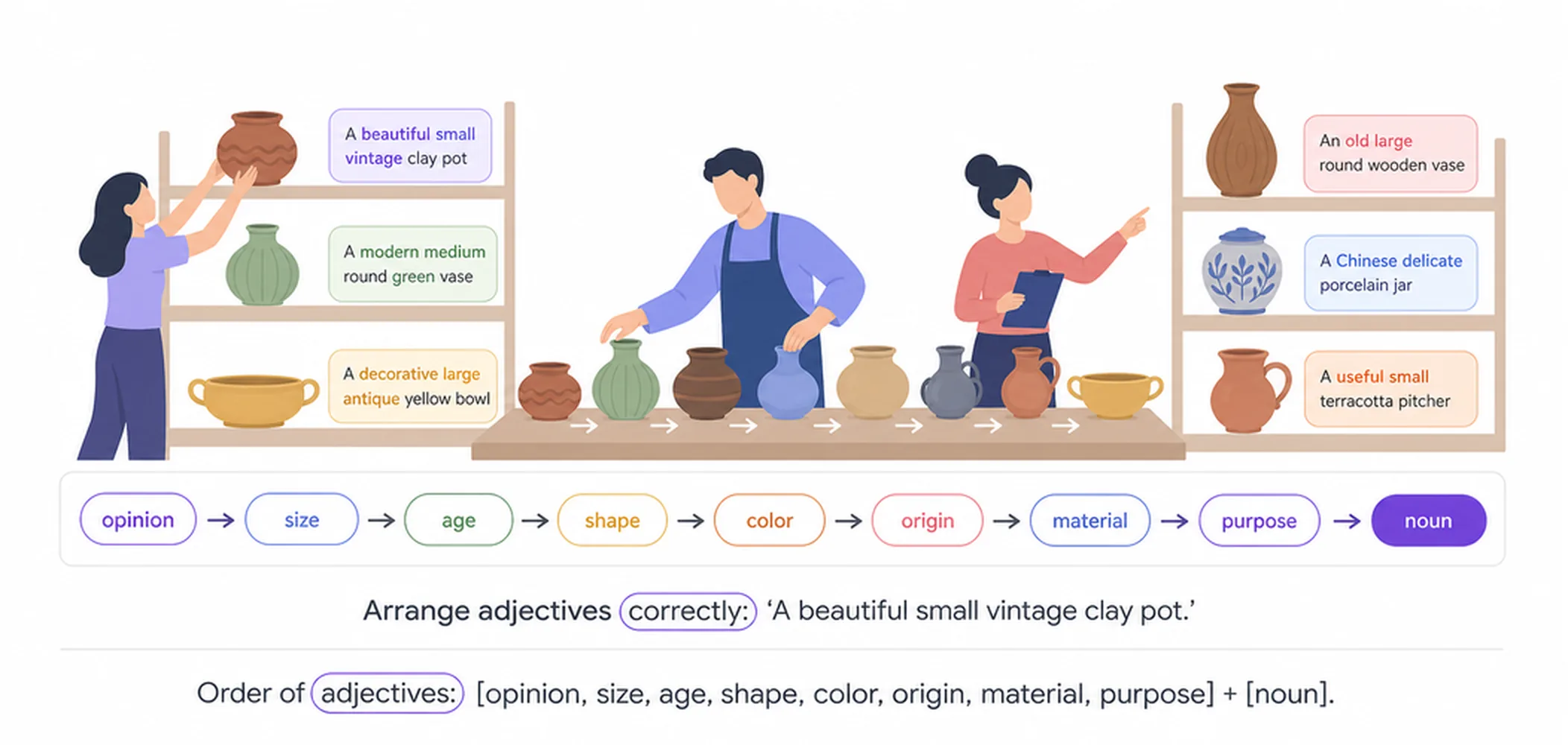
When you use more than one adjective to describe a noun, there is a natural order that English speakers follow. This order sounds natural and correct to native speakers, even if they don't think about the rule consciously. For example, we say 'a beautiful old house' not 'an old beautiful house'. Learning this order helps you speak and write more naturally in English.
The Basic Order of Adjectives
There are seven main categories of adjectives, and they follow this order: 1) Opinion (beautiful, good, ugly), 2) Size (big, small, tiny), 3) Age (old, young, new), 4) Shape (round, square, narrow), 5) Colour (red, blue, green), 6) Origin (Italian, French, English), 7) Material (wooden, plastic, metal). Most sentences only use two or three adjectives, so you don't need to memorize all categories. The key rule is: opinion adjectives come first, and material adjectives come last.
Common Patterns and Practical Tips
In daily English, you will most often see adjectives in this simple order: opinion + size + colour + noun, or opinion + age + noun. For example: 'a lovely small blue garden' or 'an interesting young man'. When you combine adjectives from the same category (like two colours or two opinions), you use 'and' between them: 'a beautiful and comfortable apartment'. If you are uncertain about the order, remember that adjectives closer to the noun usually describe what something IS (age, colour, material), while adjectives further away describe what you THINK about it (opinion, size).
Full Order of Adjectives — Quick Reference Table
| # | Category | Question It Answers | Example Adjectives |
|---|---|---|---|
| 1 | Opinion | What do you think of it? | lovely, terrible, beautiful |
| 2 | Size | How big or small is it? | tiny, large, enormous |
| 3 | Age | How old is it? | old, young, ancient |
| 4 | Shape | What shape is it? | round, square, triangular |
| 5 | Colour | What colour is it? | red, golden, dark blue |
| 6 | Origin | Where is it from? | French, Japanese, Italian |
| 7 | Material | What is it made of? | wooden, silver, cotton |
| 8 | Purpose | What is it used for? | sleeping (bag), cooking (pot), racing (car) |
Examples





What to Remember
- When using multiple adjectives, follow the natural order: opinion, size, age, color, origin, material, purpose.
- Opinion adjectives always come before size adjectives, even though they're not always about the noun's physical qualities.
- Place color adjectives after size and age but before origin and material adjectives.
- Native speakers instinctively know the correct order, so an adjective sequence that sounds wrong usually violates this rule.
- You rarely use more than three adjectives together in natural English, even though the full ordering system exists.