What are opinion adjectives?
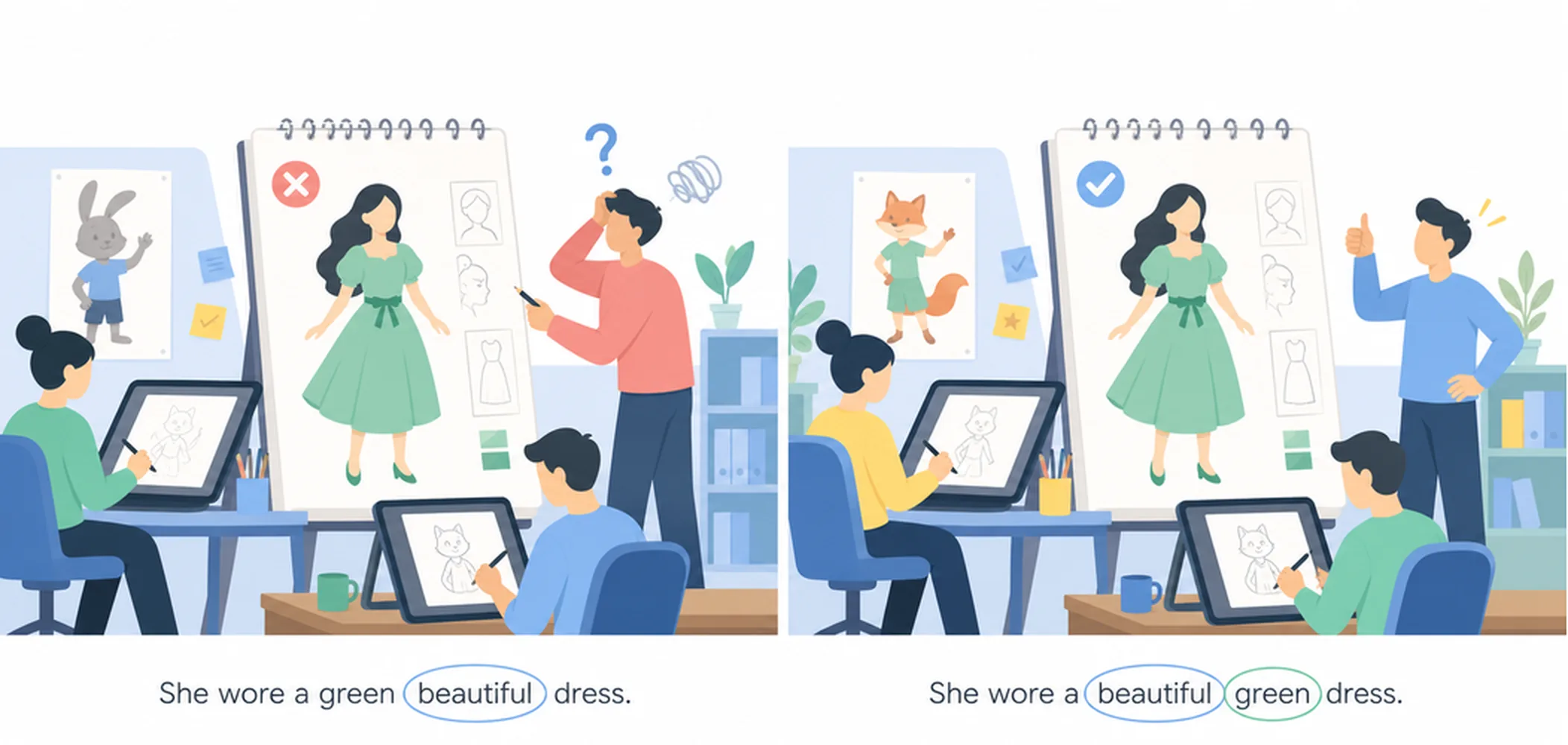
Opinion adjectives describe what we think or feel about something. They are different from factual adjectives (like color, size, or material). Opinion adjectives include words like beautiful, terrible, interesting, boring, wonderful, and awful. They tell us the speaker's personal judgment about a noun, not an objective fact.
Position of opinion adjectives
Opinion adjectives usually come BEFORE descriptive adjectives and the noun. When you have multiple adjectives, the order is: opinion + other adjectives + noun. For example: a beautiful red flower (not a red beautiful flower). Opinion adjectives can also come after the verb 'to be' or other linking verbs like seem, look, and taste.
Common patterns and exceptions
Most opinion adjectives follow the rule above, but some adjectives (like 'good', 'bad', 'nice') are so common that native speakers sometimes place them flexibly. Additionally, in informal speech, people may break these rules for emphasis. However, for B1 level, following the standard pattern is most important: put opinion adjectives before size, color, and material adjectives.
Opinion Adjectives — Position at a Glance
| Position | Pattern | Example | Adjective Order Note |
|---|---|---|---|
| Attributive (before noun) |
Opinion adj + noun | a lovely day a horrible smell a beautiful painting |
Opinion adjectives come first, before fact adjectives (size, age, shape, colour, origin, material). e.g. a lovely big house ✓ / a big lovely house ✗ |
| Attributive (before noun — multiple adjectives) |
Opinion + Fact adj(s) + noun | a gorgeous little old Italian car a wonderful small wooden table |
Full order: Opinion → Size → Age → Shape → Colour → Origin → Material → Purpose → Noun |
| Predicative (after linking verb) |
Subject + linking verb + opinion adj | The day is lovely. The smell seems horrible. The painting looks beautiful. |
No ordering conflict — only one adjective typically follows the linking verb. Common linking verbs: be, seem, look, feel, taste, smell, sound, appear, become. |
| Common Opinion Adjectives | lovely, beautiful, gorgeous, wonderful, brilliant, awful, horrible, terrible, dreadful, nasty, nice, pleasant, unpleasant, strange, odd, interesting, boring, exciting, frightening, surprising, amazing, ridiculous, perfect, ideal, important | ||
| Key Rule | Opinion adjectives express a personal view or judgement (not an objective fact). They can be used in both attributive and predicative positions. Most opinion adjectives work in either position, but a small number (e.g. utter, mere, sheer) are attributive only: utter nonsense ✓ / the nonsense was utter ✗. | ||
Examples



What to Remember
- Opinion adjectives describe personal judgments or feelings about something, not objective facts.
- Opinion adjectives always come before other descriptive adjectives and the noun.
- Common opinion adjectives include beautiful, terrible, interesting, boring, wonderful, and awful.
- When using multiple adjectives, always place opinion adjectives first in the sequence.
- Don't confuse opinion adjectives with factual adjectives like color, size, or material.