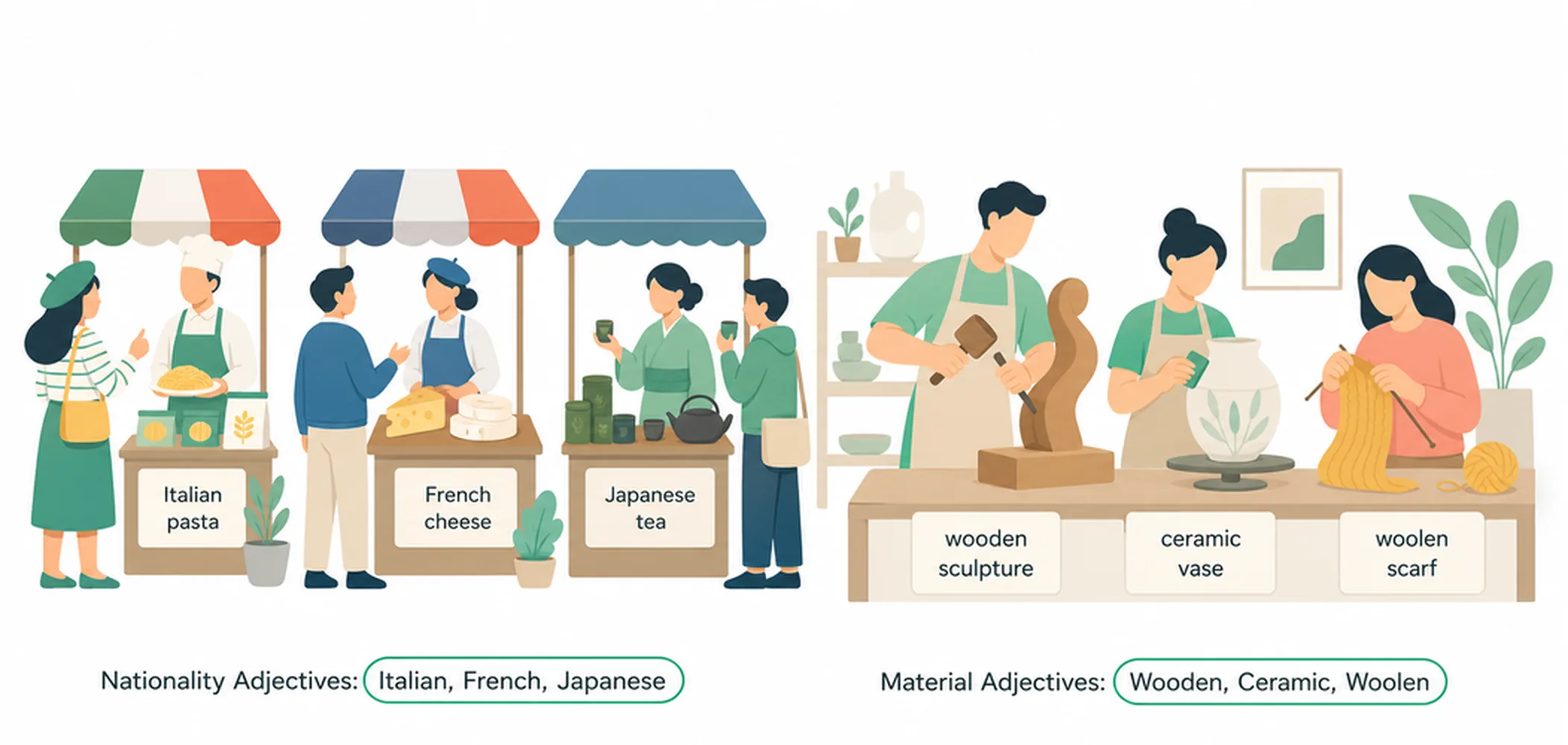
What Are Origin Adjectives?
Origin adjectives describe where something comes from or what it is made of. They include two main types: nationality adjectives (which tell us the country or region something is from) and material adjectives (which tell us what substance something is made from). These adjectives follow a specific position in the adjective order, which helps English sound natural and correct.
Word Order: Where Origin Adjectives Go
Origin adjectives come after descriptive adjectives but before the noun. The general order is: opinion → size → color → origin → material → noun. For example, a "beautiful Italian leather bag" follows this pattern: "beautiful" (opinion) + "Italian" (origin) + "leather" (material) + "bag" (noun). When you use an origin adjective with a material adjective, the origin always comes before the material.
Nationality vs. Material Adjectives
Nationality adjectives like "French," "Japanese," and "Brazilian" describe where something originates. Material adjectives like "wooden," "plastic," and "silk" describe what something is made from. Sometimes you use both together: "a Swiss chocolate" combines nationality with a material reference. Remember that nationality adjectives are always capitalized in English, while most material adjectives are not (except when they come from a proper noun, like "Italian silk").
Nationality vs. Material Adjectives: Side-by-Side Comparison
| Property | Nationality Adjectives | Material Adjectives |
|---|---|---|
| Definition | Adjectives that describe the country, region, or culture of origin of a person, place, or thing. They indicate where something or someone comes from geographically or culturally. | Adjectives that describe what a noun is made of or composed from. They indicate the physical substance or raw material from which an object is constructed. |
| Form / How They Are Derived | Derived from proper nouns (country or region names) using suffixes such as -an, -ian, -ish, -ese, -i, -ic, or -ean. Examples: America → American; Spain → Spanish; Japan → Japanese; Italy → Italian. | Derived from common nouns (names of substances or materials) using suffixes such as -en, -ern, -ic, -al, or sometimes used without a suffix when the noun functions directly as a modifier. Examples: wood → wooden; silk → silken; gold → golden; glass → glass (attributive). |
| Capitalization Rules | Always capitalized in English because they are derived from proper nouns (place names). This rule applies consistently regardless of the adjective's position in the sentence. E.g., French, Brazilian, Chinese. | Never capitalized unless they begin a sentence, because they are derived from common nouns. They follow standard lowercase rules for ordinary adjectives. E.g., wooden, metallic, cotton, ceramic. |
| When to Use | Use when specifying the national, cultural, or geographic origin of a noun — whether referring to people, languages, cuisines, traditions, or products associated with a particular country or region. | Use when describing the physical composition or substance that makes up an object. Appropriate when the material from which something is made is relevant or distinguishing information. |
| Positive Example | She wore a Mexican dress to the festival. He ordered an Italian coffee at the café. They spoke in their native Korean language. |
She wore a silk dress to the festival. He drank from a ceramic cup at the café. They built a wooden bridge over the stream. |
| Negative Example (Common Errors) | She bought a french perfume. (Incorrect — must be capitalized: French) He enjoys japanese food. (Must be: Japanese food) |
The table is made of Wooden material. (Incorrect — should be lowercase: wooden) She wore a Golden bracelet. (Unless starting a sentence, should be lowercase: golden) |
| Question Example | Is this a German car or a Japanese one? Which Indian dish would you recommend? Are those Swiss chocolates in the box? |
Is this a leather bag or a canvas one? Which wooden furniture would you recommend? Are those plastic containers safe for food? |
| Position Relative to the Noun | Typically placed before the noun (attributive position): a Spanish guitar. Can also appear after linking verbs (predicative): This guitar is Spanish. When multiple adjectives are used, nationality adjectives generally come after material adjectives but before the noun. | Typically placed immediately before the noun (attributive position): a wooden chair. In a sequence of adjectives, material adjectives appear closest to the noun, after opinion, size, age, shape, colour, and origin adjectives — following standard English adjective order. |
| Key Signal Words / Clues | Words like from, made in, origin, culture, language, tradition, or references to countries and regions signal that a nationality adjective may be appropriate. Common examples: American, British, Nigerian, Thai, Argentine, Polish, Greek. | Words like made of, made from, constructed of, composed of, or references to raw substances signal that a material adjective is appropriate. Common examples: wooden, metallic, cotton, woollen, stone, glass, plastic, rubber, copper. |
| Can They Combine? | Yes — both adjective types can appear together to describe the same noun, following standard adjective order (material before origin/nationality, and nationality before the noun). Example: a wooden Japanese cabinet (material → nationality → noun) or an Italian leather jacket (nationality modifies the compound, though natural usage may vary). | |
| Overlapping / Tricky Cases | Some nationality adjectives can describe materials associated with a region (e.g., Chinese silk — here Chinese is a nationality adjective modifying silk, not a material adjective). The adjective still functions as a nationality adjective and must be capitalized. | Some material nouns are used directly as adjectives without a suffix change (e.g., glass table, stone wall, cotton shirt). These are sometimes called attributive nouns or noun adjuncts rather than true adjectives, but they function as material adjectives in meaning. |
| Key Difference: Nationality adjectives answer the question "Where is it from?" and are always capitalized because they come from proper nouns (country names). Material adjectives answer the question "What is it made of?" and are always lowercase because they come from common nouns (substance names). Both types are origin adjectives — one describing geographic or cultural origin, the other describing material or physical origin — and when used together they follow a fixed order in English: material adjective → nationality adjective → noun (e.g., a golden French trophy). | ||
Examples






What to Remember
- Origin adjectives describe where something comes from or what material it is made from.
- Nationality adjectives tell you the country or region an item originates from.
- Material adjectives describe the substance or composition of an object.
- Origin adjectives come after descriptive adjectives but before the noun in adjective order.
- The correct sequence is: opinion → size → color → origin → noun.